
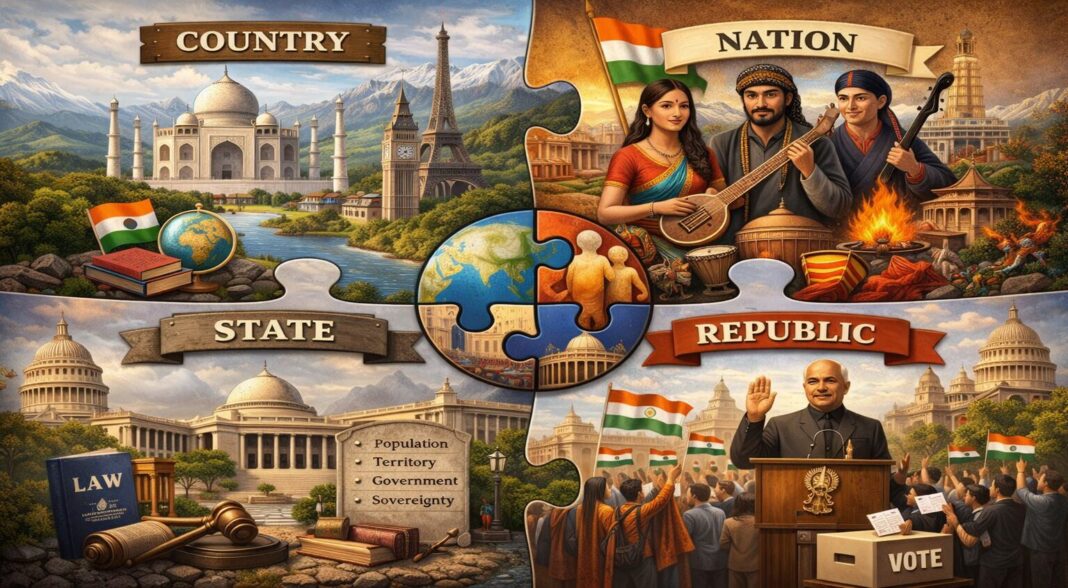
A country is the physical and political space we live in, defined by territory, borders, and governance; a nation is the collective soul of its people, bound by shared history, culture, values, and a sense of belonging. A state is the legal and sovereign authority that governs a defined population through institutions, laws, and international recognition. A republic is a form of government in which power rests with the people and the head of state is elected, not hereditary. India is all of these together: a country by geography, a timeless nation by civilization, a sovereign state under international law, and a democratic republic where authority flows from the will of its people.
1. Country

A country is a commonly used, informal term referring to a political–geographical entity that people recognize as a place with its own government, territory, and population.
- Emphasizes geography and political identity
- Used in daily speech and diplomacy
- May or may not be fully sovereign in strict legal terms
Example: India, Japan, France
(“Country” has no single rigid legal definition.)
2. Nation
A nation is a cultural and emotional concept rather than a legal one. It refers to a group of people who share a common identity—such as language, history, culture, ethnicity, or a sense of shared destiny.
- Emphasizes people and identity
- Does not require defined borders or sovereignty
- A nation may exist without having its own state
Examples:
The Odia nation (nation without a state)
The Indian nation (many cultures united by shared history and identity)
3. State
A state is a formal legal entity in international law. To qualify as a state, it must meet the criteria defined by the Montevideo Convention (1933):
- A permanent population
- A defined territory
- A government
- Capacity to enter into relations with other states
- Emphasizes sovereignty and legal status
- The core unit of international relations
- Recognized by other states
Example: The Republic of India as a sovereign state
Relationship Between the Three
Term Focus Nature
Country Place Informal / common usage
Nation People Cultural / emotional
State Authority Legal / political
Common Combinations
Nation-State: When a single nation aligns with a single sovereign state
Example: Japan
Multinational State: One state with multiple nations
Example: India
Stateless Nation: A nation without a sovereign state
Example: Kurds
In one line:
- Nation = who we are
- State = who governs us
- Country = where we live
4. Republic
A republic is a form of government in which supreme political authority rests with the people and is exercised through their elected representatives, rather than by a hereditary ruler.
Core Features of a Republic
No hereditary monarchy
The head of state is not a king or queen; the position is usually elected or appointed for a fixed term.
Popular sovereignty
Political power ultimately belongs to the citizens.
Rule of law
The government operates under a constitution or legal framework, not personal rule.
Public office as a trust
Those in power govern on behalf of the people and are accountable to them.
What a Republic Is Not
- Not a monarchy
- Not a dictatorship (unless elections are sham)
- Not necessarily a democracy in practice (some republics exist only in name)
Types of Republics
Democratic Republic – leaders chosen through free and fair elections
Example: India
Constitutional Republic – powers limited by a constitution
Example: United States
Federal Republic – power shared between central and regional governments
Example: India, Germany
People’s Republic – typically one-party dominated systems
Example: China
Republic vs Monarchy (at a glance)
Republic Monarchy
Head of state elected Head of state hereditary
Power derives from people Power derives from dynasty
Office is time-bound Office is lifelong
Indian Context
India became a Republic on 26 January 1950, when its Constitution came into force, replacing the British monarch as head of state with an elected President of India.
In one sentence:
A republic is a system where the people are sovereign, and the state is governed by representatives chosen by them, not by birthright.