
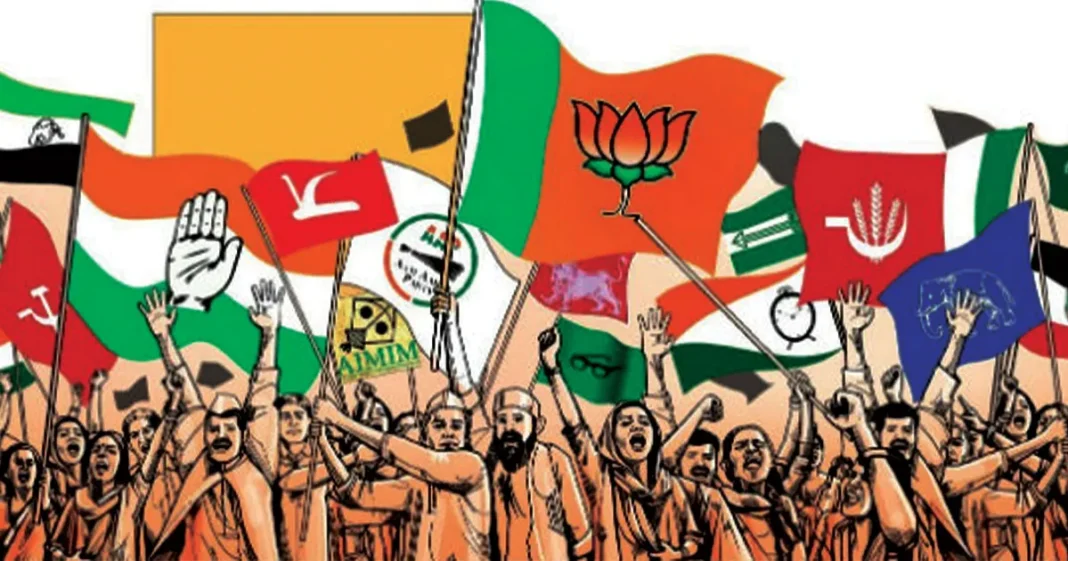
Generally, politicians emerge from students leading at various college levels. Apart from that, children of influential people or those from families with a background in genuine social service join politics. Furthermore, after the abolition of royalty, many clever members of former royal families found it better to rule as ministers rather than kings. Since politics today is considered the most profitable business in the country, competition has increased intensely. Due to caste-based reservations, some from the poor and Dalit classes have managed to enter politics; however, within just a few years of “dedicating” themselves to social service, they become owners of property worth crores of rupees. Thus, there is such a rush to sacrifice one’s life for the “business of social service” rather than ordinary trade, there is no longer a need to look for any specific background or criteria to enter politics. One simply needs to have a lot of money because, without a minimum investment, it is impossible to find a place in a lucrative business-like politics. Even the public doesn’t spare a glance at a decent candidate who lacks money, let alone vote for them.
When the people of any state become fed up with autocratic misrule, when they fear criticizing the government, and when all print and electronic media are busy only singing the government’s praises—the fall of that government is certain! At such a time, there is no time to check the background of specific organizations, parties, or candidates; the goal is only one—to gain freedom from the current misrule. This is exactly what happened in some states. Some teachers, contractors, education businessmen, clerks, fishmongers, liquor traders, and priests—people capable of investing money—contested the elections, won easily, and even formed the government. Excluding a handful of experienced individuals, most were young leaders elected for the first time. Many had zero knowledge of how the administration functions; they are now rambling as if a fox had ascended a throne to run a kingdom. Despite having an honest gentleman as Chief Minister, no work is moving forward. Village roads are broken, and the plight of drinking water hasn’t been addressed yet. A year has passed, but no visible progress has been made.

Seeing their condition, a political story comes to mind: A leader of a party that had somehow won a recent election and formed a government went to an efficient politician like Sitaballav Babu for advice. He asked for guidance on how to run the state with such unorganized officials. He said, “Most leaders in my party have never even seen a government file; how long can I run the state by buttering up these bureaucrats?” Sitaballav Babu smiled and said, “My dear, the public everywhere in the world is almost the same! It’s very easy to handle them. They don’t remember much, and whatever they do remember, they forget completely with a little meat and liquor! Don’t worry, since you’ve come, I’ll tell you a secret method. Don’t tell anyone, and you can easily run it for five years; we’ll see about the rest later!” Saying this, he took three sealed envelopes he had kept ready, put them inside a larger envelope, and handed it over, saying, “When you don’t know what to do and can’t see a way out, open the first one and act accordingly!” Having received this ‘Guru Mantra,’ the leader returned with great joy.
A few days passed in celebrating the election victory, more days in forming the cabinet, and quite a few more in felicitation ceremonies. It was becoming difficult to understand what work to do and how to do it. The leader of leaders, the Chief Minister, was in great worry. He remembered the envelopes given by Sitaballav Babu. He immediately took the large envelope out of the cupboard and saw three envelopes inside, each with something written on it. On the first envelope, it was written: “Open only when you are confused.” Meaning, when you are in a dilemma about what to do, open it. With joy, he opened the first envelope. It said: “Blame your predecessor.” In other words, pin all the faults and failures of the government machinery on the previous government. After that, who could stop him? With the strength of a hundred lions, he started shouting about mining scams, water scams, chit-fund scams, Tamil scams, and Telugu scams—vowing to expose them one by one. “There is no place for corruption in our government; every corrupt minister and official will be jailed,” he proclaimed. The front pages of all newspapers were filled with such news. The public was thrilled, thinking they had finally put the right party in power. A few peons, orderlies, clerks, and forest guards were arrested to set an example—because “small fish” are always easy to catch. The government was happy, the media was happy, and the public was happy too! A year and a half passed this way.
Later, some intellectuals started asking questions: “They ruined everything and left, but nearly a year and a half has passed; what have these people actually achieved?” The voice of criticism began to rise. The leader grew anxious. Why wasn’t any work getting done? While thinking, he remembered Sitaballav Babu again. He opened the cupboard and looked at the second envelope. On it was written: “Tell Tall Talks.” This meant making grand promises, announcing various developmental projects, and filling the front pages of all newspapers with massive advertisements. The era of pomp and show began. Huge hoardings were put up on the roads. Through rallies and meetings, the new government began sharing its “inner thoughts” (Mann ki Baat). Five thousand ‘MoUs’ were signed. Inauguration plaques for various projects were installed everywhere. The gullible public was overjoyed. They even lit wood in the chimneys of some old, closed factories to show the people smoke coming out. The public was happy, the media was happy, and the government was happy too!
In this way, another two years passed in just running around. Nearly three and a half years of the government’s term had passed, but everything remained limited to announcements. What would they do in the remaining year and a half? If work had been done, the party workers would have earned something! The workers began to revolt. Criticism started that apart from announcing a few free allowances, what has this government actually done? Chaos ensued. The leader was worried again. He remembered the final third envelope. He opened the cupboard and saw it was written: “It’s high time, you must prepare three envelopes like this and follow the detailed instructions inside.” This meant the time had come to prepare three more envelopes for whoever comes next. The important instruction was: start various tenders as quickly as possible to gather as much money as possible and get ready for the upcoming election.
In a democracy, quantity is important, not quality. Since the number of “hungry” people in our country is excessive and a system of “excessive democracy” is being practiced, almost all political parties have adopted this “Three Envelopes” formula of running a government. There is no escape from it!
 Pramod Kumar Dhal is a social commentator, author, and wildlife photographer from Kendrapara, Odisha. His work focuses on judicial integrity, administrative reform, and citizens’ rights. He is the author of “The Birds of Orissa: A Pictorial Encyclopedia,” for which he received the Sambad Parivesh Samman Award. Contact: +91 7008810112. [Views are personal]