

For years, we have been hearing the “tears without grief” of politicians for our farmers. From waiving agricultural loans to various schemes like KALIA, these efforts are akin to “throwing small fry to a fish”—tossing a bit of money to deceive them without bringing any real improvement to their condition. Why is the situation of Odisha’s farmers so pathetic even today?
Returning from the market, a farmer thinks: a simple pumpkin now costs 40 rupees per kilo; perhaps I should cultivate pumpkins this time. He calculates—at least ten pumpkins will grow per pit; if one weighs 3 kilos, then 5,000 pumpkins from 500 pits would mean 15,000 kilos. Even at a minimum price of 20 rupees per kilo, he expects to earn 3 lakh rupees.

But after toiling day and night, when he produces 20,000 kilos instead of 15,000, the trader says: “Take 2 rupees per kilo if you want, otherwise leave it!” What will the farmer do now? Where will he sell? Who will buy? Where will he store it? Consequently, I have not seen any farmer in the areas I know actually using the “gift money” provided by the government for agriculture. Instead, they use that money for household expenses, children’s education, or daughters’ weddings, and turn their faces away from farming.
Of course, Odisha’s farmers themselves lack discipline. What is the use of blaming the government for everything? Here, people cannot easily break free from traditional farming methods; they farm solely on “God’s mercy.” Whether it is vegetables or fruits, people here steal the produce. They raise cattle and goats but let them loose in others’ fields to graze on their crops. Our people are quite surprising—if they see anything growing by the roadside, they have a strong urge to pluck it. Even if they have flowers in their own garden, many find great self-satisfaction in stealing flowers from a neighbour’s yard!
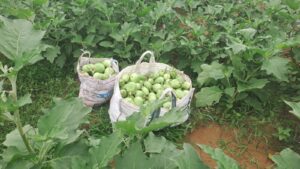
Recently, I visited some interior rural areas of Karnataka. I was delighted to see their discipline in farming. Along the roads, guava, sapota, grapes, papaya, mango, brinjal, and other vegetables grow without any fences, yet there isn’t a single instance of someone plucking from another’s garden. They invest heavily in farming. Despite a severe water shortage, almost all farmers use scientific methods. The landholdings there are large; pipes are laid across acres for drip irrigation. Long ridges are covered with polythene sheets (mulching) to maintain proper soil temperature and moisture. In brinjal fields, ample space is left between rows, and beautiful permanent trellises are built for other vegetables. Even the base of large coconut trees is properly managed for watering. Every farmer grows grass on a portion of their land for their livestock; they don’t let their animals into others’ fields like in Odisha. Cars or motorcycles are parked near almost every field; you don’t see the “face of poverty” there like you do with our farmers.
But why is the condition of Odisha’s farmers so miserable? Here, a farmer is always seen in a torn vest and torn slippers. We worship the famous farmer Lord Balarama (Haladhar) inside the Baladevjew temple, and we worship Lord Krishna, the epitome of animal husbandry, in the Jagannath temple; yet we can neither farm properly nor raise cattle. Agriculture is the mainstay for most people in Odisha, with over 60% depending on it directly or indirectly for their livelihood. We have almost no “big” farmers here; except for a few royal families and veteran politicians, everyone else is a small farmer with marginal landholdings, most of whom are sharecroppers. Out of the 8 million farmers in Odisha, over 90% are small or marginal farmers.
Undoubtedly, Odisha’s agriculture faces many challenges, including low productivity due to traditional practices, inadequate irrigation, and the impact of climate change. Small landholdings, weak markets, and the farmer’s inability to bargain also hinder progress. Natural disasters like frequent floods, droughts, and cyclones complicate these issues, leading to crop loss and reduced income. About 62% of arable land depends on rain and is affected by the vagaries of the monsoon. Odisha’s agriculture is centered on water-intensive paddy with little diversification into pulses, oilseeds, or high-value crops.
Farmers struggle with modern technology, lack of capital, and fragmented land due to inheritance. Due to various government “freebie” schemes, there is a severe shortage of labour during harvest seasons; finding agricultural labour in Odisha today has become an arduous task. Lack of awareness about sustainable practices leads to soil erosion. No one is interested in investing capital in agriculture, which hinders modernization.
The sorrow of the farmer will not vanish by politicians wearing spotless white clothes on Akshaya Tritiya and posing with their hands on a plough. Throwing small crumbs for years will not satisfy the farmer’s hunger. Even waiving loans with taxpayers’ money won’t improve farming because that loan money is rarely used for actual cultivation.
Instead, the government should:
• Activate the Agriculture Department and move officials from air-conditioned rooms to the villages.
• Provide knowledge on profitable crop production and training in modern scientific methods.
• Take responsibility for marketing all produce and task the Agriculture Department with collection and storage.
• Above all, grant “Industry Status” to Agriculture.
Only then will the farmer smile, Odisha will smile, and no one will see a farmer in a torn vest and slippers again!
 Pramod Dhal
He is a social commentator, author, and wildlife photographer from Kendrapara, Odisha. His work focuses on judicial integrity, administrative reform, and citizens’ rights. He is the author of “The Birds of Orissa: A Pictorial Encyclopedia,” for which he received the Sambad Parivesh Samman Award. Contact: +91 7008810112.