
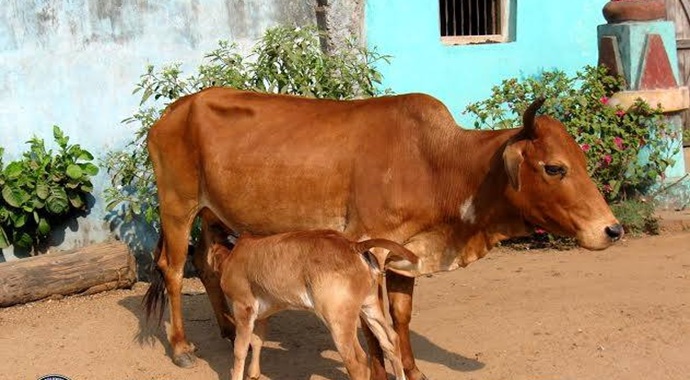
India’s indigenous cattle breeds are living repositories of genetic resilience, shaped by centuries of adaptation to local conditions. Among them, the Motu cattle of Odisha represent a unique but rapidly vanishing genetic treasure. Native primarily to the southern district of Malkangiri and adjacent areas of Chhattisgarh and Andhra Pradesh, this dwarf breed has been nurtured for generations by the Koya tribal community. Though classified as a low milk yielder, the Motu excels in draught power, heat tolerance, and survival under minimal inputs; qualities that make it ideally suited for sustainable, climate-resilient farming in marginal areas.
The author along with a team led by Susanta Kumar Dash, an animal geneticist and professor in the Department of Animal Breeding and Genetics at the Odisha University of Agriculture and Technology (OUAT), Bhubaneswar, took up task of the documentation and registration of the breed. The registration of Motu cattle (Accession No. INDIA-CATTLE-1526-MOTU-03031) as a distinct draught breed from Odisha was carried out by the ICAR-National Bureau of Animal Genetic Resources (NBAGR)

The breed takes its name from the Motu region in Malkangiri. It thrives in undulating, hilly terrain with poor soil fertility and harsh climatic swings, hot summers touching 47°C and cooler winters dipping to 7°C. Koya tribes rear these cattle through traditional extensive grazing systems, relying on forest grasses, crop residues, and almost zero supplementary feeding. This co-evolution between people, animal, and environment has produced a remarkably hardy livestock well-integrated into tribal livelihood and culture.
Motu cattle are small, compact, and muscular, with short legs that help them navigate narrow and uneven fields. Adult males weigh around 170 kg and females about 136–140 kg, while heights rarely exceed 102 cm in males and 97 cm in females. Their coat is predominantly reddish-brown, with occasional grey or white variants. A striking feature is that nearly 60% of the animals are naturally hornless. When horns are present, they are short, straight, and pointed upward with rounded tips. They have small ears held parallel to the ground and a long tail reaching below the hock. This dwarf yet sturdy build gives them an edge in rugged landscapes where larger animals struggle.
The real strength of Motu cattle lies in their performance as draught animals. Despite their modest size, a pair of bullocks can plough roughly 0.4 acres in six hours, making them highly efficient for traditional agriculture in hilly tracts. Their compact frame and strong musculature allow superior manoeuvrability in undulating fields.
Equally impressive is their adaptability. They tolerate extreme temperatures, survive on poor-quality fodder, and show natural resistance to many local diseases and parasites. These traits translate into very low maintenance requirements -ideal for small and marginal farmers who cannot afford high-input exotic breeds.
Milk yield remains low, typically 60–140 kg per lactation with less than one litre daily, and milking is not traditionally emphasised. However, the milk has a relatively high fat content (4.8–5.3%), adding nutritional value for household consumption. Beyond milk and draught, the cattle provide valuable organic manure and support integrated farming systems. Cow dung is used both as fertiliser and for plastering houses, while the animals themselves symbolise economic security and social status within tribal communities.
For the Koya and other local communities, Motu cattle are far more than livestock. Herd size reflects a family’s resource base and resilience. The breed is woven into cultural practices and provides multiple livelihood benefits with minimal investment. In resource-constrained regions, they offer reliable draught power without dependence on costly machinery or fossil fuels.
Unfortunately, the Motu population is declining steadily. Mechanisation of agriculture has reduced demand for draught animals. Indiscriminate crossbreeding with exotic dairy breeds is causing genetic dilution. There is also market pressure from beef traders who target these animals due to their meat quality and low purchase cost. Many farmers now view the breed as uneconomical compared to high-yielding commercial cattle, leading to distress sales and neglect of traditional breeding practices. The gradual erosion of indigenous knowledge systems among younger generations further accelerates the decline.
Preserving Motu cattle is essential for maintaining India’s livestock biodiversity. They carry valuable genes for heat tolerance, drought resistance, disease resilience, and the ability to thrive on low-quality feed; traits that will become increasingly important as climate change intensifies.
For marginal and tribal farmers, these animals remain a practical, affordable option for sustainable agriculture. Their conservation also helps protect Odisha’s tribal cultural heritage and traditional ecological knowledge. Losing the Motu breed would mean losing a proven model of low-input, climate-resilient livestock keeping.
Effective conservation requires a practical, community-centric approach. Selective breeding programmes should focus on improving productivity while preserving the breed’s core adaptive strengths, avoiding indiscriminate crossbreeding. Establishing dedicated breeding centres in the native tract and promoting controlled mating can help.
Greater involvement of local farmers through breed societies and Panchayati Raj institutions is crucial. Government policies must include targeted incentives, financial support, and inclusion of Motu cattle in livestock development schemes. Scientific documentation of their genetic profile and phenotypic traits should go hand in hand with value addition—such as promoting organic manure, niche marketing of indigenous breed products, and eco-friendly farming models.
In-situ conservation within their natural habitat, combined with farmer education on the long-term benefits of indigenous breeds, offers the best chance of success.
The Motu cattle may appear modest in size and milk output, but their endurance, efficiency in difficult terrain, and minimal resource needs make them a perfect fit for Odisha’s challenging southern landscapes. In an age of climate uncertainty and the push for sustainable agriculture, such indigenous breeds are not relics of the past but assets for the future.
Timely and thoughtful intervention i.e., blending traditional wisdom with scientific support can prevent the Motu from disappearing. Saving this unique cattle breed is not just about protecting one animal; it is about safeguarding genetic diversity, rural livelihoods, cultural identity, and resilient farming systems for generations to come.
 Dr. Bishnupada Sethi
The author is the Chaiman of OFDC and Chief Administrator of KBK districts of Odisha.