

In nineteenth-century Odisha, saint-poet Bhima Bhoi turned spirituality into an instrument of social resistance. Emerging from the Kandha tribal margins, he placed human suffering at the core of his quest, redefining saintliness as active solidarity with the oppressed rather than detached piety. At a time when orthodox religion reinforced caste hierarchy and exclusion, Bhima Bhoi forged a path of dignity, equality, and collective redemption. His life fused empathy, moral courage, and reformist zeal, creating a rare synthesis that still challenges contemporary Odia society.
Born into poverty within a Kandha tribal family, Bhima Bhoi grew up under a rigid social order where birth dictated worth, resources, and respect. These early hardships were not mere backdrop; they forged his worldview. Unlike reformers who spoke from privilege or courted royal patronage, he knew deprivation firsthand. This intimate encounter lent authenticity to his critique of power and his insistence that true spirituality must address the pain of the marginalised.

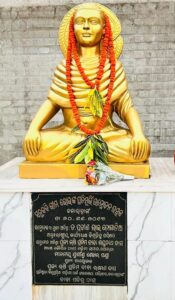
His turning point came through association with Mahima Swami, founder of Mahima Dharma. Bhima Bhoi accepted his guru as the sole provider of his needs and mocked at favours from kings and feudal lords. The new faith rejected idol worship, ritual excess, and caste barriers. It preached devotion to a formless, attributeless divine reality called Alekha or Sunya Brahma. For Bhima Bhoi this was no abstract theology; it supplied a radical ideological base to dismantle oppression and imagine a society built on spiritual equality.
What set him apart was the depth of his compassion. At sixteen, the devastating famine of 1866 left him shattered. No contemporary voice matched the anguish he expressed. His most famous declaration, “I will suffer the pains of hell if the world may be saved thereby” was not poetic flourish but a complete reorientation of spiritual purpose. He shifted the goal from individual moksha to universal welfare, elevating compassion as the supreme ethical imperative. Suffering, in his vision, was both deeply personal and universally shared; he internalised the anguish of the downtrodden and converted it into a moral summons for awakening.
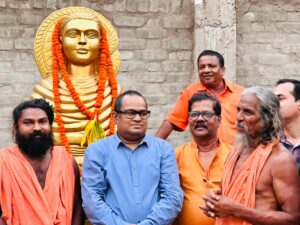
His literary works became the chief vehicles of this mission. In Stuti Chintamani, Bhajanmala, and Nirveda Sadhana, he wove devotional verse with sharp social critique. Composed in simple, spoken Odia rather than Sanskritised literary forms, the poems shattered the elite monopoly on sacred knowledge. They reached the illiterate and the excluded, turning spirituality into a participatory act. Each verse served a double purpose: it comforted the afflicted while exposing the structures that caused their pain. Thus poetry functioned simultaneously as solace and as a weapon of resistance.
Central to his teaching was an uncompromising rejection of caste. In a world where birth determined spiritual worth, Bhima Bhoi declared that all humans manifest the same divine essence. He asserted that only two castes exist, male and female, as ordained by the creator. Adherence to caste, he argued, was incompatible with the pursuit of truth. This stance eroded the ideological roots of inequality and attracted followers from the poorest, most neglected sections of society. The resulting community transcended traditional divisions and modelled the egalitarian order he envisioned.
Bhima Bhoi’s thought rested on a distinctive spiritual humanism. He dismissed external ritualism and priestly mediation, insisting instead on inner purity, ethical conduct, and selfless service. Sunya Brahma, being beyond sensory grasp, could not be confined to temples or idols; realisation had to occur within the seeker. Religion, therefore, became a lived moral practice rather than a performance of rites. Remarkably, his reformist ideas developed independently of the parallel social and religious movements then sweeping nineteenth-century India.
Equally striking was his commitment to gender equality. In a patriarchal age, he affirmed women’s full spiritual capacity and encouraged their active participation in religious life. This stance challenged not only prevailing social norms but also the internal biases of many reform movements. His ashram at Khaliapali embodied these principles. It became a vibrant hub where people of every background gathered for spiritual practice and social reorganisation, proving that an inclusive community could be built in practice as well as preached.
Opposition was inevitable. Orthodox sections saw his rejection of ritual and caste as a direct threat to established authority. He faced criticism, social boycott, and royal displeasure. Yet Bhima Bhoi never resorted to political confrontation. His resistance remained moral and spiritual: by questioning the legitimacy of practices that sustained inequality, he quietly dismantled their foundations. He offered concrete alternatives i.e., humility, service, and compassion rather than mere denunciation.
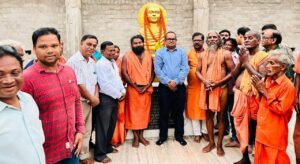
Long before modern theories of subaltern consciousness, Bhima Bhoi articulated the lived reality of the silenced. Emerging from the margins himself, he transformed the suffering of the oppressed into a source of moral authority. His writings gave voice to those historically denied speech. While his approach integrated spirituality and reform in a distinctive manner, it prefigured later anti-caste struggles and demonstrated the continuity of resistance across generations.
The power of his legacy lies in its continued relevance. Today, when inequality assumes new forms, Bhima Bhoi’s insistence that social change begins with moral consciousness offers a vital corrective to policy-driven solutions alone. In Odisha his poetry is recited widely in villages and his ideals animate spiritual and social initiatives. He stands as a living symbol of how empathy, when fused with courage and conviction, can reshape society.
Ultimately, Bhima Bhoi reimagined the saint’s role. True devotion, he showed, does not isolate one from the world but plunges one into its pain. By centring humanity’s suffering, he converted compassion into a revolutionary force. His life and work remain a compelling testament that spirituality, rightly understood, can dismantle injustice and nurture a just, humane order.
 Dr. Bishnupada Sethi
Dr. Bishnupada Sethi has received several awards/ honours i.e., (1) Mahimashree Samman- 2008 from Mahima Ashram, Sohela, (2) Bhakti Taranga Samman- 2008 from Bhakti Taranga Organisation, (3) Santha Sevak Samman- 2010 from Bishwaprashiddha Mahima Dharma Gobeshana Parishad, Bhubaneswar, (4) Bhima Bhoi Smruti Samman- 2018 from Bhima Bhoi Samadhi Pitha Trust, Khaliapali, (5) Bhima Bhoi Samman-2019 from Sarala Sahitya Sansad, (6) Santha Bhima Bhoi Sanskruti Gaurav Samman- 2021 from Bishwaprashiddha Mahima Dharma Gobeshana Parishad, Bhubaneswar, (7) Santha Bhima Prava Samman-2022 from Santha Bhima Bhoi Sahitya Parishad, Anugul for popularising Mahima Philosophy.