
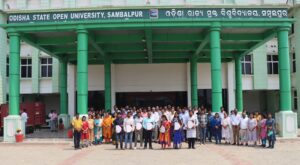
In the evolving story of higher education in Odisha, the Odisha State Open University (OSOU) emerges not as a conventional institution, but as a quiet redefinition of what a university can be. Established in 2015, it was born out of necessity rather than prestige—a response to the vast number of learners left behind by rigid systems of formal education. From its very inception, OSOU chose a different path. It did not build walls; it dissolved them. It did not seek the few; it reached out to the many. What makes OSOU remarkable is not merely its structure, but its intent. In a state where geography often dictates destiny, the university transformed distance from a barrier into a bridge. Its network of study centres, spread across urban and rural Odisha, became access points for aspiration. Here, education is not confined to classrooms or schedules; it adapts to lives already in motion—farmers, working professionals, homemakers, and first-generation learners all find space within its fold. This flexibility is not an administrative convenience; it is a philosophical commitment to inclusion.
The Philosophy of Openness: Education for All
At its core, OSOU is built on the principles of flexibility, inclusivity, and affordability. The university offers undergraduate, postgraduate, diploma, and certificate programmes through Open and Distance Learning (ODL) and online modes. What makes OSOU distinct is not just its mode of delivery, but its learner-centric design:
- Flexible entry and exit options aligned with modern educational reforms
- Affordable fee structures targeting disadvantaged groups
- Regional and study centres spread across Odisha ensuring localized support
- Skill-oriented and value-added courses enhancing employability
Its academic ecosystem extends beyond traditional disciplines to include journalism, rural development, disaster management, computer science, and communication skills—reflecting the evolving needs of society. The university’s NAAC B++ accreditation further underscores its commitment to quality education within an open framework.
A Digital and Democratic Learning Model
OSOU’s uniqueness lies in how it blends technology with social responsibility. Platforms like e-Gyanjyoti and open educational repositories provide free and accessible learning materials, ensuring that knowledge is not a privilege but a shared resource. Assignments, evaluations, and academic interactions are increasingly digitized, allowing learners from distant regions to participate without physical constraints. In many ways, OSOU anticipates the future of education—hybrid, inclusive, and borderless.
The university regularly organizes national conferences, seminars, and academic dialogues, particularly around transformative themes like:
- National Education Policy (NEP 2020)
- Digital learning ecosystems
- Quality assurance (NAAC, NIRF frameworks)
- Skill development and employability
Such conferences bring together academicians, policymakers, researchers, and institutional leaders, creating a vibrant intellectual space even within an open university system. These events serve multiple purposes:
- Bridging policy and practice
- Encouraging interdisciplinary research
- Positioning OSOU as a thought leader in open education
In many ways, OSOU challenges the stereotype that distance universities lack academic vibrancy—it proves the opposite.
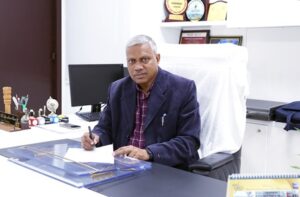
Prof. Shyam Sundar Pattnaik: The Man with a Mission and Leadership that Shapes Vision, Vice-Chancellor, Odisha State Open University
At the helm of this transformative institution is Prof. Shyam Sundar Pattnaik, a distinguished academic and administrator whose career spans over three decades.
With a PhD in Engineering and post-doctoral research from the University of Utah, Prof. Pattnaik brings both technical depth and institutional experience. He has served as:
- Vice-Chancellor of Biju Patnaik University of Technology (BPUT)
- Director of NITTTR, Chandigarh
- A prolific researcher with over 300 publications and multiple books
Over the years, OSOU has steadily expanded its academic canvas, offering programmes that are both relevant and responsive. From humanities and commerce to journalism, rural development, and information technology, its courses reflect a deep awareness of social and economic realities. The emphasis is not only on degrees, but on dignity—on equipping learners with skills that translate into opportunity. In this sense, OSOU does not merely educate; it empowers. Equally significant is the university’s embrace of technology. As the world leans into digital learning, OSOU has ensured that its students are not left behind. Through online platforms, digital study materials, and virtual academic support, it has created a learning ecosystem that is both accessible and contemporary. Yet, it balances this digital shift with its grounded presence across the state, ensuring that progress does not exclude those on the margins. What further distinguishes OSOU is its intellectual vibrancy. Contrary to the stereotype of distance education as passive, the university actively fosters dialogue and discourse. Conferences, seminars, and academic gatherings—especially around transformative frameworks like the National Education Policy—have positioned OSOU as a space where ideas are not just delivered, but debated. It participates in shaping the future of education even as it practices it.
Its achievements, including NAAC accreditation and a steadily growing learner base, reflect institutional maturity. But beyond metrics lies its deeper success—the countless individuals whose educational journeys were revived or reimagined through its platform. These are not just statistics; they are stories of second chances and renewed purpose. Ultimately, the uniqueness of Odisha State Open University lies in its quiet radicalism. It challenges the traditional notion that education must be exclusive to be excellent. Instead, it proves that accessibility and quality can coexist, that flexibility can strengthen rather than dilute learning, and that a university can be both expansive and intimate at once. In a world still grappling with inequalities in education, OSOU stands as a compelling model—an institution where knowledge does not wait to be reached, but travels outward, finding its learners wherever they are.