

The assertion that “Prakrit is, like Sanskrit, a literary language”, emphasized by Andrew Ollett, represents a major shift in how we understand India’s linguistic and cultural history. Awarded the Infosys Prize 2025 for his pioneering work on classical Indian languages, Ollett challenges long-standing assumptions about the hierarchy between Sanskrit and Prakrit and invites us to reconsider the multilingual foundations of premodern Indian literature.
When Andrew Ollett, the 2025 Infosys Prize winner in Humanities and Social Sciences, stated that “Prakrit is, like Sanskrit, a literary language,” he was challenging centuries of assumptions about the cultural and literary history of India. For long, popular and academic narratives alike presented Sanskrit as the refined, elite literary medium, while Prakrit was considered merely a vernacular, a language of ordinary people. This oversimplification has obscured the rich literary tradition that Prakrit cultivated for over a millennium. Ollett’s work restores Prakrit to its rightful place, showing that it was not only widely used but also deeply structured, governed by grammatical conventions, and capable of expressing poetic and philosophical subtleties just as Sanskrit could.

Prakrit flourished in multiple forms across the Indian subcontinent, from the fifth century BCE to the medieval period, playing a central role in religious, poetic, and narrative literature. Jain canonical texts, Buddhist stories, royal inscriptions, and courtly poetry all attest to the sophistication of Prakrit as a literary medium. In drama, Sanskrit plays often included characters speaking Prakrit, not as a mere sign of social status but as an acknowledgment of its poetic and aesthetic value. Its lyric poetry, in particular, was celebrated for its expressiveness and musicality, demonstrating that premodern India embraced a multilingual literary culture rather than privileging a single language.
Ollett’s scholarship emphasizes the idea of a “language order,” a dynamic and interdependent system where Sanskrit, Prakrit, and emerging vernaculars coexisted, influenced one another, and were used for different literary and social purposes. This approach challenges the simplistic hierarchy that places Sanskrit above all other languages and highlights the richness of India’s multilingual intellectual life. By recognizing Prakrit as a literary language in its own right, Ollett reframes how we understand India’s cultural and literary heritage, revealing a world in which language choice was deliberate, context-driven, and deeply meaningful.
A centerpiece of Ollett’s research is his book Language of the Snakes: Prakrit, Sanskrit, and the Language Order of Premodern India, in which he offers a sweeping historical study of Prakrit and its interaction with Sanskrit over two thousand years. The book demonstrates that Prakrit was never simply a derivative or “lesser” form of Sanskrit but a complex and fully developed literary system with its own grammar, stylistic norms, and genres. It explores the ways in which these languages shaped literary expression, religious thought, and cultural identity, and argues that the true literary landscape of premodern India cannot be understood without acknowledging the coequal role of Prakrit.
By repositioning Prakrit alongside Sanskrit as a literary language, Ollett invites scholars and readers alike to rethink the foundations of India’s classical literature. His work shows that premodern Indian culture was inherently multilingual, with a literary ecosystem that valued multiple modes of expression and bridged social, religious, and artistic worlds. Far from being a secondary or vernacular tongue, Prakrit emerges as a sophisticated and essential part of India’s intellectual history, reminding us that literary excellence in South Asia was never the sole preserve of Sanskrit.
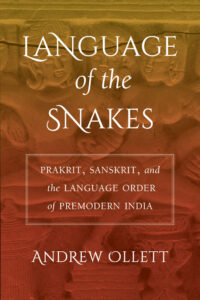
Language of the Snakes, authored by Andrew Ollett, is a groundbreaking study of classical Indian languages and their literary cultures. The book challenges the long-held perception that Sanskrit was the sole literary language of premodern India, showing instead that Prakrit was an equally sophisticated and cultivated medium of literary expression. Ollett introduces the concept of a “language order,” highlighting the dynamic interplay between Sanskrit, Prakrit, and regional vernaculars, each serving distinct literary, religious, and social functions. Drawing on two millennia of texts—from royal inscriptions and Jain and Buddhist literature to lyric poetry and drama—he demonstrates that Prakrit had its own grammar, stylistic conventions, and genres, making it a fully realized literary system. The book not only reframes our understanding of India’s multilingual literary heritage but also underscores the richness and diversity of premodern literary production, positioning Prakrit as a coequal partner alongside Sanskrit in shaping the intellectual and cultural history of South Asia.