

In the stony expanse of Balangir’s Bangomunda block, Ranipur-Jharial preserves one of Odisha’s most significant contributions to India’s religious and architectural history: the Chausatha Yogini Temple. This 9th-10th century hypaethral shrine, dedicated to the sixty-four Yoginis, represents a mature expression of Tantric thought that developed distinctive characteristics in western Odisha. Its circular form and iconographic programme reveal a sophisticated philosophical vision rather than mere devotional display, positioning the site as a key node in the evolution of Shakta-Tantric traditions in eastern India.
The temple’s architecture is governed by precise symbolic logic. Measuring approximately 50 feet in diameter and open to the sky, it creates a mandala in stone where sixty-four niches originally housed Yogini images around a central pavilion. At the core stands a three faced, eight armed dancing Shiva, one foot upon Nandi, with Ganesha present. This spatial organisation is not decorative but doctrinal: Shiva as the stationary bindu of consciousness encircled by the dynamic energies of the Yoginis, giving concrete form to the Tantric understanding of reality as the interplay of Purusha and Prakriti, stillness and movement. The hypaethral design ensures the structure remains integrated with the cosmos above, aligning ritual space with celestial cycles in a manner distinct from enclosed temples.

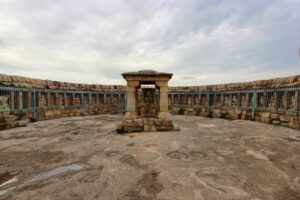
The sculptures demonstrate intellectual independence. The Yoginis are uniformly shown in karana postures drawn from classical dance, capturing arrested motion that suggests perpetual cosmic rhythm. Significantly, a substantial number bear animal heads i.e., cat, cow, elephant, bird while displaying hybrid human forms. Conventional Matrikas are largely absent, indicating that the tradition at Ranipur-Jharial followed its own developmental path rather than replicating standardised iconographic sets found elsewhere. This selectivity and the incorporation of primal, theriomorphic elements reflect a deliberate engagement with local folk and tribal cosmologies, integrating them into a coherent Tantric framework. The figures’ attributes like mirrors, weapons, skull-cups point to practices concerned with transformation, power and transcendence, consistent with Tantric emphasis on siddhis and direct engagement with Shakti.
Religiously, the Pitha embodies a refined synthesis. Emerging in a landscape with earlier Buddhist associations, as evidenced by aniconic footprint symbols, the site transitioned into a major Somavamsi period centre of Shaiva Tantric worship. References to Somatirtha in the Vamana Purana and local inscriptions link it to established pilgrimage circuits centred on sacred water bodies. The Yogini cult here operated at the intersection of esoteric ritual and royal patronage, offering practitioners and rulers alike a structured avenue to harness feminine divine forces. The central Shiva surrounded by Yoginis articulates a non-hierarchical interdependence of consciousness and energy that remains one of Tantra’s most enduring philosophical contributions. Influences from Vajrayana and Sahajayana streams, flowing from the Sambalpur region, further enriched this matrix without compromising its essential Shaiva orientation.
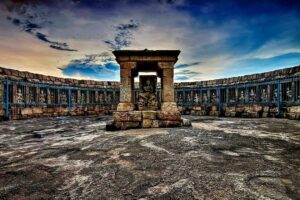
Architecturally, the temple exemplifies Odisha’s capacity for innovation within regional parameters. Constructed in local sandstone, the circular plan and niche system required exacting geometric control and structural stability. Its scale exceeds that of the Hirapur Yogini temple, suggesting Ranipur-Jharial functioned as a principal seat of the sixty-four Yogini tradition in the region. Within the larger complex which once contained 120 to 200 shrines including the Someswara and Indralath temples, the Yogini Pitha stands as the most philosophically charged element. The coexistence of Rekha, Khakhara, and hypaethral forms across the site demonstrates a mature architectural culture capable of adapting diverse ritual needs while maintaining aesthetic coherence.
The cultural matrix that produced this monument deserves careful recognition. Located along historic trade corridors connecting Kosala with Madhya Bharat and Dakshinapatha, Ranipur-Jharial absorbed multiple currents i.e., Buddhist, Shaiva, Shakta and indigenous fusing them into a distinctive local expression. The dancing Yoginis, with their integration of performative movement and sculptural form, indicate a close relationship between ritual, visual art and embodied practice. This capacity for synthesis without loss of identity characterises Odisha’s historical approach to cultural formation, allowing the region to generate original contributions rather than merely receiving external influences.
Today the temple maintains active worship, primarily as a Shaiva shrine, with regular offerings and heightened participation during Maha Shivaratri. This continuity, though transformed, testifies to the resilience of the underlying spiritual current. The weathering of the sandstone figures, while diminishing surface detail, has imparted a solemn dignity consistent with the site’s contemplative nature. Approximately forty-eight Yogini images survive, their remaining forms still conveying the intellectual seriousness of the original conception.
Ranipur-Jharial’s importance lies in what it reveals about medieval Odisha’s intellectual and spiritual climate. During a period of political fragmentation, the region sustained vigorous temple building and philosophical activity. The Yogini Pitha demonstrates that Tantric practice was not marginal but central to the period’s religious imagination, offering a systematic approach to understanding and engaging with reality’s energetic foundations. Its iconography and spatial design preserve evidence of a worldview that treated the material, the symbolic and the transcendent as interconnected domains, a perspective that retains analytical value beyond its historical context.

For Odisha, the site constitutes a substantial part of its civilisational record. It documents the region’s role in developing and sustaining Tantric traditions that influenced wider Indian religious history. The architectural and sculptural achievements reflect high levels of technical skill, aesthetic judgement and conceptual clarity among Odia artisans and thinkers. Recognition of this legacy strengthens understanding of the state’s historical depth and creative autonomy.
Systematic study, conservation and contextual presentation of Ranipur Jharial remain essential. The site’s remote location has offered some protection from excessive intervention, yet natural degradation continues. Proper archaeological attention and scholarly engagement can yield further insights into the precise ritual protocols, patronage structures and chronological nuances that shaped this remarkable complex.
The Chausatha Yogini Temple at Ranipur-Jharial stands as concrete evidence of Odisha’s historical engagement with profound questions of energy, consciousness and cosmic order. Its circular mandala, dancing figures and hybrid iconography preserve a thoughtful, regionally distinctive articulation of Tantric philosophy. In examining this monument, one encounters not romantic mystery but the tangible outcome of serious intellectual and spiritual labour; an achievement that forms an enduring part of Odisha’s contribution to India’s cultural and philosophical heritage.
 Dr. Bishnupada Sethi
Dr. Sethi serves as the Chaiman of OFDC and Chief Administrator of KBK districts of Odisha.