

On the night of October 29, 1999, Odisha faced one of the darkest chapters in its modern history. What began as a deep depression over the Bay of Bengal rapidly transformed into a monstrous super cyclone, unleashing winds of over 260- 270 km per hour, torrential rainfall, and a devastating storm surge that swallowed entire settlements. By the time the storm subsided, it had left behind a trail of destruction so vast that it fundamentally altered the way disaster management is perceived in India.
The cyclone made landfall near Paradip, but its impact was not confined to a single district. It ravaged vast stretches of coastal Odisha, particularly Jagatsinghpur, Kendrapara, and Puri, before stalling inland near Bhubaneswar. This unusual stalling prolonged the suffering, subjecting people to nearly two days of relentless winds and rain. Communication networks collapsed, roads disappeared, power lines snapped, and for days, entire regions were cut off from the outside world.

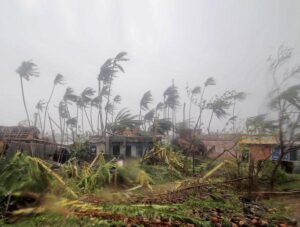
The 1999 super cyclone was not just another tropical storm. It was a rare meteorological phenomenon marked by explosive intensification. Within a span of 24 hours, the central pressure of the system dropped dramatically, indicating rapid strengthening. Satellite imagery captured a perfectly formed eye, surrounded by dense clouds with extremely low temperatures, a clear signature of a powerful cyclone.
The storm’s structure made it particularly lethal. Its inner core packed extreme winds concentrated within a narrow radius, causing catastrophic damage in localized areas. At the same time, a much larger outer wind field spread destruction across multiple districts. Gale-force winds lashed the coast hours before landfall and continued long after, compounding the devastation.
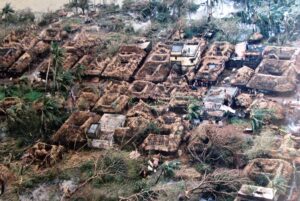
Yet, the most destructive element was not the wind. It was the sea. A massive storm surge, rising more than 5- 7 meters in some areas, surged inland, flooding villages up to 20 kilometres from the coast. Entire habitations were washed away within minutes. People who had survived the winds found themselves engulfed by walls of water in the darkness of night.
The cyclone’s fury did not end at the coastline. Heavy rainfall ranging from 400 mm to nearly 1000 mm in just a few days triggered widespread flooding across river basins. Rivers such as the Baitarani and Brahmani swelled beyond capacity, breaching embankments and inundating inland areas already battered by the storm.
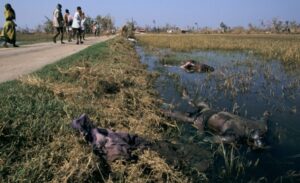
The deltaic plains between the Mahanadi and Subarnarekha rivers were submerged under several metres of water. Poor drainage systems caused water to stagnate for days, prolonging human suffering. In many places, floodwaters remained for over a week, turning villages into islands of despair.
Saline water intrusion added another layer of devastation. As embankments collapsed, seawater flowed deep into agricultural lands, rendering them infertile for years. For a largely agrarian society, this was not just a temporary setback but a long-term economic catastrophe.
The human toll of the cyclone was staggering. Official estimates placed the death toll at around 10,000, though some field assessments suggested even higher numbers. Jagatsinghpur district alone accounted for thousands of deaths, with entire families wiped out overnight.
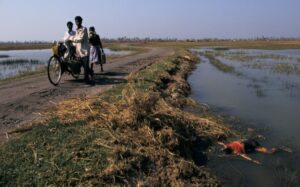
Nearly 1.9 million houses were damaged or destroyed, leaving millions homeless. Livestock losses crossed hundreds of thousands, depriving families of critical sources of income. Crops spread across millions of hectares were destroyed, pushing rural communities into prolonged economic distress.
Urban centres were not spared either. Bhubaneswar and Cuttack witnessed severe damage, with rainfall of over 500 mm and high-speed winds crippling infrastructure. Electricity, water supply, and communication systems remained disrupted for days, highlighting the vulnerability of even relatively developed areas.
One of the most striking aspects of the 1999 cyclone was that it was not entirely unforeseen. The India Meteorological Department had tracked the system and issued warnings days in advance. Forecasts regarding its movement and landfall were reasonably accurate, a testament to the scientific capabilities available even at the time.

Yet, the tragedy unfolded on a massive scale. The answer lies not in forecasting, but in the last mile of preparedness and response. Warning dissemination was uneven. Many coastal communities either did not receive timely alerts or did not fully comprehend the severity of the threat. Infrastructure to support evacuation such as cyclone shelters and all-weather roads was grossly inadequate.
Although around 150,000 people were evacuated, this number was far from sufficient given the scale of vulnerability. Large sections of the population remained in fragile houses or low-lying areas, directly exposed to the storm surge.
Odisha’s coastline is inherently prone to cyclones. The Bay of Bengal, with its warm waters and funnel-shaped geography, is a breeding ground for intense storms. The state’s long, low-lying coastline interspersed with river deltas and amplifies the impact of storm surges.
Dense population, poverty, and dependence on agriculture further heighten vulnerability. Many coastal communities live in kutcha houses, with limited access to infrastructure or emergency services. Environmental degradation, particularly the loss of mangroves, has removed natural barriers that once absorbed the force of storm surges.
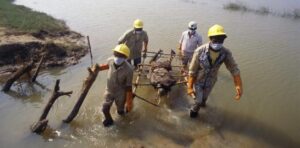
The 1999 cyclone exposed how these structural vulnerabilities can turn a natural hazard into a humanitarian disaster. It would be unrealistic to suggest that a cyclone of such magnitude could have been entirely prevented. However, the scale of loss especially human lives could certainly have been reduced.
- The first gap was in infrastructure preparedness. At the time, Odisha had very few dedicated cyclone shelters. Today, thousands of such shelters dot the coastline, but in 1999, their absence proved fatal. Many people simply had nowhere safe to go.
- Second was the failure of communication systems. Even though warnings were issued, they did not reach everyone effectively. A robust, multi-layered communication network combining technology with community outreach could have ensured better awareness.
- Third was the lack of community preparedness and awareness. Many people underestimated the cyclone’s intensity or chose not to evacuate, partly due to lack of trust or understanding. Regular drills, education campaigns, and community engagement could have changed this behaviour.
- Fourth, environmental mismanagement played a role. The degradation of mangroves and coastal ecosystems removed natural buffers, increasing the impact of storm surges.
Finally, there was a need for integrated planning, bringing together meteorology, hydrology, infrastructure, and governance. The cyclone demonstrated that disasters are rarely the result of a single factor; they emerge from the interaction of natural forces with human vulnerabilities.

The devastation of 1999 became a turning point. It led to the creation of institutional frameworks, improved forecasting systems, and massive investments in disaster preparedness. Odisha gradually emerged as a model for disaster management, as seen in later cyclones like Phailin and Fani, where large-scale evacuations saved thousands of lives.
Cyclone shelters were built across vulnerable districts. Early warning systems were strengthened. Community-based disaster preparedness programs were introduced. Evacuation planning became systematic and proactive.
These measures demonstrated a powerful truth: while disasters cannot be stopped, their impact can be dramatically reduced.
The 1999 super cyclone remains etched in Odisha’s collective memory, not just as a disaster, but as a lesson. It exposed the consequences of unpreparedness, but also laid the foundation for resilience.
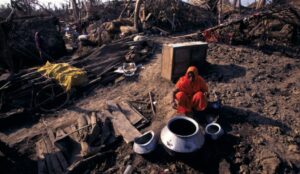
Today, when cyclones approach the Odisha coast, there is a sense of urgency, but not helplessness. Evacuations are swift, warnings are clear, and communities are better prepared. Lives are saved not because storms have become weaker, but because systems have become stronger.
The cyclone that shook Odisha in 1999 was a natural event of extraordinary intensity. But the scale of human suffering it caused was not inevitable.
With stronger infrastructure, better communication, environmental conservation, and community awareness, thousands of lives could have been saved. The tragedy was not just in the power of the storm, but in the gaps that allowed it to become so deadly.
As climate change threatens to intensify future cyclones, the lessons of 1999 become even more relevant. Preparedness is no longer optional. It is essential. Odisha’s journey since then shows that resilience is possible, but only when science, governance, and community action come together.
The storm of 1999 may have passed, but its message endures: disasters test societies, but preparedness defines their outcome.
 Bishnupada Sethi
The author is an IAS Officer and presently serves as the Chairman of the Odisha Forest Development Corporation (OFDC) and continues as the Chief Administrator of the KBK districts.