

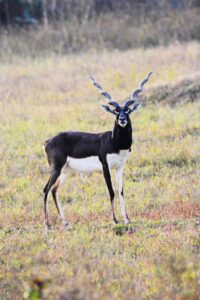
The Blackbuck (Antilope cervicapra), also known as the Indian Antelope, is called Krushnasara Mruga in Odisha. Under the Wildlife (Protection) Act of 1972, it is classified as a Schedule-I animal. Currently, the Ganjam district of Southern Odisha serves as the only natural habitat for these mammals. They are most commonly found in the Ghumusar region, particularly in areas like Bhetnoi, Balipadra, and Buguda, where they roam freely across open fields and farmlands. While it’s true that many of Odisha’s forests have become empty of wildlife over the years, Ganjam stands out as a vibrant exception. The story of why the blackbuck thrives there isn’t just about biology; it’s about a unique, deep-rooted bond between the people and the land.
A Symbol of Prosperity
The local people regard the Blackbuck as a harbinger of good luck and a symbol of purity. Much like the Bishnoi community of Rajasthan, the people of Ganjam have been protecting these creatures for generations, believing that their presence brings a message of prosperity.

Legends and Folklore
There are several folklores behind why the villagers of Ganjam protect this species so fiercely. The ancient text Manusmriti mentions:
“Krushnasarastu charati mrugo yatra swabhavatah; Sajneyo yajnyayo desah.” > (The land where the Blackbuck roams naturally is considered a land fit for performing sacred rituals/Yajnas).
According to local legend, following the Great Famine of 1866 and a subsequent drought in 1879, thousands died in the Ghumusar region. Suddenly, hundreds of Blackbucks appeared, roaming freely. On the advice of scholars, a Yajna (sacred ritual) was organized, after which heavy rains arrived. Overjoyed, the people returned to their farming. Since then, locals believe that seeing a Blackbuck in a paddy field is auspicious, and no one harms these innocent animals. They feel their destiny is intertwined with the fate of the Blackbuck.
The British Era Connection
Another perspective suggests that in 1883, after the famine, the British government began constructing the ‘Sorisamuli’ and ‘Ghumusar’ anicuts near Bhanjanagar. At that time, there was a superstitious fear of human sacrifice (Narabali) associated with large construction projects, leading locals to flee the area. To solve the labour shortage, the British brought workers from Kenya, Tanzania, Zimbabwe, and South Africa via ships. They also brought Blackbucks on these ships as a food source for the workers.
After the projects were completed, some animals were left behind. The new irrigation led to lush grass and crops, allowing the animals to thrive. Coincidentally, harvests became bountiful, reinforcing the local belief that the animals brought good fortune.
A Unique Model of Conservation
It is remarkable that while the Forest Department often faces challenges in conserving elephants, tigers, bears, and boars, the Blackbucks have flourished. This success is entirely due to community participation.
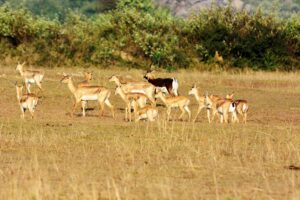
The Ganjam model is unique because it is led by local residents across all castes and backgrounds rather than a specific tribe or government mandate. In almost every village, “Blackbuck Protection Committees” have been formed. While the government’s direct contribution is modest, the direct involvement of villagers ensures the animals are safe and free. Population Growth Statistics: during 1973: only 523 individual blackbucks were recorded while during 2023 census there are 7,743 individuals. The highest concentration (4,636) is in the Ghumusar South Division. Due to this population boom, they are now spreading to nearby blocks like Aska, Polasara, Khalikote, and even towards the Salia Dam in Banapur.
Harmony with Agriculture
There is a deep-rooted belief that the more the “sacred” animals graze on the crops, the higher the yield will be. About 70 villages in Ganjam have protected these animals for over a century. Despite the potential for crop damage, the people provide protection based on Sanatan (eternal/traditional) religious sentiments. They believe these “divine” beings prevent droughts and bless the land with food and wealth. Many even worship the Blackbuck as a symbol of Lord Krishna.
Biological Traits and Behavior
Blackbucks enjoy eating fresh tender leaves, grass, crops, and vegetables. They spend a long time feeding, which helps maintain their water balance; consequently, they can survive without drinking water for anywhere from a day to an entire week.
They are social animals that prefer grazing in herds. Typically, two or three dominant males lead a group of 15 to 20 females. Occasionally, males fight for dominance over the harem; the defeated male either gets injured/dies or is forced to leave the territory.
In the history of Odisha, such a “mantra” of conservation is rare. In the Sanatan tradition, animals, birds, and plants are all interconnected. If we can replicate this model—by creating localized stories and awareness in schools and colleges near forest areas—our forests would once again flourish with wildlife.
 Pramod Dhal
He is a social commentator, author, and wildlife photographer from Kendrapara, Odisha. His work focuses on judicial integrity, administrative reform, and citizens’ rights. He is the author of “The Birds of Orissa: A Pictorial Encyclopedia,” for which he received the Sambad Parivesh Samman Award. Contact: +91 7008810112.