
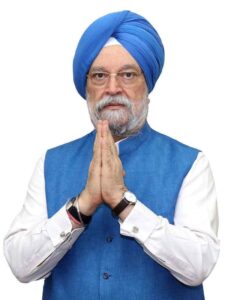
Hardeep Singh Puri stands among the rare Indian public figures whose career bridges high diplomacy, multilateral statecraft, and executive governance. With nearly four decades in the Indian Foreign Service followed by a consequential political career, Puri embodies the evolution of India’s engagement with the world—from moral diplomacy to strategic realism, and from global forums to domestic reform.
Formative Years: Global Exposure, Indian Roots
Born on 15 February 1952 in Delhi, Hardeep Singh Puri grew up during a period when India was still defining its post-colonial identity. Exposure to Europe at an early age—living in Germany and the United Kingdom—gave him a firsthand understanding of Western political systems, social institutions, and diplomatic culture. This international upbringing, combined with strong grounding in Indian history at Hindu College, University of Delhi, shaped his lifelong ability to balance global outlook with national interest.
His academic excellence and early involvement in student leadership reflected a deep interest in governance, debate, and public affairs—traits that would later define his professional life.
The Making of a Diplomat
At Hindu College, University of Delhi, history was not merely a subject—it was a living argument. Puri studied empires, revolutions, and political orders not as abstractions, but as forces that shape human destiny. His brilliance in the classroom was matched by his presence in debate halls and student assemblies, where leadership first found its voice in him.
Before diplomacy claimed him, teaching briefly did. As a young lecturer at St. Stephen’s College, he learned an enduring lesson: ideas matter only when they are communicated with clarity and courage. That lesson followed him for life.
In 1974, he entered the Indian Foreign Service, joining a cadre entrusted with carrying India’s voice into a world still divided by Cold War certainties. But Puri was not content with ceremonial diplomacy. He gravitated toward complexity—conflict zones, multilateral negotiations, institutions where consensus was fragile and power uneven.
Indian Foreign Service: Architect of Strategic Multilateralism
A Diplomat Beyond Protocol
Joining the Indian Foreign Service in 1974, Puri was part of a generation that moved Indian diplomacy beyond symbolism into assertive engagement. Unlike conventional envoys focused on bilateral niceties, Puri specialized in institution-building, crisis negotiation, and strategic positioning.
His assignments in Sri Lanka, the United Kingdom, Brazil, and at the Ministry of Defence allowed him to operate across conflict zones, developed economies, and emerging power blocs. His tenure as Joint Secretary in the Ministry of Defence was particularly significant—it placed a career diplomat at the heart of India’s defence planning, a rare crossover that sharpened his understanding of hard power.
History rarely announces its apprentices. They emerge quietly—shaped by classrooms, conversations, distant cities, and the invisible grammar of nations. Hardeep Singh Puri belongs to that lineage of public men whose lives unfold not in dramatic ruptures, but in sustained engagement with the world’s deepest questions: power and principle, sovereignty and cooperation, nation and humanity.
Across Capitals and Conflicts
From Colombo, during years of civil strife, to London, where India reimagined its post-imperial relationship with Britain, Puri observed how history weighs differently on each nation. In Brasília, he witnessed the rise of the Global South as a serious geopolitical force, helping strengthen partnerships that challenged Western dominance.
His posting to the Ministry of Defence marked a decisive turn. Here, diplomacy met strategy. It was a rare space for a foreign service officer, but one that sharpened his understanding of security, sovereignty, and the limits of moral rhetoric in a dangerous world.
At the United Nations: Power, Principle, and Paradox
If one chapter defines Hardeep Singh Puri’s diplomatic legacy, it is his years at the United Nations.
In Geneva, he negotiated trade, health, and human rights at a time when global institutions were expanding in authority but weakening in legitimacy. In New York, as India’s Permanent Representative to the UN, he stood at the crossroads of global power—during wars justified in the name of peace, interventions framed as compassion, and terrorism disguised as ideology.
As President of the UN Security Council and Chairman of the Counter-Terrorism Committee, Puri spoke with restraint but unmistakable firmness. He challenged selective morality, questioned interventionism without accountability, and argued that international order cannot survive on double standards.
These experiences would later find voice in his writing. “Perilous Interventions” was not merely a book—it was an indictment, a testimony, and a warning about the chaos born when power outruns principle.
From Global Halls to Public Mandate
When Puri left diplomacy in 2013, he could have remained an international commentator—respected, quoted, and comfortable. Instead, he chose the harder road.
Politics beckoned not as ambition, but as responsibility.
Joining the Bharatiya Janata Party in 2014, he transitioned from negotiation to governance. The shift was profound: no longer speaking for India abroad, he now worked to reshape India at home.
Reimagining the Indian City
As Minister for Housing and Urban Affairs, Puri confronted one of India’s greatest challenges—the city itself. Urban India was growing faster than its institutions, its aspirations colliding with infrastructure gaps.
His approach was unsentimental and structured. Cities were not problems to be endured, but systems to be redesigned. Policies were not slogans, but mechanisms. Governance, he believed, must be measured not by announcements, but by delivery.
The Trial of Energy and Crisis
In 2021, amid a world convulsed by pandemic aftershocks and geopolitical upheaval, Puri assumed charge as Minister of Petroleum and Natural Gas.
Oil markets were volatile. Supply chains fractured. Global pressure mounted.
Here, the diplomat returned—this time as a minister. He negotiated energy security not with ideology, but with realism. India diversified sources, defended consumer interests, and asserted its right to independent decision-making.
Energy, under his stewardship, became not just a commodity—but a dimension of sovereignty.
The Man Behind the Office
Married to Lakshmi M. Puri, herself a distinguished global leader at the United Nations, Hardeep Singh Puri’s life is a partnership defined by service rather than spotlight. Those who know him speak of discipline, intellectual honesty, and an almost austere respect for institutions.
He is not a populist. He does not chase applause. His strength lies in continuity—the rare ability to carry experience across domains without losing integrity.
A Legacy Still Unfolding
Hardeep Singh Puri’s career defies easy categorization. He is:
A diplomat who shaped global discourse
A minister who managed crisis-driven governance
A thinker who documented power politics
A public servant bridging India and the world
In an era where diplomacy, energy security, and urban resilience define national strength, Puri’s trajectory reflects India’s own transformation—from a cautious post-colonial state to a confident global stakeholder.
Hardeep Singh Puri’s story is not one of spectacle, but of substance. It mirrors India’s own journey—from moral persuasion to strategic assertion, from idealism to capability, from voice to influence. In a world increasingly loud and impatient, his career reminds us that nations are not built on noise, but on judgment, memory, and resolve. And some lives, lived across frontiers, quietly shape the course of history.