
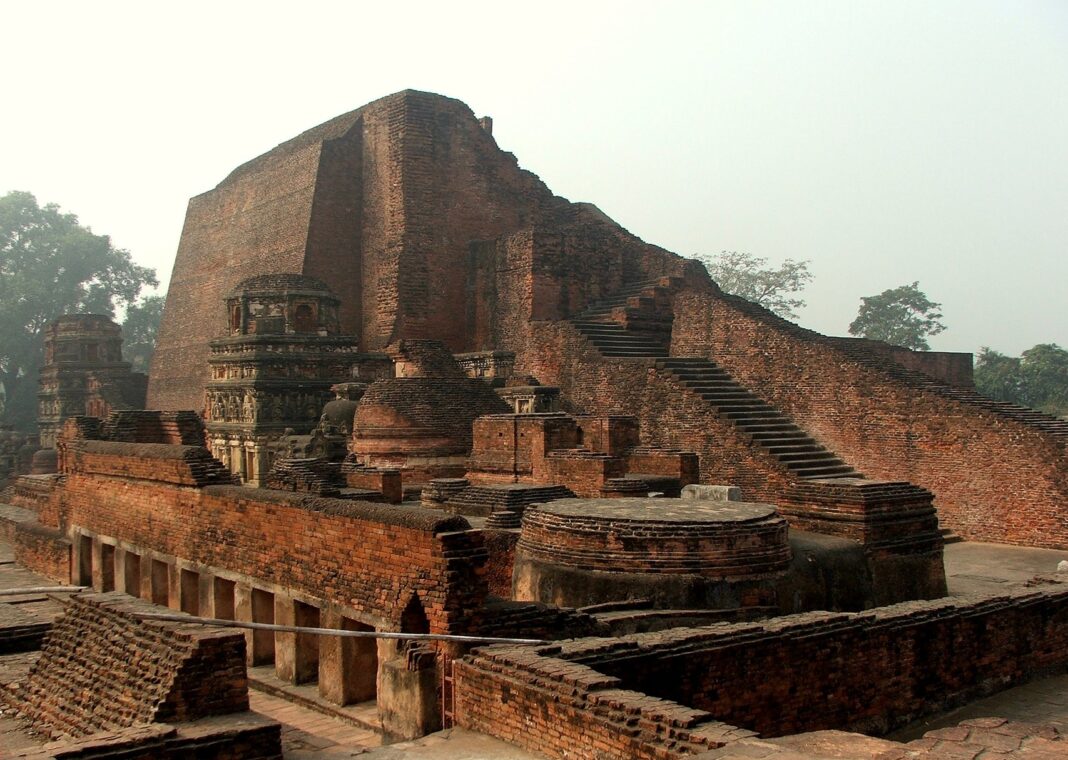
The alleged destruction of the ancient University of Nalanda in Bihar by the Mamluk (Turk) general Bhaktiyar Khilji is widely quoted as proof of the senseless destructiveness of all Muslim invaders. This destruction is believed to have occurred in 1193 CE. Very little is however known about him or his army especially as this event evidently happened just one year after Muhammad Ghori, the first Muslim ruler of north India, defeated Prithviraj Chauhan at Tarain in 1192.
It is therefore rather doubtful that Bhaktiyar and his army could somehow reach a thousand miles east of Tarain through hostile kingdoms or why he chose to desecrate Nalanda when there were so many far richer targets like the wealthy temples and important religious places like Hardwar or Varanasi.

Actually the originally Buddhist Nalanda University had been attacked at least three times. The first attack was done by a Brahmin ruler named Pushyamitra Shungya who took advantage of declining Mauryan dynasty and its weak rulers. Nalanda had been for many centuries a huge residential university where Buddhist as well as Vedic studies were taught. The Sunga soldiers attacked the university and the monks but did not burn down the libraries. It seems that the attack was only to rout out the Buddhists. This event occurred when Hindu revivalism was replacing Buddhism as India’s principal religion.
When the Guptas came to power about 600 years after the Mauryan dynasty they reconstructed the great University and restored Nalanda. But after their decline there was another destroyer who came to power in eastern India that was the Gauda Dynasty (of present day Bengal). King Shashanka was one of the most powerful Gaudiya rulers. During his time Buddhists were being heavily persecuted and Nalanda University was again attacked.
The inscriptions of Chinese monk Hsuan Tsang (who travelled extensively in India during this period) describes Shashanka as a vile serpent and the Brahmin scholar Bhanabhatta also describes king Shashanka’s cruelty to the Buddhists. After that Harshavardhan of Vardhana dynasty (present day Kanauj) came to power and defeated the Gauda ruler and again restored Nalanda University.
Following the invasion of North India by Turks Bhaktiyar Khilji reportedly attacked Nalanda and the last ruler fled to Tibet and the attackers burnt all the many valuable manuscripts. An inscription found in Tibetan script of the 12th century also mentions the attacks on Nalanda before Bhaktiyar Khilji completely destroyed it. The Nalanda University had also been in a long state of decline and never regained its former glory. It is also significant that the records of the destructions by Pushyamitra and Shashanka on Nalanda University had been recorded by Hindu scholars who had witnessed the devastation.
Although several Muslim rulers were undoubtedly guilty of persecuting Hindus many of these accounts were based on Muslim records praising the piety of the iconoclasts. D. N. Jha, who had been president of the Indian history congress in 2004, says “Central to Hindutva perception is the belief that Muslim rulers indiscriminately demolished Hindu temples and broke Hindu idols. They propagate the (unsubstantiated) canard that 60,000 Hindu temples were destroyed during Muslim rule, though there is hardly any credible evidence for the destruction of more than 80 of them”. Jha later says that there is actually no evidence that Bhaktiyar Khilji even went to Nalanda but, in fact, he sacked the nearby Odantapuri Mahavihara in modern day Bihar Sharif.
Jha goes on to add… “In Sultanpur district alone no less than 49 Buddhist sites seem to have been destroyed by fire as Brahminism won its final victory over Buddhism.” Later he says…” In the post Gupta centuries when Hsuan Tsang (who visited India between 631 and 545 CE) the Huna ruler Mihirkula, a devotee of Shiva (according to Kalhana’s Rajatarangani) destroyed 1,600 Buddhist stupas and monasteries and killed thousands of Buddhists monk and laity.” He further adds… “1000 Sangramas in Gandhara were destroyed and 1400 in Uddiyana laid waste and desolate.”
Some fanatics from the left and right wings will try to distort the history. The left will blame bigoted Hindu rulers for the destruction while the right blames the Muslims. There were many examples of great destruction in all religious struggles but the propaganda against Bhaktiyar Khilji and Muslim destructiveness is supported by very shallow evidence.
 By Murad Baig
An Independent Writer & Professional Editor. He is an author of books in history, mythology and religion. I also write for several journals on cars. author of books on cars, humour, religion and history

Via Mohan Guruswamy
He is a distinguished public policy analyst, author, and commentator with a diverse academic and professional background. He graduated from Nizam College, Hyderabad, and holds postgraduate qualifications in public policy, international affairs, and management. He is an alumnus of Harvard University’s John F. Kennedy School of Government and Stanford University’s Graduate School of Business.