

In the turbulent mid-19th century, when Odisha languished under British colonial fragmentation, feudal exploitation, rigid caste hierarchies, a profound socio-spiritual revolution quietly took root. Politically divided after British occupation (1803–1830), with Odia-speaking regions scattered across neighboring provinces, the land saw its people reduced to minorities in their homeland. Economic imperialism through land alienation and heavy taxation ravaged agrarian communities, while tribals and Dalits constituting nearly 40% of the population endured dehumanizing exclusion. The catastrophic famine of 1865–66 claimed about 30% of the population, amplifying despair amid superstition, fatalism, and all kinds of exploitation.
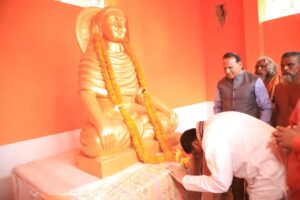

Educated urban elites, though exposed to Western democratic ideals from the French Revolution (1789) with its proclamation that “Men are born and remain free and equal in rights” and unification movements in Italy and Germany, however remained detached. Influenced by thinkers critiquing colonial barbarity, they clung to feudal privileges, viewing the masses as unfit for liberty or equality. In this darkness, Bhima Bhoi (c. 1850–1895), a tribal saint- poet from western Odisha, emerged as a visionary whose universalistic teachings and poetry anticipated the democratic dawn that would illuminate independent India decades later.
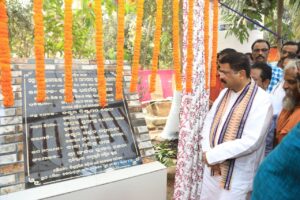
Born around 1850 in a poor Kondh family, possibly in villages like Jatasingha near Subalaya (Subarnapur) or Kankadapara near Rairakhol (Sambalpur) some say that Bhima suffered blindness early, likely from smallpox. As an untouchable tribal, he toiled as a cattle herder for landlords, living near cowsheds and absorbing Bhagabata recitations from afar. Legends describe his miraculous rescue from a well by Mahima Swami, founder of Mahima Dharma, a monotheistic movement devoted to a formless Supreme Being called Sunya Brahma or Alekha. Rejecting idol worship, priestly mediation, elaborate rituals, and caste distinctions, Mahima Dharma offered direct, egalitarian devotion.
This encounter transformed Bhima from a marginalized herder into the movement’s foremost propagator. Leaving servitude around age 12, he wandered for tapasya at Kapilas hills, later settling in areas like Jaronda and Khaliapali near Sonepur, he composed prolifically. Illiterate in formal scriptures, Bhima orally dictated hundreds of bhajans, stutis, and poems transcribed by disciples (four scribes at a time) on palm leaves. Major works include Stuti Chintamani (a 2,000-line masterpiece of prayers to Brahma), Bhajanamala, Nirveda Sadhana, Shruti Nisedha Gita, Brahmanirupana Gita, Cautisa Madhuchakra, and Granthabali, these spread through tungis (Mahima centers) across Odisha.
Bhima’s poetry rejected ritualism and hierarchy, emphasizing inner transformation over external rites. He challenged orthodoxy’s exploitation and caste-based exclusion, offering simplified devotion to all. His verses, sung with gongs and drums in rural gatherings, ignited hope among tribal, agrarian, and marginalized masses in forested hills.
At the heart of Bhima’s vision lay ideals mirroring modern democracy’s pillars: liberty, equality, and fraternity, rooted in indigenous spiritual humanism rather than Western influence.
Equality was radical. Denouncing caste as illusory, Bhima proclaimed universal oneness: “Go and search the three worlds,/ You will find only one man and one caste,/ The Almighty has made/ This world with a single caste” (Stuti Chintamani, 70.13). He declared: “All those fifty-six crores of living beings/ Appear like as my own soul.” True devotion eradicates distinctions: “Brahma bhakatire nahin jatiira kalpana / Ucha-nicha bheda garibanakara bhabana” (In devotion to the Supreme, there is no imagination of caste/ Do not think of high-low differences). Mahima Dharma welcomed untouchables and tribals without barriers, dignifying labor and exposing upper-caste hypocrisy. This prepared the downtrodden to question subjugation, fostering self-respect and agency-foreshadowing constitutional equality.
Fraternity arose from profound compassion and ahimsa. Bhima saw the divine in all: “Be they wicked or saintly, servant or master/ Insect or bird, you pervade all / I see you equally in all beings.” Empathy extended to animals, urging kindness. His universalism shone in the iconic line: “Praninka Arata Dukha Apramita/ Dekhu Dekhu Keba Sahu,/ Mo Jibana Pachhe Narke Padithau/ Jagat Uddhar Heu” (Who can withstand the miseries of the countless,/ Let my life be condemned to hell forever,/ But let the world be uplifted). Another: “I know that a single bone, a drop of blood/ And a small pulp of flesh makes a human being/ That is why I can’t withstand/ The sufferings of the living beings.” Prioritizing collective redemption over personal salvation, he broke fatalism, inspiring shared humanity against divisive hierarchies.
Liberty defined his fearless independence. Declaring: “Rajara Paraja Nohu Sina Amhe/ Nohu Sahura Khataka” (I am not subject of any king,/ Nor loanee to any usurer), he obeyed only his Guru. He championed spiritual freedom from priestly enslavement, denouncing all hypocrisy. Boldly: “Eka Dibasare Kshyanika Bhitare/ Dyanti Pruthvi Olatai” (In a single moment/ I could overturn the world), restrained by restraint. He advocated women’s emancipation, admitting sanyasinis: “The God has created only two classes—The male and the female,/ There is no third kind.” Opposing exploitation by priests, kings, and officials, he envisioned a democratic “Mahanityapura” of equality.
Bhima propagated tirelessly in rural western Odisha, without modern tools, reaching villages and tungis. His bhajans inspired resistance, influencing tribal assertiveness. Radicalism isolated him, drawing harassment from king, elites, feudals, and British, yet Mahima Dharma challenged hegemony.
Bhima’s humanism prefigured India’s 1950 Constitution—Fundamental Rights, justice, liberty, equality, fraternity. As a universalist claiming freedom as a birth right for Supreme Being’s offspring, his rationalized spirituality emphasized inner transformation, preparing marginalized for mental liberation and equitable future.
In persistent inequalities, Bhima Bhoi’s legacy endures as Odisha’s gift. His words “Jati khojile mukti nahin; Mukti khojile jati nahin” (If you cling to caste, no liberation; seek liberation, caste vanishes) remind that annihilating divisions brings true freedom. Through divine oneness, he empowered generations, foreseeing democracy’s dawn where dignity prevails for all.
 By Bishnupada Sethi, IAS
The author serves as the Chairman of the Odisha Forest Development Corporation (OFDC) and continues as the Chief Administrator of the KBK districts.