

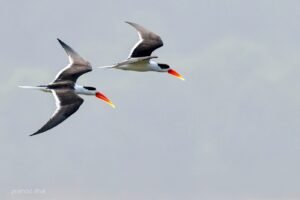
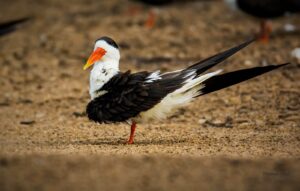
The “Indian Skimmer” or “Indian Scissor-bill” is a unique species of bird known in Odia as “Panichira” (Water-cutter) or “Kainchi Thantia” (Scissor-billed). Its beak structure is entirely different from other birds. Most birds that forage on flat land or in water have beaks with equal-sized mandibles, allowing them to peck at food easily. However, the Indian Skimmer’s beak is uneven. Because the upper beak (upper mandible) is significantly shorter than the lower beak (lower mandible), it is impossible for the bird to pick up food by pecking. Instead, it flies parallel to the water’s surface, “cutting” through the water to catch fish. While gliding just above the surface, it keeps its beak open like a pair of scissors and submerges its long lower mandible into the water. As soon as the lower mandible strikes a fish, it snaps shut instantly against the upper mandible, trapping the prey like a snare. This distinct behaviour is why it is named the Skimmer or Scissor-bill. These birds primarily feed on fish, crustaceans, aquatic insects, and larvae, leading them to inhabit rivers, estuaries, and coasts where fish are abundant.
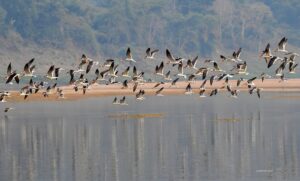

While the global population of mature Indian Skimmers is estimated to be between 2,450 and 2,900, Odisha has emerged as one of the most critical strongholds for the species outside of the Chambal River. Until a few years ago, the Chambal River was the primary known habitat for Indian Skimmers in India, where they bred safely. Because the Chambal was a protected zone for Gharial crocodiles, fishing was prohibited, and human activity was minimal. This provided an abundant food supply and safe nesting grounds on sandbars. For a long time, it was believed that the Chambal was the only breeding site for this species. Skimmers typically inhabit in Open wetland ecosystems, Freshwater lakes, Riverine sandbars and islands; Estuaries (during non-breeding seasons, some are seen in coastal areas.
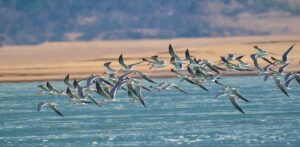
Gradually, these birds were spotted in other states, including Odisha. Retired IFS officer and wildlife expert Shri Suresh Chandra Mishra spotted two pairs near Tikarpada, Satkosia, during a survey of the Mahanadi in 1989. A research paper titled “Avifauna of Bhitarkanika Mangroves” reveals recording over 100 Skimmers in the Praharajpur and Barunei areas of Kendrapara in 2006. While researchers suspected they were breeding in Odisha, there was no photographic evidence at the time.
Due to habitat loss, pollution, and increased human interference, the IUCN (International Union for Conservation of Nature) has classified this species as Vulnerable/Endangered.
The First Photographic Evidence
On October 26, 2014, author Pramod Dhal, along with his bird-loving friends Somshri Patnaik and Manoj Sahu, discovered a flock of over 150 Indian Skimmers in the Satkosia Tikarpada region of the Mahanadi. They captured the first-ever photographic documentation of the species in Odisha. Later, they found them near Badamul and the Mundali Bridge in Cuttack also.
In February 2016, photographers and sanctuary managers captured images of Indian Skimmers nesting and laying eggs on the sandbars near Mundali Bridge. As crowds gathered to take photos, the safety of the birds was threatened.
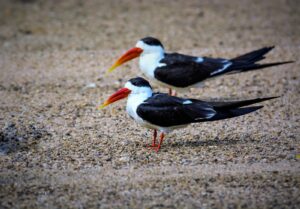
Responding to the risk, the Chandaka Wildlife Authorities took decisive action and declared the area a restricted zone for photographers and fishing boats; and Ensured a safe environment for the breeding process.
The Forest Department and local communities have intensified their “Nest Guardian” approach:
Round-the-Clock Surveillance: At sites like Kakhadi (Athagarh), forest guards and local volunteers protect nests from stray dogs, jackals, and crows.
Water Level Management: The Forest Department now coordinates with the Water Resources Department to ensure that water is not suddenly released from upstream barrages during the nesting months (February–May), which previously washed away many eggs.
Community Involvement: Local fishermen have been integrated into conservation, acting as “Bird Mitras” (Friends of Birds) to prevent boat movement near nesting sandbars.
Mahanadi River (Mundali & Kakhadi) remains the most active breeding site. Recent observations (2024–2025) recorded approximately 165 to 205 individuals congregating in this stretch during the breeding season.
In a major conservation milestone, breeding was recorded at the Baladamara sandbar ((Satkosia Gorge) within the Satkosia Tiger Reserve. In recent cycles, about 24 to 30 birds have been spotted staying back to nest, moving away from more disturbed areas.
Small groups also continue to be reported in the Chilika Lake (Nalbana), Bhitarkanika, and the Hirakud Reservoir, though these are primarily used for foraging rather than large-scale nesting.
Thanks to these measures, regular and safe breeding is now occurring in the region. There is now a glimmer of hope for the population growth of this endangered “Water-cutter,” ensuring that they will continue to “cut” through the waters of the Mahanadi for generations to come. The discovery of these birds in the Mahanadi has shifted the “center of gravity” for Skimmer conservation in India. It is no longer just a “Chambal bird”—the Mahanadi is now recognized as its second most important home in the world.
 Pramod Dhal
He is a social commentator, author, and wildlife photographer from Kendrapara, Odisha. His work focuses on judicial integrity, administrative reform, and citizens’ rights. He is the author of “The Birds of Orissa: A Pictorial Encyclopedia,” for which he received the Sambad Parivesh Samman Award. Contact: +91 7008810112.