
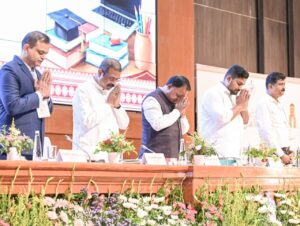
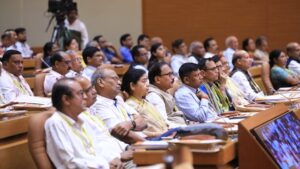
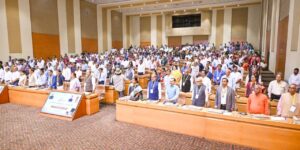
In May 2026, Bhubaneswar witnessed a landmark moment in the history of education reform as policymakers, academicians, researchers, vice-chancellors, and education administrators gathered for the two-day national workshop “Pragya Prerna.” Organized by the Higher Education Department of the Government of Odisha, the workshop focused on the effective implementation of the National Education Policy 2020 and its role in reshaping Odisha into a knowledge-driven and innovation-oriented state.
The event symbolized a transition from traditional education models centered merely on buildings and examinations toward an ecosystem emphasizing research, innovation, skill development, internships, practical learning, and community engagement. The workshop also reflected Odisha’s ambition to align itself with the national vision of “Developed India” by 2047.

Among the distinguished leaders present were Dharmendra Pradhan, Mohan Charan Majhi, Higher Education Minister Suryabanshi Suraj, and noted educationist Shyam Pattnaik, along with vice-chancellors, professors, and scholars from across the country.
Odisha: A Land of Knowledge
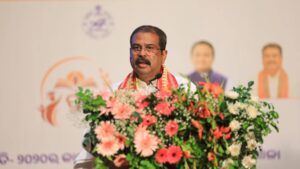
One of the central themes of the workshop was the rediscovery of Odisha’s intellectual heritage. During his address, Dharmendra Pradhan described Odisha as a “Land of Knowledge” whose civilizational contributions once guided the world. He highlighted the state’s historic achievements in maritime trade, temple architecture, literature, astronomy, agriculture, and philosophy.
Referring to personalities such as Pathani Samanta, Upendra Bhanja, Fakir Mohan Senapati, Gangadhar Meher, and Bhim Bhoi, Pradhan emphasized that Odisha’s educational future must remain connected to its cultural roots.
He stressed that universities should no longer focus only on constructing infrastructure but should instead focus on “building ideas.” According to him, institutions must become centers of innovation capable of solving local problems through research and indigenous knowledge systems.
Dharmendra Pradhan’s Vision: Education Rooted in Identity and Innovation
The speech of Dharmendra Pradhan emerged as one of the defining moments of the workshop. He argued that education should inspire self-confidence rooted in Indian languages and culture while simultaneously preparing youth for global competition.
He called for:
- Integration of Odisha’s local history and heroes into curricula
- Promotion of practical knowledge and skills over rote learning
- Greater use of digital platforms such as SWAYAM and AI-based Odia learning content
- Internationalization of higher education
- Expansion of research and innovation ecosystems
- Emphasis on mother tongue-based education
Pradhan highlighted Odisha’s demographic advantage, noting that a significant portion of the state’s population belongs to the youth category. He described this demographic strength as Odisha’s greatest asset and emphasized that NEP 2020 provides tools such as the Academic Bank of Credit and Apar ID to empower students in the 21st century.
Excerpts from Dharmendra Pradhan’s Speech
- “Universities should not focus only on buildings, but on building ideas.”
- “Odisha has always been a land driven by education and knowledge.”
- “To build Developed Odisha and Developed India, educational institutions must become centers of innovation, research and social transformation.”
- “Our education system must connect students with the glory of their land, language and civilization.”
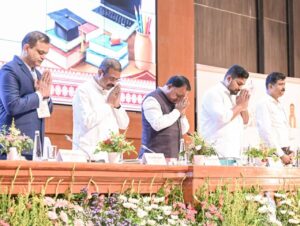
Mohan Charan Majhi’s Address: Building a Developed Odisha
Mohan Charan Majhi presented education as the foundation of Odisha’s developmental journey. He emphasized that the implementation of NEP 2020 would not remain confined to policy documents but would be transformed into actionable reforms benefiting every district and village.
Majhi highlighted the Odisha government’s commitment to educational inclusivity, digital transformation, and rural outreach. He reiterated that quality education should not remain limited to urban centers and announced large-scale educational initiatives aimed at bridging social and geographical disparities.
One of the biggest announcements linked with the workshop was the ambitious Godabarish Mishra Adarsha Vidyalaya programme. Under this initiative, modern schools are proposed in all 6,794 Gram Panchayats of Odisha with an investment of approximately ₹12,000 crore.
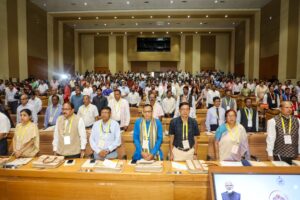
Majhi also underlined the importance of empowering marginalized communities through education. The government announced:
- 11.25% reservation for SEBC students in higher education
- Financial assistance for Scheduled Tribe students under the Shaheed Madho Singh Haath Kharcha Yojana
- Excerpts from Mohan Charan Majhi’s Speech
“Education is the strongest foundation for a developed Odisha.”
“Every child of Odisha, whether from a city or a remote village, deserves access to modern and quality education.”
“NEP 2020 will transform our youth from degree-holders into innovators, researchers and nation-builders.”
“Our goal is not merely educational expansion, but educational excellence.”
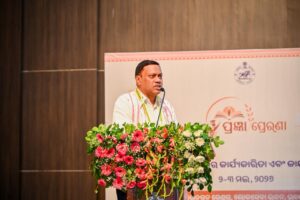
Professor Shyam Sundar Pattnaik’s Perspective: Knowledge With Social Responsibility
Education thinker Professor Shyam Sundar Pattnaik, VC-OSOU, Sambalpur focused on the moral and social dimensions of education. He argued that higher education institutions must cultivate socially responsible citizens instead of producing only job seekers.
Pattnaik stressed the importance of:
- Community-based learning
- Ethical education
- Research connected to local realities
- Internship and field engagement
- Rural innovation ecosystems
He praised the launch of the “Internship and Community Service Guidelines” booklet during the workshop, describing it as a bridge between classroom learning and societal responsibility. According to Pattnaik, education becomes meaningful only when knowledge directly contributes to human welfare.
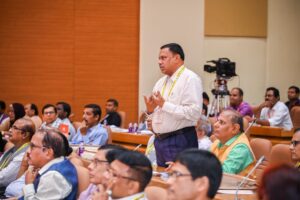
Excerpts from Shyam Sundar Pattnaik’s Speech
“Education must not create isolated intellectuals; it must create socially conscious citizens.”
“Knowledge gains value only when it serves society.”
“The classroom must connect with the village, the laboratory with the farmer, and research with the people.”
Launch of Key Educational Initiatives
A major attraction of the workshop was the release of the “Internship and Community Service Guidelines” booklet designed to strengthen experiential learning among students. The initiative aims to make internships, fieldwork, and community service integral parts of higher education.
The event also witnessed the launch of the Shaktishri mobile application focused on women’s empowerment and safety.
These initiatives reflected the broader NEP philosophy that education should combine academic learning with life skills, social responsibility, and practical exposure.
The Broader Vision of Pragya Prerna
“Pragya Prerna” was not merely a workshop; it represented a philosophical shift in Odisha’s educational thinking. The discussions consistently emphasized that education should:
- Encourage critical thinking
- Promote innovation and entrepreneurship
- Preserve cultural identity
- Support scientific inquiry
- Empower marginalized communities
- Create globally competitive youth
The workshop also highlighted the importance of preparing Odisha for two historic milestones:
2036: The centenary of Odisha as a separate linguistic state
2047: The centenary of India’s independence
The vision emerging from the event was clear — Odisha aims to become a major knowledge hub of India by combining its ancient intellectual heritage with modern educational reforms.
Conclusion
Pragya Prerna marked a defining chapter in Odisha’s educational transformation. The workshop successfully brought together policymakers, educators, and intellectuals under a common vision of creating a research-oriented, inclusive, and innovation-driven education ecosystem.
The speeches of Dharmendra Pradhan, Mohan Charan Majhi, and Shyam Pattnaik collectively conveyed a powerful message: education must shape not only careers, but civilization itself.
As Odisha moves toward 2036 and India toward 2047, “Pragya Prerna” may well be remembered as the beginning of a new intellectual awakening in the state.
“A developed society is built not merely through economic growth, but through enlightened minds shaped by meaningful education.”