

The Raighar goat, an indigenous livestock genetic resource of Odisha, has emerged as one of the most prolific and adaptable goat populations in eastern India. Native to the tribal-dominated regions of Nabarangpur district and adjoining areas of Kalahandi and Nuapada, along with neighbouring parts of Chhattisgarh, this hardy goat has evolved over generations under difficult agro-climatic conditions and low-input farming systems. Named after the Raighar area of Nabarangpur district, the breed is deeply intertwined with the livelihood, culture, and traditional knowledge systems of Bhatra, Gond, and Gouda communities, who continue to rear and conserve it across the region.
Despite its remarkable traits, the Raighar goat remained largely undocumented for decades. Scientific characterization of the breed was systematically undertaken by our team led by Dr. S.K. Dash, Professor of Animal Breeding and Genetics at OUAT. The monograph, “Raighar: The Goat Genetic Resources of Odisha,” provided one of the most comprehensive scientific accounts of this lesser-known indigenous goat population. Extensive surveys covering 66 villages, 544 farm families, and more than 3,200 animals generated detailed information on its morphology, reproductive performance, management practices, and socio-economic importance. Subsequent field studies further strengthened the evidence regarding the breed’s genetic potential and livelihood value.

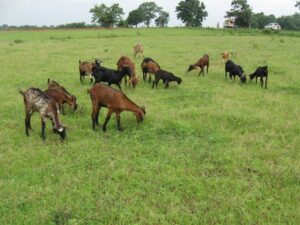
Odisha possesses nearly 65 lakh goats, accounting for around one-third of the state’s livestock population, and goat rearing remains a critical livelihood activity for marginal and landless households. Within this broader livestock economy, the Raighar goat occupies a unique position because of its exceptional adaptability and reproductive efficiency. It thrives in the warm, humid, and sub-humid climate of southern Odisha, where annual rainfall exceeds 1,500 mm and temperatures fluctuate sharply between seasons. Vast stretches of forest land, roadside vegetation, harvested crop fields, and scrublands provide the primary grazing resources for these animals.
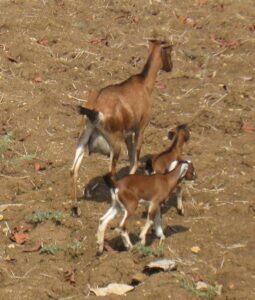
The Raighar goat is a medium-sized, compact meat-type animal with a sturdy frame and highly efficient grazing behaviour. Adult males generally weigh around 30 kg, while females average nearly 28 kg under traditional management systems. The breed possesses a well-proportioned body with an average height at withers of about 64 cm and body length closely matching its height, giving it a balanced and compact appearance suited for long hours of grazing. Most animals are deep brown in colour, though light brown, grey, blackish-brown, black, and mixed coat patterns are also observed. Distinctive white or black stripes and spots on the face are among the most recognizable breed characteristics. Both males and females are horned, with backward-oriented horns and medium-sized ears that droop slightly downward.
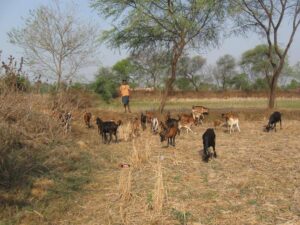
The breed’s physical characteristics are closely linked to its ecological adaptation. Raighar goats are capable of walking long distances and browsing on sparse vegetation with minimal nutritional supplementation. They survive almost entirely on grazing and browsing resources, consuming roadside grasses, forest shrubs, crop residues, and naturally available vegetation. Farmers rarely provide concentrate feed except occasional rice gruel or household leftovers to lactating females. Despite such low-input conditions, the goats maintain satisfactory growth performance. Kids are born with an average weight of around 1.5 kg and attain 16–17.5 kg by one year of age, reflecting efficient feed utilization and strong survivability under extensive systems.
However, the most remarkable feature of the Raighar goat is its extraordinary reproductive performance. The breed displays one of the highest prolificacy rates among indigenous goats of India. More than 64 percent of births are multiple births, with nearly 57 percent twinning and about 7 percent triplets. Occasional cases of quadruplets have also been reported. Such reproductive efficiency significantly enhances flock productivity and provides substantial economic benefits to poor rural households. Females attain sexual maturity at around 9-10 months of age and usually produce their first kid at approximately 15 months. The average kidding interval is around 226 days, or roughly 7-8 months, enabling rapid flock multiplication under traditional systems.
Importantly, Raighar goats are non-seasonal breeders, though a higher concentration of kidding is observed during winter. Their reproductive ability, combined with low maintenance requirements, makes them highly suitable for resource-poor farmers. Studies conducted by Dash and Sethi revealed moderate heritability estimates for reproductive traits, indicating that selective breeding could further improve productivity. Positive correlations among body weight, maturity, and reproductive performance suggest that carefully designed breeding programmes could strengthen the breed without compromising its adaptability.
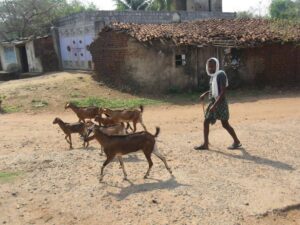
The socio-economic importance of the Raighar goat is immense. Most keepers belong to economically weaker tribal communities possessing little or no agricultural land. Goat rearing acts as a dependable source of income, nutrition, and financial security. Farmers often describe goats as a “living bank,” since animals can be sold quickly during emergencies, crop failures, marriages, festivals, or medical needs. Castrated males fetch high prices in local markets because of the strong demand for quality chevon and their use in religious and cultural ceremonies among both Hindu and Muslim communities.
Women play a central role in goat husbandry. While men and children usually take animals for grazing, women manage feeding of lactating mothers, care of newborn kids, health management, and occasional marketing activities. Thus, the breed contributes not only to household income but also to women’s participation in rural economic activities. In rain-fed tribal regions where crop agriculture is uncertain and seasonal migration is common, goat rearing provides regular livelihood support with very little capital investment.
Another major strength of the Raighar goat lies in its resilience to harsh environmental conditions. The breed is naturally tolerant to heat, humidity, poor-quality feed, and several common diseases. Farmers frequently rely on indigenous veterinary practices for minor ailments, while periodic vaccination programmes by government agencies help control major diseases such as PPR and FMD. The goats are known for strong mothering ability, high kid survival, and capacity to perform under extensive systems where veterinary infrastructure remains limited.
Yet, despite its proven strengths, the Raighar goat remains under-recognized at the national level. The absence of formal breed recognition and organized conservation programmes has exposed it to genetic dilution through indiscriminate crossbreeding and unregulated distribution of non-native goats by development agencies. Shrinking grazing lands, changing land-use patterns, and increasing pressure on common property resources also threaten the long-term sustainability of traditional goat-rearing systems.
The significance of conserving such indigenous breeds has increased considerably in the context of climate change and sustainable agriculture. High-input exotic breeds often struggle in resource-constrained rural environments, whereas local breeds like the Raighar goat possess valuable adaptive traits developed over centuries. Heat tolerance, disease resistance, ability to survive on poor fodder, and high reproductive efficiency make these animals critically important for future livestock production systems in ecologically fragile regions.
The Raighar goat is therefore more than merely a meat-producing animal; it represents a unique combination of biodiversity, traditional knowledge, and rural resilience. Its success under low-input systems demonstrates the importance of locally adapted livestock resources in sustaining livelihoods among tribal and marginal communities. The scientific documentation carried out by our team has brought overdue attention to this remarkable indigenous breed and highlighted its potential for sustainable livestock development in Odisha.
At a time when preservation of indigenous genetic resources has become a national priority, the Raighar goat stands as a living example of how traditional breeding practices and ecological adaptation can create highly productive and resilient livestock populations. Protecting and strengthening such breeds is not only essential for biodiversity conservation but also for ensuring livelihood security, nutritional support, and economic stability for thousands of rural families across the tribal heartlands of Odisha. Formal recognition, conservation and development of this precious breed of nature needs urgent attention.
 Dr. Bishnupada Sethi
The author is the Chairman of OFDC and Chief Administrator of KBK districts of Odisha.