

Book Summary
In On Liberty (1859), John Stuart Mill constructs one of the most formidable philosophical defenses of individual freedom ever written. Not a romantic ode to rebellion, but a razor-sharp inquiry into the limits of social and governmental authority, the book argues for a single, powerful principle:

The only legitimate reason for exercising power over any member of a civilized community, against his will, is to prevent harm to others.
This “harm principle” becomes the spine of the entire work.
Mill begins by reframing liberty. The struggle, he says, is no longer simply between citizen and tyrant. Modern societies face a subtler danger: the tyranny of the majority. When public opinion hardens into moral coercion, society itself becomes despotic. Law may not imprison you—but custom, stigma, and collective intolerance can suffocate you just as effectively.
🔹 Chapter 1: The Principle of Liberty
Mill establishes that individuals are sovereign over their own body and mind. Self-regarding actions—those that affect only oneself—must remain free from coercion. Society may advise, persuade, or warn—but not compel. However, when actions harm others, society is justified in intervening.
🔹 Chapter 2: Liberty of Thought and Discussion
This is the intellectual heart of the book. Mill argues that silencing an opinion robs humanity—both present and future. The suppressed opinion may be:
True, in which case we lose truth.
False, in which case truth becomes lifeless dogma without opposition.
Partly true, which is most often the case.
Truth, he insists, is not a relic but a living force sharpened through debate. Even widely accepted beliefs must remain open to challenge. Otherwise, they decay into prejudice.
🔹 Chapter 3: Individuality as a Component of Well-Being
Mill moves from freedom of thought to freedom of character. Individuality, he claims, is not selfish eccentricity—it is the engine of human progress. “Experiments in living” allow humanity to evolve. Conformity breeds mediocrity; diversity breeds advancement.
🔹 Chapter 4: The Limits of Society’s Authority
Mill refines the boundary between private and public action. While society may regulate conduct that harms others, it must resist moral paternalism. The state cannot rightfully force a person to be virtuous “for his own good.”
🔹 Chapter 5: Applications
Mill applies his principle to issues such as trade, speech, and governance, demonstrating how liberty operates in real civic life. Even here, he is not anarchic; he allows for civic duties and necessary regulation—but only where genuine harm is at stake.

Review by The Truth One
There are books one reads. And then there are books that rearrange one’s internal architecture. On Liberty belongs unapologetically to the latter category.
Mill does not merely argue for freedom; he anatomizes oppression in its most refined and socially acceptable forms. What makes this work astonishingly modern is not its Victorian prose, but its prophetic accuracy. Mill saw what liberal democracies still struggle to confront: that freedom is rarely destroyed by kings—it is eroded by consensus.
His critique of the “tyranny of the majority” reads like a commentary on contemporary culture, where public opinion often masquerades as moral authority. Mill understood something psychologically profound: humans fear social isolation more than legal punishment. Thus, social conformity becomes more powerful than law.
What elevates the book beyond political theory is its ethical depth. Mill’s defense of free speech is not procedural—it is existential. He does not protect speech merely to preserve democracy; he protects it because truth itself depends on contestation. A belief untested by criticism becomes intellectual fossilization.
Even more radical is his celebration of individuality. In an age increasingly obsessed with sameness—of thought, lifestyle, and acceptable opinion—Mill insists that eccentricity is not a flaw but a civic contribution. Civilization progresses through deviations, not repetitions.
Yet Mill is no naïve libertarian. He is acutely aware of responsibility. The harm principle is not a license for chaos; it is a disciplined framework. Liberty ends where injury to others begins. His vision is structured freedom, not reckless autonomy.
What makes On Liberty enduring is its moral courage. Mill writes with the quiet confidence of someone who knows he is confronting not a tyrant, but a crowd. And confronting a crowd requires greater bravery.
The most chilling insight of the book is this: society rarely recognizes its own oppression. It calls it “morality,” “public order,” “tradition,” or “security.” Mill strips these disguises away. He reminds us that civilization’s progress depends on protecting dissenters—even when we are convinced they are wrong.
In an era of algorithmic echo chambers and polarized discourse, Mill’s demand for open contest of ideas feels almost revolutionary. He insists that certainty without scrutiny is intellectual laziness. To silence opposition is to confess weakness.
If one were to distill the book into a single intellectual thunderbolt, it would be this:
Freedom is not valuable because we are always right. It is valuable because we are often wrong.
Few works of political philosophy manage to be simultaneously elegant, rigorous, humane, and unsettling. On Liberty achieves all four. It is not just a defense of free speech or civil rights—it is a manifesto for intellectual humility and moral maturity.
More than a 19th-century treatise, it remains a warning: whenever society grows comfortable in its own righteousness, liberty is already at risk.
And perhaps that is why this slim volume still feels explosive.
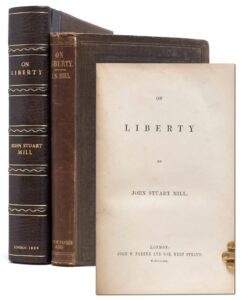
On Liberty by Mill, John Stuart.
London: John W. Parker and Son, 1859. First edition. Octavo; collates: 207, [1, colophon]; complete (this copy bound without the 16 pages of publisher’s ads found in some copies). A handsome Very Good+ copy in the publisher’s original blindstamped purple cloth with orange-coated end papers. Dampstain affecting the fore-edge of the front and rear boards, text leaves unaffected. Minor wear at the spine ends. Internal contents generally clean with the odd smudge or turned corner. Housed in a quarter-leather custom clamshell case.
An extremely influential work in political philosophy and the foundation for all branches of liberalism. The author argues that “over himself, over his own body and mind, the individual is sovereign.” An extension of which is the harm principle, first outlined in this work: “the only purpose for which power can be rightfully exercised over any member of a civilized community, against his will, is to prevent harm to others.” One conclusion of this argument is that people should have the freedom to pursue their interests, even if damaging to themselves morally or physically, as long as they are not harming others. While these concepts are quite commonplace within democracy today, they were radical in their day, breaking new ground in political theory. © Whitmore Rare Books