

Across India’s vast rural landscape, indigenous livestock breeds embody centuries of ecological adaptation, cultural tradition and community knowledge. Yet many of these invaluable genetic resources remain little known beyond the regions where they evolved. In Odisha, one such remarkable but under-appreciated treasure thrives quietly along the wetlands of Chilika Lake, the Chilika buffalo. Perfectly adapted to the lagoon’s marshy ecosystem, this hardy indigenous breed supports rural livelihoods, sustains traditional food practices and represents an important component of India’s livestock biodiversity. Preserving and promoting this unique breed is therefore not merely a matter of agricultural interest but also of cultural and ecological significance.
A fascinating link between this breed and Odisha’s cultural heritage can be found in Manikapatna, a serene village in Puri district situated near the shores of Chilika Lake. The village is renowned for its legendary Manikapatna Dahi (curd), a delicacy deeply intertwined with the sacred traditions of Lord Jagannath.

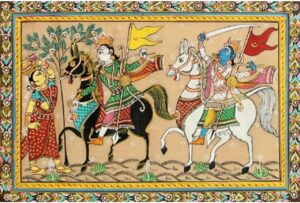
According to folklore associated with the historic Kanchi Abhijan, a humble milkmaid named Manika Gauduni once offered curd to Lord Jagannath and Lord Balabhadra as they travelled incognito. Pleased with her devotion, the deities blessed her, and the village later came to be known as Manikapatna. Since then, the curd prepared here has acquired a special place in Odia culture and devotional traditions.
The fame of Manikapatna Dahi lies not only in its taste but also in its unique method of preparation. Thick, creamy and delicately textured, the curd is traditionally set in organic bamboo baskets using milk obtained from the rare Chilika buffalo breed that thrives in the Chilika ecosystem. The milk of this indigenous buffalo gives the curd its distinctive richness, high nutritional value and remarkable ability to remain fresh without souring quickly.
Recognising its unique cultural and regional identity, the Odisha University of Agriculture and Technology has initiated efforts to secure a Geographical Indication (GI) tag for Manikapatna Dahi. Such recognition would not only promote this traditional dairy product but also bring wider attention to the Chilika buffalo, the indigenous breed that makes it possible.
A Distinct Indigenous Breed of the Chilika Ecosystem
India possesses one of the richest reservoirs of livestock biodiversity in the world. Over centuries, indigenous breeds of cattle and buffalo have evolved under diverse agro-climatic conditions, developing traits that enable them to thrive in local environments. Among these valuable genetic resources, the Chilika buffalo of Odisha stands out as a remarkable example of adaptation to a coastal wetland ecosystem.
The Chilika buffalo derives its name from its natural habitat, the Chilika Lake region of coastal Odisha. This area extends across parts of present-day Khordha, Puri and Ganjam districts and is characterised by a humid tropical climate, moderate rainfall and extensive marshy wetlands associated with the lagoon.
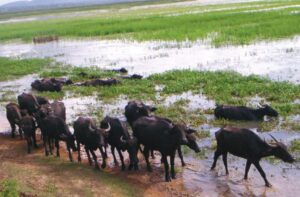
For generations, farming communities living along the shores of Chilika Lake have maintained this buffalo population under traditional systems of management. Scientific studies made by our team led to recognition of the Chilika buffalo as a distinct germplasm resource of India, registered with the accession number INDIA_BUFFALO_1500_CHILIKA_01012.
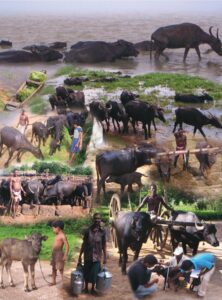
The livelihood systems of the communities around Chilika Lake are closely linked with natural resources such as fisheries, wetlands and grazing lands. Within this ecological setting, the Chilika buffalo has evolved as a hardy and adaptable animal capable of surviving under low-input conditions. Unlike many specialised dairy breeds, these buffaloes thrive largely on natural grazing and require minimal external inputs. As a result, they form an important component of the mixed farming systems practiced in the region.
Physically, the Chilika buffalo is a medium-sized animal with a compact body and strong legs, well suited to marshy terrain. The coat colour usually varies from brownish-black to jet black.
One of the most distinctive identifying features of this breed is the characteristic shape of its horns. As the animal matures, the horns initially grow upward and sideways before curving inward, often forming a sickle-shaped structure. In some animals, the horn tips nearly meet, giving them a circular appearance.
The animals possess a well-proportioned body structure with a broad chest and sturdy limbs that enable them to move easily across wet and marshy landscapes. Adult males weigh on average about 352 kg, while females weigh approximately 341 kg. Based on body measurements such as body length, height at withers and heart girth, the breed is relatively small compared with many other recognised buffalo breeds in India. In fact, it is considered one of the smallest among the recognised riverine buffalo breeds of the country.
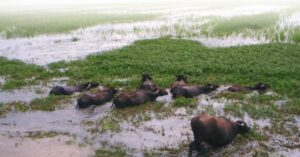
One of the most remarkable characteristics of the Chilika buffalo is its unusual grazing behaviour. These animals feed extensively on aquatic and marshy vegetation found in the shallow waters of Chilika Lake. They are capable of grazing on submerged weeds and aquatic plants, a trait rarely seen in other buffalo populations.
Because they often move into the lake during night hours to graze, they are locally referred to as the “night queens of Chilika.” This nocturnal grazing habit reflects their extraordinary adaptation to the lagoon ecosystem.
Their grazing activity also contributes to the ecological functioning of the lake. By feeding on aquatic weeds, the buffaloes help regulate vegetation growth in the lagoon. Their movement and grazing patterns expose the roots of grasses along the lake margins, which are then consumed by birds inhabiting the wetland. In this way, the animals interact closely with the ecological processes of the Chilika landscape.
The management of Chilika buffaloes follows a distinctive community-based system rooted in local traditions. Individual farmers usually maintain small herds ranging from 10 to 60 animals. However, several households within a village often pool their buffaloes together to form larger communal herds.
These pooled herds, sometimes consisting of 200 to 300 animals, are collectively taken for grazing in the marshy areas surrounding the lake. Such cooperative arrangements enable efficient use of the natural vegetation available in the wetland ecosystem.
Housing facilities for these animals are minimal. Most of the time they remain outdoors and depend almost entirely on natural vegetation for feed. Supplementary feeding is rarely practiced. Before moving to grazing areas, the animals typically visit freshwater ponds in nearby villages to drink water.
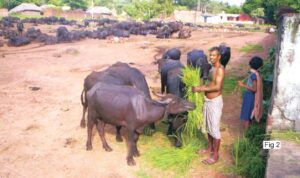
At resting sites, dung accumulated by the herd is collected by the families and used either as organic manure in agriculture or dried and used as a domestic fuel source.
Chilika buffaloes serve multiple purposes in the rural economy. Apart from providing milk for household consumption, they are also valued for their draught ability in agricultural activities such as ploughing and transportation. This dual utility makes them particularly suitable for the traditional farming systems of coastal Odisha.
The dairy performance of the breed reflects its adaptation to low-input production systems rather than intensive milk production. The average daily milk yield is about 2 litres, while peak yield may reach around 2.7 litres in different lactations.
Although the quantity of milk is modest, its quality is notable. The milk contains a high fat percentage of about 8.6 to 8.8 percent, which enhances its nutritional value and makes it particularly suitable for preparing traditional dairy products such as the famous Manikapatna Dahi.
Reproductive performance is also satisfactory under traditional conditions. Females attain sexual maturity at around 1065 days, while the average age at first calving is approximately 1362 days (about 44- 45 months). The average calving interval of 406 days indicates a reasonably efficient reproductive cycle.
The chromosomal configuration confirms that the Chilika buffalo belongs to the riverine type of buffalo, even though certain aspects of its body morphology show similarities with swamp-type buffaloes. Cytogenetic studies have therefore played an important role in establishing the genetic identity of this breed.
A Heritage Worth Conserving
The Chilika buffalo illustrates how indigenous livestock breeds evolve in close harmony with their environment and the socio-economic systems of the communities that sustain them. Adapted to marshy wetlands, capable of feeding on aquatic vegetation and surviving under minimal management inputs, the breed represents a distinctive component of Odisha’s livestock biodiversity.
Scientific documentation and characterisation of the Chilika buffalo have helped bring attention to this unique germplasm resource. Its ecological adaptation, distinctive physical features and characteristic chromosomal profile underline its importance within India’s diverse livestock heritage.
At a time when many indigenous livestock breeds face pressures from changing agricultural practices and shrinking grazing resources, the Chilika buffalo stands as a reminder of the value of traditional knowledge and locally adapted genetic resources. Sustained efforts toward recognition, conservation and promotion of such breeds are essential not only for maintaining livestock biodiversity but also for strengthening rural livelihoods and preserving cultural traditions linked to them.
Grazing quietly in the wetlands of Odisha’s great lagoon, the Chilika buffalo is more than just a domestic animal: it is a living symbol of the enduring relationship between nature, culture and community.
 Bishnupada Sethi
The author is an IAS Officer and presently serves as the Chairman of the Odisha Forest Development Corporation (OFDC) and continues as the Chief Administrator of the KBK districts.