

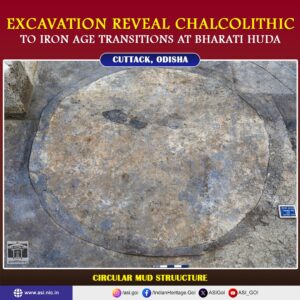
Excavations at Bharati Huda, located in Jalarpur village of Cuttack, Odisha, have revealed the remains of an organized rural settlement dating to approximately 3500–4000 years before present. Findings include circular mud structures, diverse ceramic traditions, stone and bone tools, metal objects, and extensive faunal remains. Evidence of cultivated rice and mung (gram), along with animal and fish remains, indicates a subsistence economy based on farming, stock raising, hunting, and fishing, offering valuable insights into early settlement patterns and everyday lifeways in the proto-historic period of coastal Odisha. Bharati Huda, in Cuttack, Odisha, is a significant archaeological mound situated between the Prachi River and the Tanala rivulet – a location that underscores its strategic importance for early human habitation. The proximity to these water sources would have provided essential resources, making it an ideal site for prehistoric settlement. Excavations conducted during the 2017–18 season revealed compelling evidence of early occupation. Among the most notable discoveries were the remains of circular mud huts and structural platforms, indicating a well-organized and possibly long-term settlement. A diverse array of artifacts was recovered, including ground stone tools, bone implements, copper objects, semi-precious stones, terracotta bull figurines, and terracotta wheels. The site’s ceramic assemblage is particularly varied, comprising red ware, red slipped ware, chocolate slip, tan-red ware, grey ware, black ware, and black-and-red ware – highlighting both technological sophistication and cultural diversity. These findings provide valuable insights into the Chalcolithic and early Iron Age phases of the region, shedding light on prehistoric technologies, settlement patterns, and socio-economic practices. — ASI
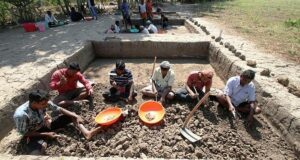

The archaeological mound of Bharati Huda, situated in Jalarpur village of Cuttack district in Odisha, has emerged in recent years as one of the most significant proto-historic discoveries in eastern India. Excavations conducted by the Archaeological Survey of India (ASI) have revealed the remains of a well-organized rural settlement dating approximately 3,500–4,000 years before present, offering vital insights into early human habitation, economy, and cultural development in the Mahanadi delta region.
1. Geographic Context and Archaeological Setting
Bharati Huda occupies a strategically advantageous landscape within coastal Odisha. Located between the Prachi River and the Tanala rivulet, the site lies in a fertile riverine zone ideal for early habitation, agriculture, and communication routes. Such proximity to perennial water sources would have ensured access to water, fertile alluvial soils, fish resources, and mobility corridors—factors that strongly favored permanent settlement in prehistoric societies.
Archaeologically, the mound forms part of a broader network of proto-historic and Chalcolithic sites across the Mahanadi delta. Studies suggest cultural similarities with nearby sites such as Golabai Sasan and Suabarei, as well as partial affinities with Chalcolithic cultures of the middle Mahanadi valley and central-eastern India.
2. Excavations and Chronology
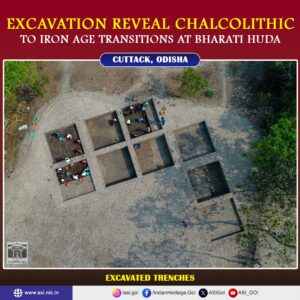
Scientific excavation at Bharati Huda intensified during the 2017–18 season. Radiocarbon dating of charcoal samples recovered from the site—conducted through Accelerator Mass Spectrometry (AMS) at the Inter-University Accelerator Centre in New Delhi—established its antiquity at roughly 3600 years, confirming occupation during the Chalcolithic horizon of eastern India.
Subsequent analysis and reporting have framed the site more broadly within a 3500–4000-year chronological bracket, aligning it with proto-historic developments preceding the early Iron Age in the region.
3. Settlement Pattern and Architecture
Excavations revealed structural remains indicating a planned and stable rural settlement. Among the most notable discoveries were:
Circular mud huts and structural platforms suggesting organized habitation layouts.
Extensive deposits of potsherds and domestic debris indicating long-term occupation.
These architectural features point to a sedentary agrarian community rather than a transient camp. The spatial organization implies a cohesive social structure capable of sustained occupation and community planning—an essential marker of proto-historic settlement development.
4. Material Culture: Tools, Ornaments, and Artifacts
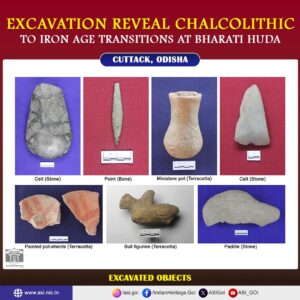
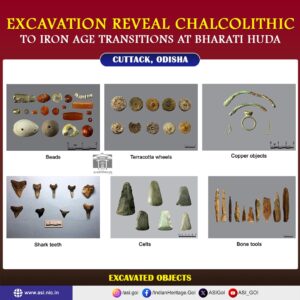
The artifact assemblage recovered from Bharati Huda is exceptionally diverse and provides a window into the technological sophistication of its inhabitants. Finds include:
- Ground and polished stone tools and bone implements reflecting daily subsistence and craft activities.
- Copper objects demonstrating emerging metallurgical knowledge characteristic of the Chalcolithic age.
- Semi-precious stone beads suggesting ornamentation and possibly exchange networks.
- Terracotta objects, including bull figurines and wheels, likely connected with ritual symbolism, transport imagery, or children’s play.
The assemblage reflects a society combining technological adaptability with cultural expression, bridging stone-tool traditions and early metallurgy.
5. Ceramic Traditions and Cultural Interaction
The pottery corpus from Bharati Huda is especially significant for understanding cultural dynamics. The site yielded a broad range of ceramic types, including:
- Red ware and red-slipped ware
- Chocolate-slipped ware
- Tan-red ware
- Grey ware
- Black ware and black-and-red ware
Such diversity suggests not only technological versatility but also possible cultural interaction with neighboring regions. Archaeologists have proposed the coexistence of distinct ethnic or cultural groups, inferred from ceramic variation and settlement phases.
6. Subsistence Economy and Environmental Adaptation
Faunal and botanical remains from the site reveal a mixed subsistence strategy combining agriculture, pastoralism, hunting, and fishing. Evidence includes:
- Cultivated rice and green gram indicating settled farming practices.
- Carbonized grains and domesticated cattle remains confirming agrarian and pastoral lifeways.
- Fish and wild animal remains showing continued reliance on natural resources.
This adaptive economy reflects the ecological richness of the delta environment and illustrates the resilience of early communities in coastal Odisha.
7. Religion and Symbolic Life
Though limited, evidence suggests emerging belief systems rooted in nature worship. A notable find is a sun motif on chocolate-slipped pottery, interpreted as an early indicator of solar reverence in the Prachi valley—traditions that later culminated in the celebrated solar cult of eastern India.
8. Bharati Huda and the Idea of a “Lost Civilization”
While Bharati Huda does not represent an urban civilization like the Indus Valley sites, it is crucial for reconstructing early socio-cultural evolution in eastern India. The site demonstrates:
- Early village planning and social organization
- Agricultural innovation and ecological adaptation
- Cultural diversity within Chalcolithic Odisha
- Regional continuity into later proto-historic and Iron Age developments
Rather than a “lost civilization” in the dramatic sense, Bharati Huda reveals a forgotten chapter of proto-historic rural life whose contributions laid the foundation for later cultural florescence in Odisha.
Conclusion
The excavations at Bharati Huda significantly enrich our understanding of prehistoric eastern India. They demonstrate that organized rural settlements flourished in coastal Odisha as early as the second millennium BCE, characterized by stable habitation, diversified subsistence, technological ingenuity, and evolving symbolic traditions. As ongoing research continues to interpret the mound’s stratigraphy and material record, Bharati Huda promises to remain a cornerstone for reconstructing the early human past of the Mahanadi delta.
Watch video here.