

In the turbulent socio-religious landscape of 19th-century India marked by rigid caste hierarchies, idol worship, superstitious rituals, and priestly dominance within Hinduism, a powerful indigenous reform movement emerged in Odisha. Known as Satya Mahima Dharma or Alekha Dharma, this monotheistic faith boldly challenged orthodox practices. It advocated devotion to one formless, supreme God and promoted universal brotherhood, non-violence, and social equality.
The movement’s founder, Prabuddha Guru Mahima Swami also called Mahima Gosain or Mahima Prabhu, remains an enigmatic figure whose early life is shrouded in legend and obscurity. According to tradition, he was an incarnation of the Absolute who spent years in the Himalayas before manifesting in Puri around 1826. There, he appeared sleeping on the bare ground, earning the name Dhulia Baba. For about twelve years, he wandered through places such as Bhubaneswar, Khandagiri, Dhauligiri, and Cuttack, propagating the philosophy that God is one and indivisible, with no multiplicity.

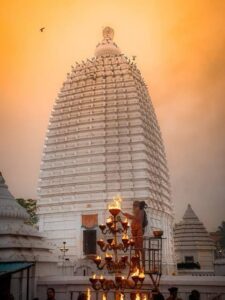
He debated learned scholars at the Puri Temple’s Mukti Mandapa Sabha. Surviving solely on water, he came to be known as Nirahari Baba. Rejecting elaborate rituals, he emphasized direct communion with the formless divine. Later, he retreated to Kapilas Hill in Dhenkanal district for 24 years of intense meditation, clad in the bark of the Kumbhi tree. For the first twelve years, he subsisted on wild forest fruits; during the next twelve, he lived on milk supplied by Raja Bhagirathi Mahendra Bahadur of Dhenkanal.
During this period of seclusion, Mahima Swami initiated his first disciple, Jagannath from Balasingha in Boudh, who renounced worldly ties and became Govinda Das Baba, the foremost of the 64 siddhas (perfected ascetics), titled Abadhutas. Mahima Swami’s teachings spread rapidly across Cuttack, Puri, Ganjam, and feudatory states such as Dhenkanal, Athagarh, Hindol, Boudh, Sonepur, Sambalpur, and Angul. He attracted disciples especially from tribal communities, Scheduled Castes, and lower castes, drawn by his miraculous powers.
He established places of worship called Alekha Tungi or ashrams for propagation. In 1874, he returned to his headquarters at Mahima Gadi in Dhenkanal. On the 14th day of the bright fortnight of Phalguna (February–March 1876), he voluntarily shed his mortal body, merging into the absolute void.
The philosophy of Mahima Dharma draws deeply from Upanishadic Absolute Monism-Brahman or Shunya-Brahman – viewing ultimate reality as one formless, omnipresent essence beyond attributes. True worship involves withdrawing from multiplicity to realize this singular essence, as poetically expressed by Bhima Bhoi. The movement synthesizes opposites: Brahmanism and anti-Brahmanism, Eastern and Western influences, Hinduism and Islam, while preserving core Indian spiritual traditions in a harmonious, unique form.
Followers adhere to strict Guruagnya (rules from the guru), including severe discipline of body, mind, and soul; celibacy; vegetarianism; and abstinence from intoxicants and violence. Prayers occur twice daily under the open sky; at dawn (Brahma muhurta) and dusk (Darshana). In the morning prayer, devotees raise their hands overhead, prostrate, and chant Alekh’s glory seven times; in the evening, they repeat it five times. Food is taken in moderation, with no water consumed from sunset to sunrise, a practice aligned with scriptural wisdom for health and austerity.Rituals are minimal: no idol worship, blood sacrifices, spirit beliefs, or deities. This rejection extended to challenging mainstream practices.
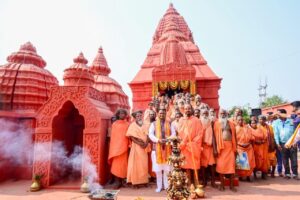
After his departure from the mortal world, followers divided into sects: Kumbhipatias (bark-clad ascetics), Kanapatias (rag-wearing mendicants with matted hair, sticks, and palm-leaf parasols), and Ashritas (householders in red kasa or Gairikabasana, akin to Brahmacharis or Jogis).
The movement’s poet-prophet, Bhima Bhoi (c. 1850–1895), the world-famous saint, mystic, and social reformer, became its most influential voice. Born into poverty, he faced immense hardships but was miraculously blessed by Mahima Swami, who reportedly restored his sight and poetic gift. Though visually impaired, Bhima Bhoi composed profound works such as Stuti Chintamani, Bhajanamala, Nirveda Sadhana, Poorna Samhita, Shunya Rahas, Adi Samhita, Nirgun Mahatmya, and Bhabisya Gupta Malika.
His poetry echoes Mahima teachings with radical empathy for suffering. His immortal lines capture selfless compassion: “Praninka Arata Dukha Apramita, Dekhu Dekhu Ke Ba Sahu, Mo Jibana Pachhe Narke Padithau, Jagata Uddhara Heu.” (Boundless is the anguish and misery of living beings; who can bear to see it? Let my soul fall into hell, but let the universe be redeemed.)
Bhima Bhoi’s bhajans and jananas remain beloved among rural folk, championing a casteless, classless society free from exploitation. He challenged the prevailing social ethos, promoting kindness to all beings including birds, animals, and insects as well as universal brotherhood, non-violence, peaceful coexistence, and freedom from greed.
The faith drew followers from Odisha’s tribes and Scheduled Castes, extending to Andhra Pradesh, Assam, Bengal, Bihar, and Madhya Pradesh. Today, it has a global reach, with devotees in Europe and beyond.
The spiritual heart of the movement is Mahima Gadi at Joranda, spanning over 100 acres and featuring key temples: Gadi Mandira, Dhuni Mandira, Sunya Mandira, and Niti Upasana Mandira. No idols adorn these spaces; worship focuses on the formless Alekh.
Mahima Dharma transcends conventional religion. It is a reformation movement, a way of life, and a code of conduct emphasizing equality, simplicity, and spiritual purity. In an era of division, it offered a vision of unity and compassion that continues to inspire Odisha and beyond proving that profound change often arises from the margins, voiced by saints like Mahima Swami and Bhima Bhoi.
 Bishnupada Sethi, IAS
The author serves as the Chairman of the Odisha Forest Development Corporation (OFDC) and continues as the Chief Administrator of the KBK districts.