

The Rajya Sabha election in India remains one of the most significant and often under-analysed processes in the country’s parliamentary democracy. Unlike the Lok Sabha elections, which involve direct public voting, Rajya Sabha elections are shaped by party arithmetic, political strategy, coalition building, and careful leadership calculations within state legislatures. The 2026 Rajya Sabha election from Odisha provides a compelling case study—especially in understanding how Naveen Patnaik and the Biju Janata Dal (BJD) have used the process to advance both political and governance narratives.
I. Understanding Rajya Sabha Elections in India

The Rajya Sabha, or Council of States, is the upper house of India’s Parliament. Its members are elected indirectly by the elected members of State Legislative Assemblies through the system of proportional representation using the single transferable vote. Each state’s strength in the Assembly largely determines the outcome of Rajya Sabha contests, making them deeply political rather than mass electoral exercises.
Because the Rajya Sabha acts as a reviewing chamber and represents federal interests, parties often nominate individuals who bring administrative experience, subject expertise, regional representation, or political loyalty rather than electoral mass appeal.
II. Odisha’s Rajya Sabha Election 2026: Political Context
In 2026, four Rajya Sabha seats from Odisha fell vacant following the completion of terms of MPs from both the BJP and BJD.
The political arithmetic of the Odisha Assembly made the contest particularly interesting:
- The BJP had sufficient numbers to secure two seats comfortably.
- The BJD was well-placed to win at least one seat outright.
- The fourth seat became politically decisive and symbolic.
This arithmetic shaped Naveen Patnaik’s strategy and ultimately influenced the choice of candidates.
III. Naveen Patnaik’s Choice: Candidates from Odisha
1. Santrupt Mishra: Party Strategist with Corporate Background
Naveen Patnaik nominated Santrupt Mishra as the BJD’s official candidate for one of the Rajya Sabha seats.
Santrupt Mishra is known as a corporate leader-turned-politician who joined the BJD before the 2024 Lok Sabha elections and contested from Cuttack.
His nomination reflected several strategic calculations:
Technocratic representation: Mishra’s corporate experience aligns with Naveen’s governance-focused political narrative.
Urban middle-class outreach: His profile appeals to aspirational voters beyond traditional party cadres.
Loyalty and adaptability: His relatively recent but prominent role in the party suggests a preference for adaptable leadership within BJD.
Given the Assembly numbers, Mishra’s election was considered almost certain.
2. Dr. Datteswar Hota: The “Common Candidate”
Naveen Patnaik’s second and more politically symbolic choice was Dr. Datteswar Hota, projected as a “common candidate.”
Dr. Hota is a renowned urologist and academician who:
- served as the first Vice-Chancellor of Odisha University of Health Sciences,
- was earlier Principal of SCB Medical College and Hospital,
- played a key role in initiating kidney transplant programmes at SCB.
Naveen publicly appealed for cross-party support for Hota, presenting him as a non-political, consensus-oriented nominee.
This choice demonstrated:
- an effort to project politics beyond partisanship,
- a commitment to sending domain experts to Parliament,
- and a tactical move to build temporary alliances in a changing political environment.
IV. Why Naveen Patnaik Chose These Candidates
Naveen Patnaik’s selections appear guided by a combination of governance logic and political strategy:
Balancing technocracy and neutrality: Mishra represents managerial governance, while Hota embodies professional expertise.
Reinforcing BJD’s image: The nominations align with Naveen’s long-standing brand of “clean politics” and non-confrontational governance.
Legislative arithmetic: With BJD and Congress MLAs together crossing the required number of first-preference votes (62 against the required 60), both candidates were well positioned to win.
Signalling flexibility: The alliance with Congress marked a notable shift in strategy compared to earlier elections when BJD often supported NDA nominees.
V. Role of Congress and the Left: Support for Naveen’s Choices
The Odisha Congress openly backed Dr. Hota’s candidature.
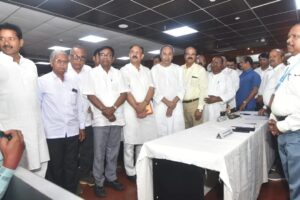
At the time of nomination filing, senior Congress leaders—including PCC president Bhakta Charan Das—stood alongside Naveen Patnaik, reflecting political coordination.
Congress leaders described Hota’s candidature as a “historic step” symbolizing unity among progressive forces.
While the communist parties in Odisha hold limited legislative strength, they broadly supported the consensus candidature, aligning with the idea of sending a professional and non-controversial figure to the Rajya Sabha.
This cooperation illustrated:
- a tactical convergence among opposition forces,
- an attempt to counter BJP dominance in national politics,
- and Odisha-specific political pragmatism.
VI. Political Reactions and Controversies
The nominations also triggered dissent within BJD ranks. Former MLA Pravat Ranjan Biswal publicly criticised the selections, arguing that long-time party workers were overlooked; he was later expelled for indiscipline.
This episode highlighted tensions between organisational loyalty and Naveen’s preference for meritocratic nominations.
VII. Key Candidates
Santrupt Mishra
Santrupt Mishra is a senior BJD leader and former corporate executive who entered active politics before the 2024 Lok Sabha elections. His Rajya Sabha nomination reflects Naveen Patnaik’s preference for professionals capable of policy engagement at the national level.
Dr. Datteswar Hota
Dr. Hota is an eminent medical academician and administrator. As the first Vice-Chancellor of OUHS and former SCB Medical College principal, he symbolizes the entry of domain experts into parliamentary politics.
Conclusion
The Rajya Sabha election in Odisha in 2026 underscores how upper-house contests often serve as laboratories for strategic experimentation in Indian politics. Naveen Patnaik’s choices—Santrupt Mishra and Dr. Dattatreya Hota—reflect a careful blend of technocratic governance, consensus-building politics, and legislative arithmetic.
The support extended by Congress and Left forces reveals the fluidity of state-level alliances and the enduring relevance of negotiation in parliamentary democracy. Ultimately, the Odisha Rajya Sabha election stands as a reminder that even indirect elections carry significant political meaning—often revealing deeper trends than direct electoral contests.