

After capturing photos of 350 bird species from every corner of Odisha in my camera, I sat down to write my book, “Birds of Odisha.” The biggest challenge before me was: which bird deserves to be on the cover? I had many beautiful and colourful bird’s photos, but the cover of the first-ever book on Odisha’s birds had to feature a species that truly represents the state—a bird that instantly signals, “This is Odisha!”
My heart went to the exquisite beauty of my own district: the Mangrove Pitta (Pitta megarhyncha). In Odia, we call it Hentalabana Nabarangi (The Nine-Coloured bird of the Mangroves) because its feathers are adorned with nine distinct colours.

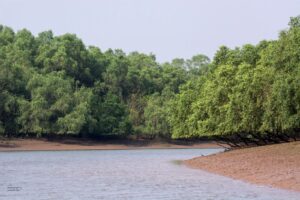
The Mangrove Pitta is found in the coastal mangrove forests of India. Because these forests are its only habitat, it is seen in the Sundarbans and the Bhitarkanika Sanctuary. However, photographers from all over India flock to our Bhitarkanika. In the West Bengal Sundarbans, trekking through the mangroves to photograph the Pitta is nearly impossible due to the presence of Royal Bengal Tigers and the lack of footpaths.
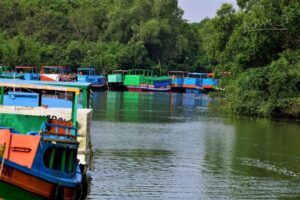
In contrast, Bhitarkanika’s favourable environment, well-maintained trekking tracks, and organized tourism management make it easier to photograph this shy bird. Consequently, bird lovers crowd Bhitarkanika; it is the only place in the country where the Mangrove Pitta is reliably documented through photography.
Interestingly, until 2007, there was no official photographic documentation of this rare bird from any habitat in India. It was Dr. Gopi G.V. and Dr. Bivash Pandav who first documented this bird as a common breeding resident of Bhitarkanika in a 2007 publication.
Before this, legendary ornithologists like Salim Ali, Dillon Ripley, Grimmett, Rasmussen, and Kazmierczak had only reported sightings from a few places in Bangladesh. In the “Handbook of the Birds of India and Pakistan,” Salim Ali and Ripley noted it as a highly migratory bird, with only one record from the Barisal region of East Pakistan (1925). While there are mentions of photographic records from the Sundarbans in the Indian Birds Journal, no one has successfully photographed it there in the last decade. Today, it is mostly the photos from our Bhitarkanika that circulate across the internet.
Capturing a perfect shot of this bird was no easy feat. I had photographed it before, but for the book cover, I wanted a high-quality, eye-level close-up. On February 27, 2016, amidst a light drizzle, I was walking along the mangrove trails. The area was quiet as other photographers had stayed back due to the rain.
After lunch, around 1:00 PM, my eyes were scanning the thickets for this “fairy.” Suddenly, I spotted her—about 20 feet to my left, sitting motionless near a muddy root. She was focused on a crab in the receding tide; I was focused on her. I knelt in the mud and crawled slowly, hiding behind trees to click countless photos. Photographers are greedy; we keep clicking until the bird flies away!
As I walked back in high spirits, I realized that just a short distance away, an eight-foot crocodile was basking near the mouth of a creek. In a panic, I scrambled through the mud to safety. That day, I realized how close danger lurks when you are intoxicated by the beauty of birds!
The Mangrove Pitta is arguably one of India’s most beautiful birds. It has a deep green back, a crown of deep yellow, and vibrant blue wing patches. Its vent (under-tail) is a brilliant red. Its scientific name, Pitta megarhyncha, comes from “rhynchos” (beak) and “mega” (large), as it has a larger beak than other Pitta species.
- Diet: It is a non-migratory resident that feeds on crustaceans, mollusks, crabs, and insects.
- Breeding: The season lasts from April to August. During this time, their two-note “whee-whee” call echoes through the dense mangroves, signalling their presence to photographers.
- Bio-indicator: The presence and population of these birds serve as a bio-indicator of the health of the mangrove ecosystem.
The IUCN has categorized this species as “Near Threatened.” According to Forest Department sources, the first-ever census of Mangrove Pittas in Odisha’s coastal districts (mainly Kendrapara and Jagatsinghpur) recorded a total of 179 birds. The highest concentration was found in the mangroves near the Mahipura river mouth within Bhitarkanika National Park. There is still a lack of basic ecological research on the Mangrove Pitta. We need more studies on their population and behaviour to aid in their conservation. This bird is the pride and symbol of Kendrapada.
This “Beauty of the Mangroves” has not only graced the cover of my book, “Birds of Odisha,” but has also played a significant role in drawing tourists from across the country to my beloved Odisha.
 Pramod Dhal
He is best described as a social commentator, grassroots observer and an author and social critic whose commentary focuses on judicial integrity, administrative reform, and the protection of the common citizen’s rights. A dynamic wildlife photographer who has made significant contributions to avian conservation with the book, “The Birds of Orissa: A Pictorial Encyclopedia” that got him the Sambad Parivesh Samman Award. He is from Kendrapara district of Odisha and can be contacted on +91.7008810112. [Views are personal]