

In the rolling hills and dense forests of eastern India, where the states of Jharkhand, Bihar, West Bengal, and Odisha now meet today, there lived a people whose courage would leave an indelible mark on the nation’s struggle for justice. The Santhals, one of India’s largest tribal communities, were traditionally peaceful farmers, hunters, and forest dwellers. They lived in harmony with nature, revering their guardian spirit Thakur Bonga, and holding their land as sacred. Yet, in the mid-19th century, British colonial policies and local exploiters shattered their peaceful existence, igniting one of the most inspiring uprisings in Indian history: the Santhal Hul of 1855-56.
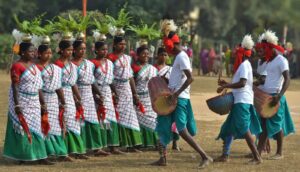
The Santhals had migrated to the Rajmahal Hills region, known as Damin-i-Koh, in the early 19th century, encouraged by the British to clear forests for agriculture. They transformed barren lands into fertile fields through hard work and community effort. But the Permanent Settlement of 1793 changed everything. It empowered zamindars with revenue collection rights, turning tribal lands into estates ripe for exploitation. Absentee landlords imposed huge rents, illegal cesses, and forced labor. Moneylenders, often called mahajans or dikus trapped Santhals in vicious debt cycles with interest rates soaring from 50% to an unbelievable 500%. When debts mounted, lands were seized, families evicted, and many forced into bonded labor.

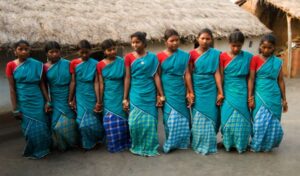
Worse still, British courts sided with the exploiters. Complaints of cattle theft, unpaid wages on indigo plantations and railway projects, violence against women including abductions and assaults went unheeded. The officials turned a blind eye. By the 1850s, despair turned to simmering anger. Sporadic acts of resistance emerged: village leaders voiced grievances, and figures like Bir Singh Parganait targeted oppressors. But the true spark came from a divine call.
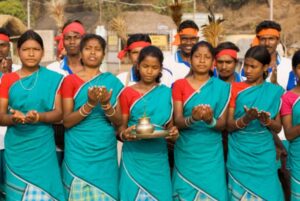
In 1855, brothers Sidhu and Kanhu Murmu, along with their siblings Chand, Bhairav, and sisters Phulo and Jhano, received visions from Thakur Bonga. The spirit appeared in symbolic forms i.e., a flame, a book, white paper, a knife, and a cart wheel, commanding them to expel the dikus and British beyond the Ganga River, restoring Santhal self-rule. This religious framing transformed economic fury into a sacred crusade, uniting villages. Secret messages spread via sal tree branches, and a mud shrine with a cart wheel became a site for offerings and sacrifices.
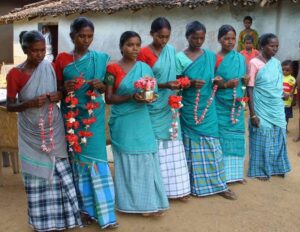
On June 30, 1855, at Bhognadih village, now in Sahibgan district, Jharkhand, Sidhu and Kanhu rallied around 10,000 Santhals while estimates suggest up to 60,000 joined overall. They declared the Hul (revolution in Santhali), formed a parallel government, collected taxes, enforced laws, and planned a march to Kolkata to petition the authorities. Processions swelled with men, women, children, drummers, musicians, and leaders on horses, elephants, and palkis. Armed primarily with bows, arrows, spears, axes, and farm tools, they embodied raw determination.
Violence erupted quickly. Police intercepted them, leading to clashes. In one incident, Daroga Maheshlal Dutta and his men threatened arrest; rebels beheaded him. Elsewhere, five notorious moneylenders, including the infamous Dindayal Roy, were killed at Barhati Bazar. Santhal bands of 1,500 to 2,000, guided by drum signals, launched guerrilla raids on moneylenders, zamindars, police stations, railway sites, postal routes, and government offices. They burned debt records, disrupted communications, and briefly established self-rule in pockets. Early victories stunned the British.
What made the Santhals truly remarkable was their bravery against overwhelming odds. Armed with primitive weapons, they faced firearms, artillery, and trained soldiers. British officers recorded scenes of astonishing heroism i.e., warriors standing firm as drums echoed, refusing to flee under volleys, regrouping calmly after retreats, and launching arrow volleys that felled soldiers. In one poignant account, 45 Santhals defended a mud hut; after relentless firing, only an old man remained, charging with his axe before falling. Major Jervis admitted shame at such steadfastness, noting no sepoy felt pride facing such calm defiance.
The British, initially underestimating the uprising, responded with ferocity. Troops under Brigadier General Lloyd and Special Commissioner A.C. Bidwell poured in. A public warning demanded surrender on August 15, 1855. Martial law was imposed from November 10, 1855, to January 3, 1856. Villages were burned, crops destroyed, and suppression tactics included mass killings and starvation as farming halted. Sidhu was betrayed and hanged in August 1855; Kanhu was captured and executed on February 23, 1856.
The Hul raged for six months, ending by early 1856. Casualties were devastating: estimates range from 15,000 to 20,000 Santhals killed, many from bullets, disease, hunger, and malnutrition in makeshift camps. Thousands were displaced, villages razed. British losses, though lower, were notable in early battles.
Though crushed, the rebellion’s impact was profound. It laid bare the horrors of colonial and zamindari exploitation, forcing reforms. The British created the Santhal Parganas district as a non-regulation area, granting special autonomy. Laws like the Sonthal Parganas Act curbed diku land transfers, protected tribal rights, and empowered village heads. Later, the Bengal Tenancy Act of 1885 addressed broader landlord abuses. These measures, while imperfect, acknowledged tribal distinctiveness and curbed some excesses.
The legacy of the Santhals endures as a beacon of resistance. The Hul inspired later tribal movements, including Birsa Munda’s Ulgulan, and fueled anti-colonial consciousness. Scholars have highlighted it as a landmark in subaltern history. Today, Santhals celebrate Hul Diwas every June 30, honoring Sidhu, Kanhu, and martyrs with songs, dances, dramas, and poems. In Jharkhand and beyond, tributes flow in cultural programs, folk performances, and commemorations in places like Dumka, Sahibganj, and Deoghar. Statues and memorials stand as reminders of their sacrifice.
The Santhals were not mere rebels; they were defenders of dignity. From harmonious farmers to fearless warriors, they mobilized tens of thousands, confronted an empire with traditional arms, and displayed suicidal bravery in hopeless stands. Their Hul proved that even the most marginalized could challenge tyranny, asserting indigenous rights, unity, and resilience. In an era of exploitation, the brave tribals of India showed the world that courage knows no bounds and their spirit continues to inspire fights for justice everywhere.
 Bishnupada Sethi, IAS
The author serves as the Chairman of the Odisha Forest Development Corporation (OFDC) and continues as the Chief Administrator of the KBK districts.