

The total budget expenditure of the Ministry of Panchayati Raj for the 2022-23 financial year was ₹868.57 crores. Perhaps for this reason, the election expenses of a Sarpanch candidate at the Panchayat level have increased tremendously nowadays; it is difficult to win an election without spending an average of ₹25 to ₹30 lakhs. However, immediately after independence, when the Panchayati Raj system began in Odisha, candidates did not have to spend a single penny. Instead, the common people would approach a suitable candidate and request them to take on this responsibility.
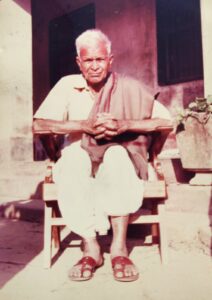
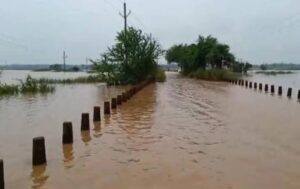
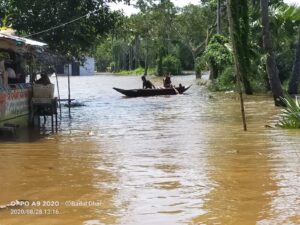
A shining example of this was the late Sreeram Chandra Dhal, the first and last Sarpanch of the undivided Dimiripal Gram Panchayat. This panchayat, consisting of seven villages under the Aali Tehsil (then in Cuttack district, now in Kendrapada), is known as a Dhoya (flood-prone) area and was perpetually neglected and ravaged by floods. He served the people continuously from 1952 to 1990.

When the Aali Dhoya region was oppressed under British and Zamindari rule, and the people were rendered helpless and persecuted—falling prey to illiteracy and superstition while losing their freedom of speech—Sreeram Chandra Dhal was born on June 6, 1906 (the 6th day of the month of Jyeshtha). He was the son of Chakradhar Dhal and Sudhala Devi of Argal, illuminating that neglected and dark environment. As the saying goes, “Tulsi smells sweet from two leaves” (greatness shows early), the young Sreeram displayed extraordinary courage by protesting against the inhuman atrocities of the British police and local Zamindars, providing relief to the people.
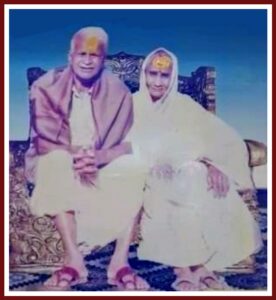
During the Great Famine (Na’anka Durbhikshya), his father gave paddy from his own granary to the people and built roads. The road from Argal to Maharakul was known as the “Famine Road,” which is now recognized as a Pradhan Mantri Gram Sadak. Inspired by his father’s social service, Sreeram dedicated his entire life to the service of society.
In 1942, Sreeram played a heroic role by sheltering his brother-in-law, Padmalava Ray, who was wanted by British police for the arson of the Jajpur Town post office. When the police learned of the Argal hideout and mobilized a four-boat raid during a massive flood, Sreeram and his brother Nidhiram acted swiftly. They smuggled Mr. Ray to Chandabali in a local boat under the shroud of night, allowing him to escape to Calcutta. Mr. Ray remained there until 1948 and eventually became Jajpur’s first post-independence MLA.
The Evolution of Local Governance
Local administration through the people is not a new concept; its origins date back to ancient times. In ancient days, five experienced members of a village were elected to form a Gram Panchayat. They made decisions on various constructive works and resolved local disputes. After independence, the government revived the idea of rural local self-government. Based on the recommendations of the Balwant Rai Mehta Committee, the government decided to grant more power, funds, and responsibility to villages for the Gram Panchayat scheme and its developmental programs.
The main objective of establishing Gram Panchayats was the decentralization of power based on democratic principles and the direct participation of rural people in the local administrative system. The Odisha Gram Panchayat Act was enacted in 1948, marking the beginning of Panchayats in Odisha. Mahatma Gandhi envisioned Gram Swaraj through Panchayati Raj; hence, Jawaharlal Nehru inaugurated the first Panchayat at Nagaur, Rajasthan, on October 2, 1952.
During that time, the Chief Minister of Odisha, Shri Nabakrushna Choudhury, made an innovative effort through the “Anchal Shasan Constitution” and created an “Anchal Fund” under the Odisha Estate Abolition Act of 1951. The Anchal Shasan Act of 1955 was intended to give full powers to the regions, enabling villagers to play a visible role in education, agriculture, cottage industries, and public health systems. Subsequently, the three-tier system of Panchayati Raj institutions was introduced in Odisha in 1961.
The Era of Dimiripal Gram Panchayat
In 1952, the “Dimiripal Gram Panchayat” was formed, comprising seven villages of the Aali Dhoya region: Manpur, Dimiripal, Madhuban, Maharakul, Sanagiri, Argal Shasan, and Argal. At that time, there were no roads connecting the villages. Nevertheless, hundreds of common people from all villages crossed fields to gather in front of Chakradhar Dhal’s house, insisting on nominating his son, Sreeram Chandra Dhal, as the first Sarpanch of the newly formed Dimiripal Panchayat. Ultimately, that is what happened.
Sreeram Chandra Dhal became the first nominated Sarpanch. Back then, the scope of a Gram Panchayat’s work included sanitation, roads, wells, schools, maintenance of burial grounds, and the responsibility of resolving small disputes among the people.
During his long tenure, people from Aali, Pattamundai, Bari, and Jajpur would invite him to seek justice. His “magical touch” was evident in every field—education, communication, agriculture, and irrigation—across 20 to 25 local villages. To bridge the “Bada Mahara,” a river-like obstacle to communication in his own village of Argal and Argal Shasan, he did not wait for government aid. He called upon thousands of people who carried earth on their heads to build embankments and ponds—structures that would be impossible to build for even a crore of rupees today. He was the first and last Sarpanch to build bamboo bridges over 15–20 canals using a system of “one bamboo and one labourer per household.”
He was a dynamic hero. At his call, thousands of people—regardless of wealth or caste—would gather for any public-oriented work. During his long tenure, Middle English (M.E.) schools were established in every village. Transforming the Lower Primary school of his village, Argal, into an Upper Primary and then a High School was another example of his achievement. Despite being the village head and Sarpanch, he found immense joy in building the mud walls of the school with his own hands, planting trees, and cleaning waste.
He played a major role in highlighting the plight of the Dhoya region through protests, from the district headquarters to the Legislative Assembly. In those days, almost no government money came to the Gram Panchayat, yet he successfully built roads and ponds with the cooperation of the villagers. During natural calamities like floods, cyclones, and droughts, he would begin relief work in Dalit settlements first; consequently, Dalits from every village were his staunchest supporters. To combat perennial flooding, he was an active member of the Brahmani-Kharsrota Flood Protection Committee from Jenapur to Manpur.
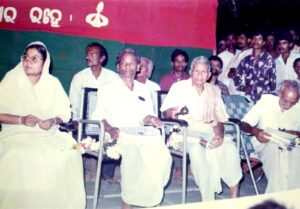
Political Popularity and Legacy
When the election process was first implemented in 1961, he was elected as an unopposed Sarpanch. Later, Mr. Dhal was elected by the people in general elections for three consecutive terms. Around 1970, a law was introduced stating that a person could not contest more than three consecutive times. Therefore, many people from various villages reached his house and requested his younger brother, the late Nidhiram Dhal, to contest. In the 1970 election, Nidhiram Dhal was elected Sarpanch with a large number of votes. This reflects the immense popularity of Sreeram Chandra Dhal.
One of the most notable steps was the leadership of both brothers in the Flood Control Committee of the Bari, Binjharpur, and Aali Dhoya regions. In the 1960s, a flood prevention committee was formed from Jenapur in Dharmasala to Manpur in Aali block, and meetings were held in every village. Both participated actively for many years. Along with the Dhal brothers, other active leaders included Shri Ganeswar Mohanty (Pattamundai), Shri Basudev Samal (Bari), Shri Rudra Samal (Angalo), Achyuti Samal (Arilo), Shri Arta Dhal (Binjharpur), and Shri Ramesh Samal (Dharmasala). Following this movement, the Chief Minister himself came in 1962 and directed Shri Sailendra Narayan Bhanja Deo to prepare a report for flood control. His report proposed the “Madanpur-Rampur Cut” and “Kalasapur Cut.” Although these were not fulfilled due to political reasons, flood control was eventually achieved through the strengthening of the Brahmani and Kharsrota embankments and the Rengali Project.
Two letters written by Shri Surendranath Dwivedy (then Deputy Chairman of the Odisha State Planning Board) to Sreeram’s younger brother, Nidhiram Dhal (Letter No. 40 SPB, dated 06/09/1973 and Letter No. 640 SPB, dated 08/11/1973), provide evidence of the communication and cooperation between the government and rural representatives, as well as the Sarpanch’s dedication to the region.
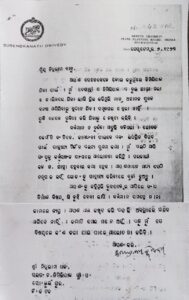
First Letter:
“Dear Nidhiram Babu, You were insisting on going to Dimiripal at that time. I had decided to go to Desahi and Dimiripal on the 5th, but it was not possible due to sudden heavy floods. *** I told you to look into the embankment construction when you come to Bhubaneswar ** You should not take the trouble to come in such a condition. I remember the matter. Therefore, I will discuss what can be done regarding it.” — Yours, (Surendranath Dwivedy)
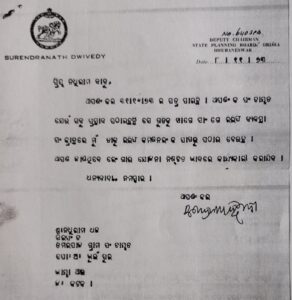
Second Letter:
“Dear Nidhiram Babu, I have received your letter dated 31/10/73. I have immediately forwarded the proposals sent by your Panchayat regarding relief measures to the Relief Commissioner. You must be knowing that the Rengali project will definitely be implemented. Thank you. Namaskar.” — Yours, (Surendranath Dwivedy)
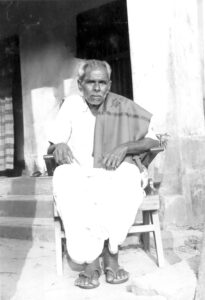
After his younger brother’s tenure, Sreeram Chandra Dhal won the elections again at the public’s request and served continuously until 1990. He contested for the last time in 1990, winning by a huge margin to serve as the last Sarpanch of the undivided Dimiripal Panchayat. In Odisha, and especially in Kendrapada, there may be no other personality who has served the people as an elected Sarpanch for such a long period of nearly 38 years. He was rare. Today, however, he is just a forgotten face in the history of Kendrapada!
In 1991, Dimiripal Panchayat was divided into three separate Panchayats: Argal, Dimiripal, and Bhuinpur. Due to declining health with age, his children prevented him from contesting again, despite public requests. For his strong contribution to social service, he was honored as the best social worker of the region by the Speaker of the Lok Sabha, Shri Rabi Ray, on behalf of the Kharsrota Cultural Council on March 9, 1991. He was also honored as the best social worker by the Sarat Kumar Deb Memorial Committee on March 15, 1995.
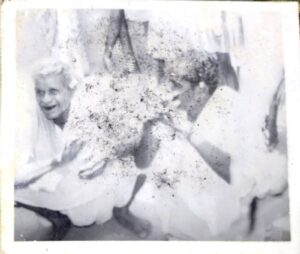
At the age of 94, on November 14, 2000, this forgotten leader passed away. Thousands of mourning people offered floral tributes at his funeral procession, and the enthusiastic slogans of “Sreeram Babu Amar Rahe” (Long live Sreeram Babu) proved the popularity of his active life. May his ideals be a lesson for others. May God grant eternal peace to his departed soul.
 Gopinath Panda
The writer is a retired Headmaster Nrusingha Jiu A.D.M. High School Argal, Aali, Kendrapada – 755061. Phone: +91.9668859908