

Every year, during the sacred return journey of Lords in Puri, an extraordinary moment unfolds i.e., the grand chariot of Lord Jagannath (Nandighosha) rolling majestically along the Grand Road, suddenly comes to a halt near a place called Balagandi. Thousands of devotees pulling its ropes with fervour, priests chanting mantras to the music of drums, watch for a while as the colossal wheels halt there. The pause is not mechanical, it is symbolically spiritual. The chariot stands still until a silent homage is paid at the samadhi of a 17th-century Muslim devotee. Everyone in the Odisha would have heard about Bhakta Kavi Salabeg.
This is not merely a tale preserved in folklore. It is a living tradition, witnessed even today, more than four centuries after Salabeg’s birth in 1592 AD. In an age often marked by division and conflicts of identities, his life remains one of Odisha’s most powerful reminders that true devotion transcends boundaries of religion, caste, and birth. Salabeg affirms the existence of God who is the cause and purpose of everything in the universe.

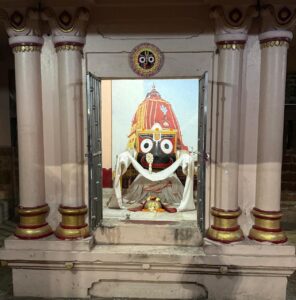
Salabeg’s story begins in paradox. He was born to Lal Beg, also known as Jahangir Quli Khan, a Mughal military officer under Emperor Jahangir, and Lalita, a Brahmin widow who was abducted and forcibly married. His very existence symbolised the intersection of two vastly different worlds: Mughal mighty authority and deeply rooted Odia Hindu spirituality. Raised as a Muslim and trained as a warrior, Salabeg initially followed his father’s path, participating in military expeditions with courage and discipline. Yet destiny intervened dramatically. During one such battle, he was grievously wounded. Despite all available medical treatment, his condition did not improve, pushing him into despair and helplessness.
It was at this turning point that his mother revealed her past; her Brahmin heritage and her lifelong devotion to Lord Krishna. She urged her son to surrender to Krishna, whom she described as Vrindavana Chandra, the divine healer and protector. Initially hesitant due to his religious upbringing, Salabeg eventually yielded to his mother’s faith.
For twelve days, he prayed with complete surrender. What followed is remembered as a moment of divine grace: Krishna appeared to him in a dream and miraculously healed his wounds. This transformative experience changed the course of his life forever. The soldier laid down his sword and took up the path of devotion.
Renouncing worldly ambitions, Salabeg dedicated himself entirely to spiritual pursuit. He travelled to Vrindavan, immersing himself in Krishna bhakti, and later journeyed to Puri, drawn irresistibly to Lord Jagannath, whom he perceived as Krishna himself.
Yet, upon reaching the sacred city, he encountered a painful contradiction that reflected the social realities of the time. The Jagannath Temple, like many major temples in pre-modern India, followed strict entry norms rooted in notions of ritual purity. These rules historically barred not only non-Hindus but also many communities considered “untouchable” within the caste hierarchy from entering the temple. In this context, Salabeg being Muslim by birth was denied entry into the temple.
This exclusion, though part of a broader social practice, became deeply personal for Salabeg. A devotee of profound sincerity found himself physically separated from the very Lord he adored. Yet, instead of anger, he chose surrender. Calling himself a “low-born yavana,” he accepted his condition with humility and transformed his pain into devotion.
Salabeg emerged as one of Odisha’s greatest devotional poets, composing several bhajans in languages such as Odia, Sanskrit, Hindi, Bengali, and Brajbuli. His poetry is suffused with viraha (the pain of separation), dainya bhava (deep humility), and total surrender. In compositions like “Ahe Nila Saila” and “Jagabandhu He Gosain,” he addresses Lord Jagannath with intimate longing. He pleads not as a scholar or saint, but as a fallen soul seeking grace. His verses vividly depict Krishna’s childhood pastimes, the rasa lila, and the emotional intensity of devotion, while identifying Jagannath as that same compassionate divine presence.
What elevates Salabeg’s poetry to a unique spiritual status is the way it is experienced by devotees. His Odia bhajans are not merely sung. They are recited, remembered, and chanted like mantras. For countless devotees across Odisha, these compositions function as living prayers, invoked in moments of joy, sorrow, and spiritual yearning. The rhythmic simplicity and emotional depth of his language allow his words to transcend literature and enter the realm of lived devotion. Even today, his bhajans are sung daily within the Jagannath Temple and echoed across villages, homes, festivals, and kirtans. In many households, lines from his songs are repeated with the same reverence as sacred chants, reflecting how deeply his words have merged with the devotional consciousness of the people.
Two remarkable episodes immortalised Salabeg in Odisha’s cultural memory. The first is the enduring miracle of the Rath Yatra. While in Vrindavan, Salabeg longed to witness Lord Jagannath but feared he would not arrive in time. In desperation, he composed a heartfelt prayer asking the Lord to wait. According to tradition, during the Bahuda Yatra, the chariot stopped at Balagandi and refused to move despite all efforts until Salabeg arrived and had darshan. Only then did the chariot proceed. This event established a sacred tradition that continues uninterrupted even today.
The second miracle took place in Balasore, where Salabeg was denied entry into the Shyama Sundar Temple. It is believed that the deity disappeared from the altar and reappeared in a position visible through an opening in the wall, allowing him darshan. This act symbolised divine grace transcending human restrictions. Together, these narratives affirm a central truth: while society may impose boundaries, the divine recognises only sincerity.
Salabeg lived during a period of political unrest and religious tension. Yet his life became a bridge between communities. While institutional practices imposed restrictions, the Jagannath tradition itself has always carried an inclusive spiritual ethos, seen in practices like the sharing of Mahaprasad across caste lines. Salabeg extended this inclusivity further, demonstrating that devotion could transcend even religious identity. His poetry blended Krishna bhakti with Jagannath worship and expressed a vision of spirituality rooted in love, emotion, and surrender rather than orthodoxy.
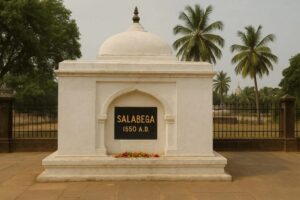
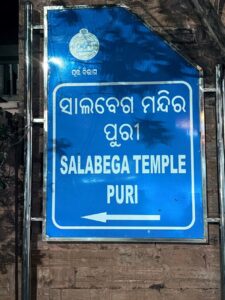
After his passing, Salabeg’s samadhi was established at Balagandi on Puri’s Grand Road. Each year, the chariot of Lord Jagannath halts near this spot, preserving a tradition that has endured for over four centuries. His influence has only deepened with time. His songs have provided solace in difficult periods, inspired cultural unity, and continue to be taught, performed, and reinterpreted across generations. Today, they are heard not only in temples and villages but also on digital platforms, reaching global audiences.
In an era where divisions often dominate public life, Salabeg’s story offers a powerful counterpoint. Denied entry into the temple, he found acceptance in the divine. Rejected by society, he became one of the most beloved voices of devotion. His life reminds us that spirituality is not defined by identity but by sincerity. His bhajans, now chanted like mantras continue to guide countless devotees toward humility, faith, and inner peace.
More than 400 years has passed, yet Salabeg remains a timeless symbol of unity and devotion showing the strength of a cultural tradition His poetry did more than praise God. It transformed devotion into an inclusive, lived experience.
As the wheels of Nandighosha pause once again at Balagandi, they carry forward a message that transcends time: true bhakti belongs to everyone. In celebrating Salabeg, Odisha honours not just a poet or saint, but the enduring truth that divine grace knows no boundaries and that the pure call of devotion, like his songs, echoes forever.
Next time, someone visits Puri, it will be worthwhile to pay tribute to the saint poet by visiting his Samadhi at Balagandi.
 Dr. Bishnupada Sethi
Dr. Sethi serves as the Chaiman of OFDC and Chief Administrator of KBK districts of Odisha.