
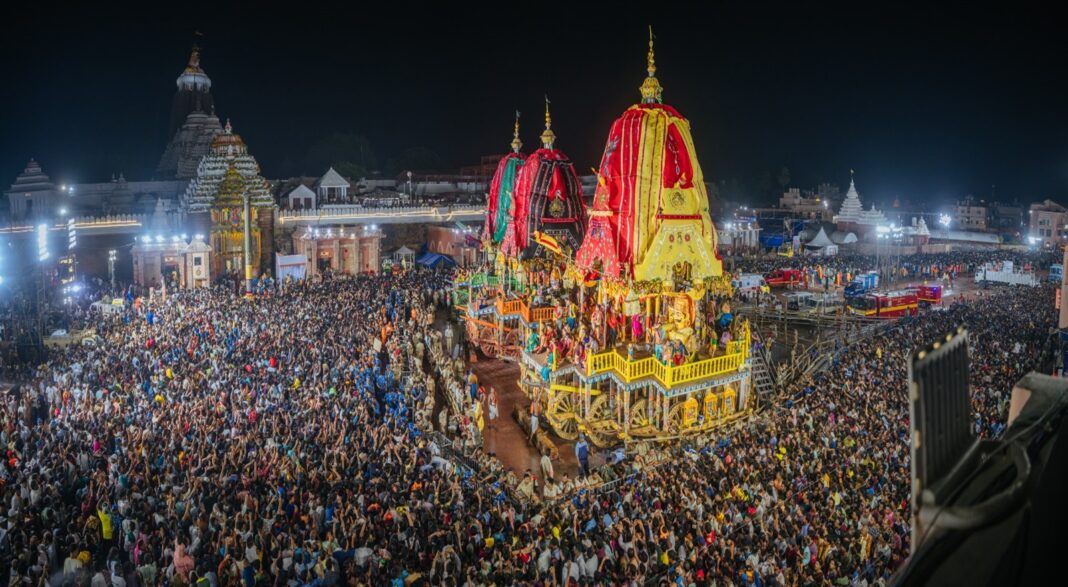
The Ratha Yatra is not merely a religious procession or a ceremonial movement of deities upon chariots. It is one of the deepest expressions of collective spiritual consciousness in Indian civilisation. The very term Yatra signifies movement, progress and transition, while Ratha symbolises the human body, society and the vehicle of destiny. Thus Ratha Yatra represents not only the journey of the Divine among humanity but also the journey of humanity towards higher consciousness. It is a union, a congregation and a sacred gathering where distinctions of caste, status, wealth and scholarship dissolve before devotion. In its ideal form, it transforms a crowd into a morally awakened community guided by noble principles, compassion and spiritual equality.
In contemporary India, the symbolic use of Rathayatra in the political sphere has also carried psychological and cultural significance. Public processions inspired by the traditional concept of Ratha Yatra have often mobilised large sections of Sanatani Hindus, awakening within them a renewed sense of identity, civilisational pride and collective responsibility. Whether analysed socially or politically, the imagery of the moving chariot possesses extraordinary emotional force because it invokes ancient memories embedded in the Indian mind — the idea that Dharma must not remain confined within temples, scriptures or philosophical debates but must move among people and participate in public life.

Yet the spiritual root of all such inspiration lies in the sacred soil of Puri where the original and most celebrated Ratha Yatra of Lord Jagannath takes place every year according to sacred tithi and nakshatra during the month of Ashadha, generally falling in June or July. The uniqueness of this festival lies in a profound theological idea rarely seen elsewhere in world religions — God Himself comes out of the sanctum to meet His devotees. In most traditions devotees travel towards the deity, but in Jagannath culture the deity travels towards the devotees. This reversal contains immense philosophical depth. It symbolises divine accessibility, compassion and democratic spirituality. Jagannath does not remain confined within temple walls or priestly exclusiveness. He emerges into the open road allowing every human being, irrespective of caste, class, religion or nationality, to behold Him.
Spiritually, the Ratha Yatra reflects the eternal relationship between the individual soul and the Supreme Consciousness. The chariot symbolises the human body, the wheels represent time and the ropes pulled collectively by thousands signify karma and collective effort. The movement of the chariot reminds humanity that life itself is a journey governed by divine will. In the Upanishadic interpretation, the body is compared to a chariot, the senses to horses, the mind to reins and the intellect to the charioteer. \text{Body = Chariot, Mind = Reins, Intellect = Charioteer} Thus the Ratha Yatra becomes a living philosophical demonstration of ancient Indian wisdom. When thousands pull the chariot together, it symbolises humanity moving collectively towards righteousness under divine guidance.
The festival also reflects a deeply familial and emotional aspect of Indian spirituality. Jagannath is not worshipped merely as a distant cosmic ruler but as a living member of the family. According to popular tradition, He travels to the Gundicha Temple, considered the house of His aunt, accompanied by His elder brother Balabhadra and sister Subhadra. This familial movement humanises divinity and creates emotional intimacy between God and devotees. The Lord comes out to understand the sufferings of His children, to mitigate their worries, to refresh Himself amidst human affection and to renew His bond with society. Such concepts make Jagannath culture remarkably humane and psychologically comforting.
Philosophically, the Ratha Yatra enacts a form of public theology in which spiritual authority is not proprietary but participatory. By bringing the deity from the sanctum into the public road, the festival declares that divine knowledge and grace are accessible to all — children, strangers, the marginalised and outsiders as much as priests and scholars. This decentralisation of sacred space transforms devotion into a shared civilisational experience. The crowd itself becomes a co creator of the ritual’s meaning through shared action, shared chanting, shared darshan and collective participation. The event also illustrates a theory of collective moral agency. Ethical progress, like the forward movement of the chariot, requires coordination, mutual trust, discipline and restraint. The Katha Upanishad’s chariot allegory finds living expression here, where thousands align their efforts under divine guidance, demonstrating that moral advancement arises not from isolated piety but from disciplined collective participation.
Scientifically and socially, the Ratha Yatra possesses several remarkable dimensions. First, it is an extraordinary example of mass management and social coordination developed centuries before modern administrative science. The construction of gigantic chariots anew every year using specified types of wood, precise measurements and traditional engineering principles demonstrates sophisticated indigenous technological knowledge. The balancing of these enormous wooden structures, their mobility without modern mechanical systems and the coordination of millions of participants reveal practical scientific understanding embedded within tradition.
From an engineering perspective, the chariots embody remarkable vernacular structural design. Every year, more than a thousand logs from multiple species of wood are transformed into thousands of carefully crafted components to build the three grand chariots — Nandighosa, Taladhwaja and Darpadalana. Traditional artisans employ mortise and tenon joinery, wooden pegs and empirically evolved proportional systems that ensure stability, flexibility and balance. The process reflects not merely craftsmanship but an inherited science of material behaviour, load distribution and structural equilibrium developed through centuries of practical experience. After the festival, much of the dismantled wood is reused in the temple kitchen and associated purposes, while afforestation initiatives attempt to replenish forest resources, highlighting the ecological dimension of the tradition.
Secondly, the festival acts as a powerful mechanism of social integration. During Ratha Yatra, social hierarchy becomes temporarily suspended. People from different backgrounds pull the same rope, chant together and participate in the same devotional atmosphere. The Gajapati King of Puri traditionally performs the Chhera Pahanra, ceremonially sweeping the chariots with a golden broom. This ritual carries immense sociological significance because it symbolises that before Jagannath all human beings are equal servants. It teaches humility in governance and equality in society.
Modern cognitive science also helps explain the extraordinary emotional force of the festival. Synchronised chanting, rhythmic pulling of the ropes, devotional music and mass participation generate collective psychological resonance. Studies in social neuroscience suggest that coordinated group activity enhances trust, emotional bonding and prosocial behaviour. The atmosphere created during Ratha Yatra therefore functions not only as a religious event but also as a large scale mechanism of emotional integration and mental catharsis. In an age increasingly marked by loneliness, anxiety and social fragmentation, such collective spiritual participation offers psychological reassurance and communal solidarity.
From the perspective of public administration and disaster management, the festival represents a highly sophisticated exercise in crowd logistics. Modern arrangements involving surveillance systems, drone monitoring, medical preparedness, sector based crowd regulation and disaster response protocols demonstrate how ancient traditions increasingly interact with contemporary governance and technology. The successful management of gatherings involving millions of devotees reveals the continued adaptability of India’s civilisational practices in the modern age.
Economically too, the Ratha Yatra sustains thousands of artisans, carpenters, painters, priests, musicians, flower sellers and small traders. Entire communities remain connected to the festival economy, demonstrating how spirituality and livelihood coexist harmoniously within Indian civilisation. The festival thus becomes not only a sacred observance but also a sustaining force for traditional occupations, hereditary craftsmanship and regional cultural economies.
At the same time, the growing globalisation of Ratha Yatra through organisations such as ISKCON and various devotional institutions has generated both appreciation and concern. On one hand, these organisations have contributed significantly to spreading awareness about Jagannath culture across India and the world. Millions who were previously unfamiliar with Lord Jagannath have come into contact with the devotional spirit of the festival through such international celebrations.
However, many traditional scholars, servitors and cultural observers believe that arbitrary alterations in ritual schedule, chariot structure, attire of the deities and ceremonial procedures may dilute the original philosophical and spiritual essence of the Jagannath tradition rooted in Puri. The Ratha Yatra of Puri is not merely a symbolic parade but a highly integrated spiritual institution governed by sacred chronology, ritual precision, theological symbolism and indigenous scientific knowledge accumulated over centuries.
In the Jagannath tradition, time itself is sacred. The observance of Ratha Yatra according to specific tithi and nakshatra forms an essential part of its spiritual coherence. When celebrations are shifted according to administrative convenience, weekend schedules or regional adjustments, critics argue that the cosmic and ritualistic harmony underlying the festival becomes weakened. Similarly, substantial modifications in the iconography of the deities, theatrical redesigning of chariots or excessive commercialisation may gradually distance the festival from its original philosophical depth and civilisational authenticity.
Jagannath culture embodies simplicity, inclusiveness, humility and collective participation rather than spectacle oriented display. The chariots of Puri are not merely decorative vehicles but sacred embodiments of metaphysical concepts linked with cosmology, social ethics and spiritual psychology. Their dimensions, colours, wheels, fabrics and construction methods possess symbolic significance evolved through generations of hereditary knowledge. Therefore many scholars emphasise that any reproduction of Ratha Yatra outside Puri should strive to preserve as much theological, ritualistic and structural authenticity as possible through consultation with traditional servitors, historians and experts of Jagannath culture.
At the same time, reasonable adaptation to local conditions may sometimes become unavoidable in different geographical and legal environments. Therefore the issue should not become one of hostility or exclusion but of responsible preservation. The challenge before modern society is to balance global dissemination with fidelity to the philosophical, spiritual and scientific integrity of the original tradition.
Philosophically, the two week festival may also be interpreted as a symbolic representation of the cycle of life itself. The outward journey signifies worldly engagement, relationships and experience, while the return journey or Bahuda Yatra symbolises the soul’s return towards its spiritual origin after completing earthly duties. In this sense the festival mirrors the eternal rhythm of departure and return that governs both human existence and cosmic order.
Ultimately, the greatness of the Ratha Yatra lies in its universal message. It teaches that divinity must not remain isolated from humanity, that society progresses only through collective effort, that humility is superior to pride and that true spirituality lies not in exclusion but in participation. The moving chariots of Jagannath therefore continue to carry not only sacred idols but also the timeless ideals of compassion, equality, unity and spiritual awakening across generations.
In the modern era, the festival may also serve as a living laboratory where ancient wisdom converges with contemporary knowledge. Sustainable forestry, preservation of traditional craftsmanship, scientific crowd management, technological safety systems and participatory governance can together strengthen the continuity of this sacred heritage. Thus the Ratha Yatra remains not merely a ritual of faith but a dynamic civilisational institution embodying spirituality, social harmony, indigenous science, ecological consciousness and the eternal aspiration of humanity towards the Divine.
 Dr. Simant Kumar Nanda
Bhubaneswar, Odisha