

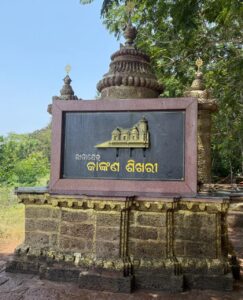
Hidden amidst the serene waters of Chilika Lake near Nairi village in Odisha, Kankana Sikhari occupies a deeply sacred and historically significant place in the spiritual geography of Jagannath culture. Though little known beyond local communities and dedicated historians, this tranquil island shrine is revered as one of the secret refuge locations where the deities of Lord Jagannath, Lord Balabhadra, Devi Subhadra, and Sudarshan were sheltered during periods of invasion and grave danger to the Puri Srimandir. More than a picturesque island, Kankana Sikhari is sanctified by sacrifice, devotion, and divine presence. It stands as a living symbol of Odisha’s spiritual resilience and the extraordinary efforts made over centuries to protect the sacred heart of Jagannath tradition.
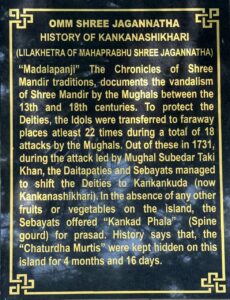
The history of Kankana Sikhari is inseparably linked with repeated attacks on the Jagannath Temple at Puri. From the medieval period onwards, the Srimandir faced successive invasions by foreign powers attracted not only by its wealth but also by its immense religious and political significance. Historical records preserved in the Madala Panji, the palm-leaf chronicle of the Jagannath Temple reveal that between the thirteenth and eighteenth centuries, the temple suffered at least eighteen major invasions. During these turbulent periods, the deities were shifted no fewer than twenty-two times to hidden locations across Odisha to save them from desecration.

One of the most important among these episodes occurred during the invasion of Odisha by Mughal Subedar Taqi Khan in 1731. As advancing forces threatened Puri, panic spread among temple authorities and devotees. The safety of the Chaturdha Murti i.e., Lord Jagannath, Balabhadra, Subhadra, and Sudarshan became the foremost concern. The responsibility of protecting the deities fell upon the Daitapati servitors, who are ritually regarded as the closest kin of Lord Jagannath and entrusted with the most intimate services of the deities.
Under the cover of darkness, the Daitapatis secretly removed the sacred idols from the temple and began a dangerous journey through hidden routes connected to Chilika Lake. Moving across rivers, marshes, and remote forested terrain, they sought a place inaccessible to invading armies. Their destination was Kankana Sikhari, an isolated island protected naturally by the vast waters of Chilika.
According to the Madala Panji, the deities remained at Kankana Sikhari for four months and sixteen days. During this period, the island ceased to be merely a remote patch of land. It became, in effect, a temporary Srikshetra, a sacred abode of Lord Jagannath himself. Every ritual associated with the deities continued despite the adverse circumstances. Temporary shrines were constructed, sacred offerings prepared, and daily worship meticulously observed by the servitors.
This uninterrupted continuation of worship is central to the spiritual importance of Kankana Sikhari. In Jagannath tradition, the physical presence of the deities sanctifies the land itself. Since Lord Jagannath resided there during one of the most critical moments in the temple’s history, the island came to be revered as a Lilakshetra, a sacred field of divine presence and memory. The holiness of Kankana Sikhari therefore does not arise merely from folklore but from its direct association with the living continuity of Jagannath worship during a period of existential threat.
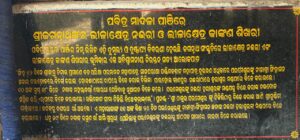
The sanctity of the island has also been acknowledged in modern times by the Jagannath Temple administration and religious authorities associated with Srimandir. In 2007, officials and representatives connected with the Puri temple visited the site to revive and reaffirm its ritual and historical linkage with Jagannath culture. The Sri Jagannatha Lilakshetra Trust has since undertaken efforts to preserve the sacred traditions of the island through regular worship, devotional programmes, and maintenance of the shrine. Informational plaques based on the Madala Panji have been installed to educate pilgrims and visitors about the island’s unique spiritual history.
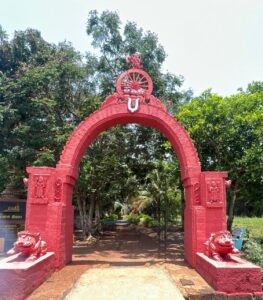
Further strengthening the sacred connection, the Shri Jagannath Temple Administration donated a wooden wheel from the Nandighosh chariot of Lord Jagannath in March 2015. The wheel is now worshipped on the island as a direct symbol of Srimandir’s spiritual association with Kankana Sikhari. Priests have been appointed, rituals institutionalised, and the island increasingly recognised as an important heritage site linked to the exile journeys of the deities.
Local traditions associated with the island further deepen its spiritual aura. During the stay of the deities, the Daitapatis and devotees reportedly struggled to procure vegetables and ritual materials in the isolated environment of Chilika. Offerings were therefore prepared using kankada or spine gourd, which grew abundantly in the area. Over time, the island acquired the name Kankana Sikhari or Kankanashikhari. This seemingly simple narrative carries profound spiritual meaning within Jagannath culture, where the Lord is believed to share the life, suffering, and simplicity of ordinary devotees.
Fresh water required for sacred rituals was brought from the nearby Jamuna-Nirjhar spring because the saline waters of Chilika could not be used for ceremonial worship. Such details reveal the remarkable dedication with which rituals were maintained even during exile. They also illustrate how geography, ecology, and spirituality became deeply intertwined in preserving Jagannath tradition.
Today, Kankana Sikhari continues to radiate an atmosphere of peace and sanctity. Surrounded by the calm waters of Chilika Lake, the island possesses a meditative silence rarely found in major pilgrimage centres. Migratory birds, natural vegetation, lake breezes, and the rhythm of devotional chants together create a sacred environment where nature itself appears to participate in worship.
One of the island’s most distinctive spiritual traditions is its floating Rath Yatra. Unlike the massive chariot procession at Puri, the deities here are ceremonially placed upon beautifully decorated interconnected boats and taken across Chilika’s waters amidst chanting, cymbals, and conch shells. The spectacle symbolically recalls the secret journeys undertaken by the deities during times of invasion while also celebrating the inseparable relationship between Jagannath culture and Odisha’s riverine and maritime landscapes.
However, the growing recognition of Kankana Sikhari also raises serious concerns regarding its future. Increased tourism and commercial interest may gradually threaten the fragile balance between spirituality and ecology that defines the island’s identity. The holiness of Kankana Sikhari lies not in grand structures or commercial activity, but in its silence, simplicity, natural surroundings, and sacred historical memory.
Any future development must therefore proceed with great caution and foresight. There is a need for a comprehensive heritage and ecological management plan that preserves both the sanctity of the island and the ecosystem of Chilika Lake. Development should remain eco-sensitive and spiritually appropriate, emphasising minimal intervention, sustainable infrastructure, regulated tourism, and preservation of natural vegetation.
Large-scale commercialisation, indiscriminate construction, pollution, and uncontrolled tourism could permanently damage the spiritual atmosphere of the island and disturb the biodiversity of Chilika. Instead, Kankana Sikhari should evolve as a contemplative spiritual destination rooted in heritage conservation and ecological harmony.
Historians and cultural scholars have increasingly advocated the inclusion of Kankana Sikhari within a broader “Jagannath Heritage Circuit” connecting the various refuge sites where the deities stayed during invasions. Such recognition would not only strengthen historical awareness but also help future generations understand the extraordinary sacrifices made to preserve Jagannath culture through centuries of adversity.
Kankana Sikhari ultimately stands as a sacred reminder of Odisha’s enduring devotion. It is a place sanctified by the physical presence of Lord Jagannath during one of the darkest periods in the history of Srimandir. The island bears silent witness to the courage of Daitapati servitors, the faith of ordinary villagers, and the collective determination of a civilisation that refused to allow its spiritual identity to perish.
Even today, the winds over Chilika seem to carry echoes of those hidden journeys, sacred chants, and whispered prayers. In preserving Kankana Sikhari, Odisha preserves not merely a shrine, but a sacred chapter of its spiritual soul.
 Dr. Bishnupada Sethi
The author is the Chairman of OFDC and Chief Administrator of KBK districts of Odisha. (Views are personal)