
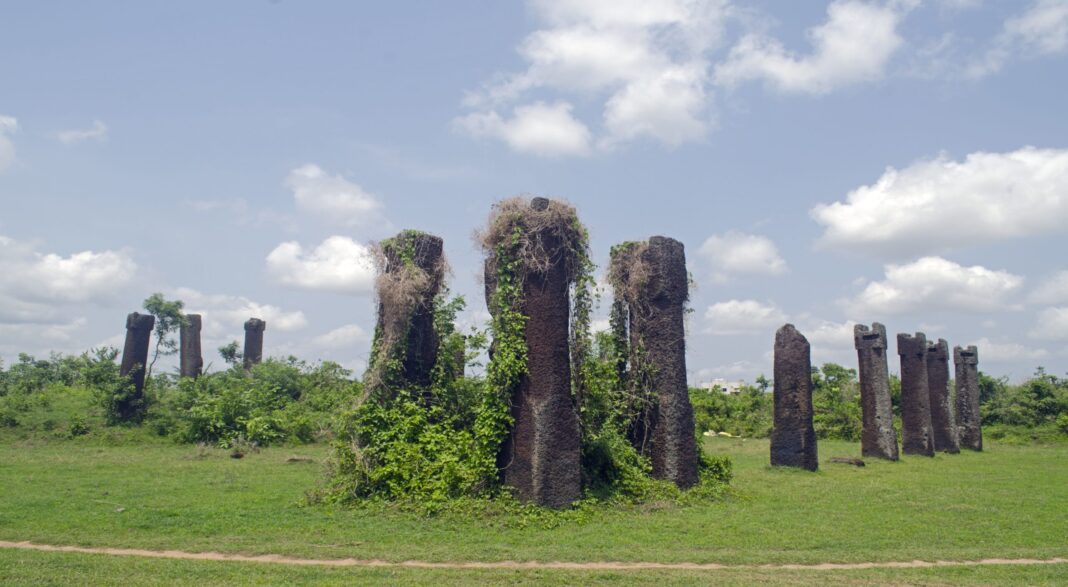
Sisupalgarh, the forgotten capital of ancient Kalinga
Just a few kilometres from the modern city of Bhubaneswar lies the weathered outline of one of India’s oldest urban marvels — Sisupalgarh. Once the thriving capital city of the ancient Kalinga kingdom, Sisupalgarh was not just a seat of power but a testament to early city planning, fortification, and civic life that pre-dated much of classical Indian urbanism. Today, however, this ancient citadel — older than Rome and contemporary with early Greek city-states — languishes in obscurity, overshadowed by urban expansion, neglect, and encroachment.

On the southern edge of Bhubaneswar, hidden in plain sight amid houses, roads, and everyday life, lie the silent embankments of Sisupalgarh—once the beating heart of ancient Kalinga. Unlike the great temple cities of Odisha or the celebrated Buddhist landscapes of Dhauli and Ratnagiri, Sisupalgarh does not announce itself through soaring spires or sculpted icons. Its story survives not in shrines, but in soil, stone, and suggestion. And perhaps that is why it has been forgotten.
A Glorious Past Unearthed, but forgotten. When history fades, myth steps in to fill the silence.
Archaeological research confirms that Sisupalgarh was inhabited as early as the 7th–6th century BCE, making it one of the earliest planned settlements in the eastern Indian subcontinent.
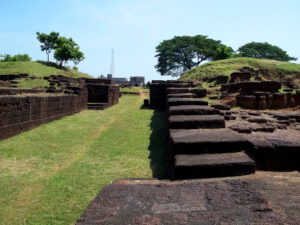
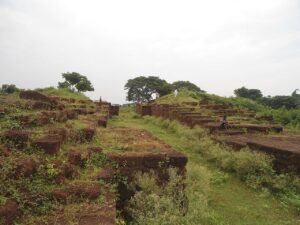
The city was constructed on a near-perfect quadrilateral plan, fortified with defensive walls rising up to nine metres high and punctuated by eight monumental gateways — architectural features that speak of strategic sophistication and civic organization.
Excavations have revealed evidence of wide streets, residential zones, water management systems, and fortification moats, suggesting a population that may have numbered 20,000 to 25,000 people — larger than classical Athens in its early days.
Beyond its structural brilliance, Sisupalgarh holds deep historical significance. It is identified with Kalinganagara, the capital associated with the powerful ruler Kharavela, and potentially with Tosali, associated with the Mauryan period under Emperor Ashoka. The city thus stands not only as a monument of ancient urban life, but as a crucial link in the story of early Indian polity, commerce, and cultural exchange.
From Pride to Neglect — The Present Condition
Despite its global archaeological value, Sisupalgarh today tells a sad story of neglect. Once encompassing over 560 acres under central protection, the city’s protected area has dwindled dramatically; only around 0.775 acres now remain officially under the Archaeological Survey of India’s (ASI) control.
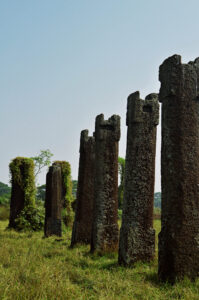
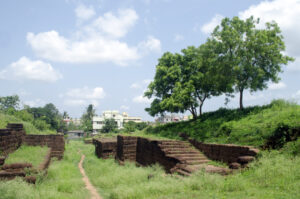
Urban settlement, housing and infrastructure have crept across and within the ancient boundaries. Illegal constructions now stand barely yards from fragile ruins. The towering earthwork walls and the **“Shola Khamba” — a group of 16 stone pillars — are isolated amidst weed-choked ground, with no proper pathways, interpretation signage, or visitor facilities to help the public understand their value.
Reports and local accounts have documented that many sections of the site have been overtaken by residential buildings, while failed enforcement of heritage laws has allowed encroachment right up to the edge of the archaeological zone. The lack of basic amenities like access roads or informative signage further isolates the site, turning it into a forgotten patch of land rather than a celebrated heritage landmark.
Heritage Value Under Threat
Sisupalgarh is not just an ancient ruin; it is a unique cultural asset that could connect modern India to its deep past:
Urban Planning Heritage: Its planned layout, fortified walls and infrastructure challenge common assumptions about early Indian cities.
Archaeological Significance: The remnants offer insights into settlement patterns, public architecture, and social life spanning over a millennium.
Educational and Cultural Potential: With proper conservation, Sisupalgarh could be a global destination for scholars, students and heritage tourism.
Yet, without urgent action, the visible fabric of this ancient capital risks further erosion, and the site’s intangible value risks fading from public memory.
A Call to Action: Questions for the Government of Odisha
Sisupalgarh’s current state should be a matter of concern for policymakers, conservationists and citizens alike. If this is truly one of the only surviving examples of an early fortified capital in India, we must ask:
What concrete steps has the Government of Odisha taken to protect and expand the defined heritage boundary of Sisupalgarh beyond its current remnants?
How can urban planning, ASI enforcement, and heritage law implementation be strengthened to halt encroachment and reclaim lost portions of the ancient site?
Is there a comprehensive conservation and interpretation plan that could make Sisupalgarh accessible and educational for visitors, without compromising its integrity?
What collaborative models, including local community participation, international research partnerships, and heritage tourism frameworks, are being considered to sustainably preserve this ancient city?
Save Sisupalgarh!
Sisupalgarh stands at a crossroads — between fading into the backdrop of modern Bhubaneswar’s growth and being revitalised as a living testament to India’s early urban genius. The walls may stand in ruin, but the cultural spirit they embody must not be abandoned.
To save Sisupalgarh is to safeguard a chapter of human history that belongs not only to Odisha or India, but to the world. The question now is urgent: Will we act in time to protect this extraordinary heritage, or will we let it slip into irreversible oblivion?
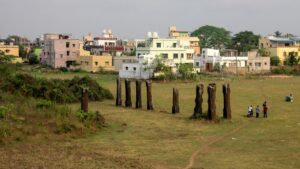
The 2,500-year-old Sisupalgarh fort city, a centrally protected monument on the outskirts of Bhubaneswar, Odisha, is facing severe, rampant encroachment, with land mafia and private developers destroying large portions of the site. Despite being notified as a protected monument in 1950, most of the original 562.68 acres is now under illegal possession, with only a tiny fraction officially under the Archaeological Survey of India’s (ASI) direct control.
Key Aspects of Sisupalgarh Encroachment:
- Shrinking Heritage: Originally covering over 562 acres, the area under direct ASI protection has dwindled to just 0.775 acres due to land grabbing.
- Illegal Construction: Over 1,000 buildings, including houses and villas, have been constructed inside the fort area, often in violation of the Ancient Monuments and Archaeological Sites and Remains (AMASR) Act.
- Destruction of Ramparts: Illegal, heavy machinery has been used to bulldoze ancient mud ramparts and mounds, particularly on the southern and western sides, to clear land for development.
- Failed Enforcement: There has been a long-standing impasse between the ASI and the Odisha state government regarding the removal of encroachers, with both agencies often failing to take effective action.
- Legal Action: The Orissa High Court has been involved since 2007, with a Public Interest Litigation (PIL) filed by INTACH to protect the site. In 2022-2023, the court directed the state government to demarcate the boundary and remove illegal structures.
Recent Developments (2021–2023):
- In 2021, the court expressed dismay at the lack of action, noting that the protected area was not properly demarcated.
- By 2022-2023, following court pressure, the state government began working with the ASI to identify and demarcate government land in the area.
- Despite these efforts, “land sharks” continue to threaten the site, even damaging newly placed boundary markers.
- The site, often described as a 2,500-year-old “Smart City” and a potential capital of the Kalinga kingdom, is at risk of being completely lost to urban encroachment.