

The Kama Sutra, composed by the Indian philosopher Vātsyāyana around the 3rd–4th century CE, is among the most misunderstood classics of world literature. Popular culture often reduces it to an erotic manual, but such a reading strips the text of its intellectual, cultural, and ethical depth. In reality, The Kama Sutra is a sophisticated treatise on human relationships, social conduct, emotional intelligence, and the pursuit of pleasure (kāma) as a legitimate aim of life.
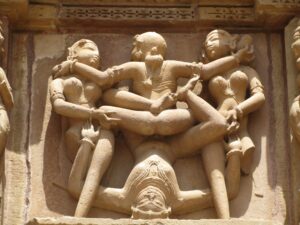

Core Idea and Structure
Vātsyāyana situates kāma within the classical Indian framework of the Purusharthas—dharma (duty), artha (material prosperity), and kāma (pleasure). Crucially, pleasure is never presented as reckless indulgence; it is to be pursued with awareness, balance, and respect for social and moral order.
The book is divided into seven parts, covering:
- Courtship and marriage
- Emotional and physical intimacy
- Communication between partners
- Social etiquette and urban culture
- The psychology of desire and attraction
Only a portion of the text deals explicitly with sexual union, and even there the focus is less on titillation and more on harmony, consent, mutual satisfaction, and understanding differences in temperament.
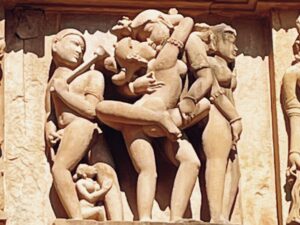
Intellectual and Cultural Value
What distinguishes The Kama Sutra is its analytical tone. Vātsyāyana writes as a social scientist of his time, categorizing human behavior with remarkable clarity. The text reflects an advanced urban civilization where conversation, aesthetics, music, and emotional compatibility were integral to relationships.
Far from being crude, the work acknowledges female desire and agency—an aspect strikingly progressive for its era. Women are portrayed not merely as passive recipients but as individuals with preferences, intelligence, and emotional complexity.
Misinterpretation and Modern Reception
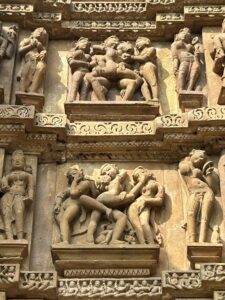
Much of The Kama Sutra’s reputation in the modern world stems from selective translations, Victorian-era censorship, and sensationalized illustrations added centuries after its composition. These distortions have overshadowed the text’s philosophical intent and reduced it to a caricature.
Read carefully and in a reliable translation, the book reveals itself as a guide to mindful living—arguing that pleasure, when informed by wisdom and restraint, enhances rather than diminishes human dignity.
Relevance Today
In an age of fragmented relationships and transactional intimacy, The Kama Sutra feels unexpectedly relevant. Its emphasis on communication, emotional attunement, and balance offers a counterpoint to both puritanical denial and unreflective excess. It reminds readers that pleasure is not the enemy of ethics, but something that must be integrated thoughtfully into life.
Verdict
The Kama Sutra is not merely a book about sex; it is a classical meditation on human connection. When read beyond its stereotypes, it stands as a testament to ancient India’s nuanced understanding of psychology, relationships, and the art of living well. The Kama Sutra is not a provocative manual, but a philosophical exploration of human closeness. Its enduring value lies in its insistence that pleasure, when guided by awareness and balance, becomes a civilizing force rather than a disruptive one.
A misunderstood classic that rewards patient and thoughtful reading—less sensational than its reputation, and far more profound.
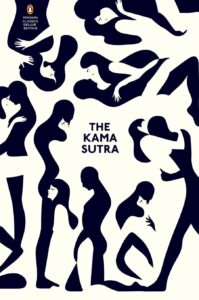
Cover design: London based Malika Favre is a French Illustrator and Art Director who has (with ease) grasped the knack of simplicity being a very powerful art medium. Her illustrations are sensual, colourful and a breath of fresh air reminiscent of something vintage at the same time. Orgy was originally a sketch she proposed for the cover of the Kama Sutra book for Penguin back in 2013. Even though it didn’t make the final cut, she just loved the flow of the bodies melting into one another so she decided to develop it as a personal piece. [Mallanaga Vātsyāyana in Kobo]
Publisher Description
The Kama Sutra is widely considered to be the standard work on human sexual behaviour in Sanskrit literature. A portion of the work consists of practical advice on sexual intercourse. It is largely in prose, with many inserted anustubh poetry verses. “Kāma” which is one of the four goals of Hindu life, means desire including sexual desire the latter being the subject of the textbook, and “sūtra” literally means a thread or line that holds things together, and more metaphorically refers to an aphorism (or line, rule, formula), or a collection of such aphorisms in the form of a manual.
Contrary to western popular perception, the Kama Sutra is not exclusively a sex manual; it presents itself as a guide to a virtuous and gracious living that discusses the nature of love, family life and other aspects pertaining to pleasure oriented faculties of human life. Kama Sutra, in parts of the world, is presumed or depicted as a synonym for creative sexual positions. The majority of the book is about the philosophy and theory of love, what triggers desire, what sustains it, how and when it is good or bad. The Kama Sutra is the oldest and most notable of a group of texts known generically as Kama Shastra. [Apple]
Synopsis
In the literature of all countries there will be found a certain number of works treating especially of love. Everywhere the subject is dealt with differently, and from various points of view. In the present publication it is proposed to give a complete translation of what is considered the standard work on love in Sanscrit literature, and which is called the ‘Vatsyayana Kama Sutra,’ or Aphorisms on Love, by Vatsyayana.
While the introduction will bear with the evidence concerning the date of the writing, and the commentaries written upon it, the chapters following the introduction will give a translation of the work itself. It is, however, advisable to furnish here a brief analysis of works of the same nature, prepared by authors who lived and wrote years after Vatsya had passed away, but who still considered him as a great authority, and always quoted him as the chief guide to Hindoo erotic literature.