
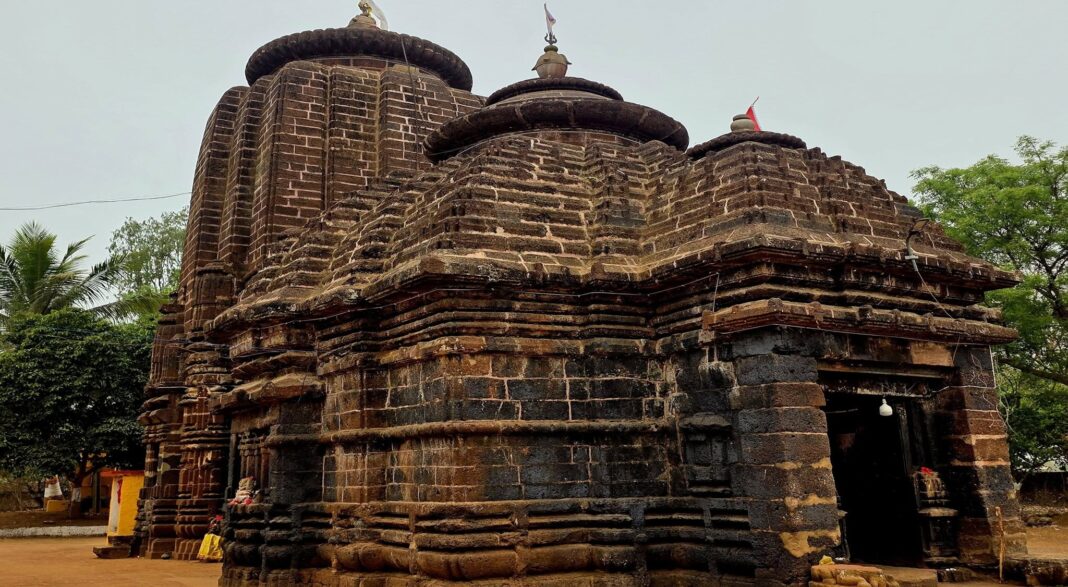
Uttareswar, Choudwar, Odisha….a temple tucked away in silence.
The road to the temple slowly leaves behind the bustle of the highway and slips into the calmer rhythms of rural Odisha. Fields stretch out lazily on both sides, and the air carries that unmistakable smell of red earth. And then, almost unexpectedly, the temple appears — modest, weathered, and deeply rooted in time.

The Uttareswar Temple, dedicated to Lord Shiva, is believed to date back to the 11th century, most likely constructed during the reign of the Somavamsi king Udyota Kesari who ruled the region in the mid-eleventh century. Built largely from laterite blocks, the temple represents the restrained yet elegant aesthetics of Kalinga temple architecture. Its sanctum houses a patalaphuta Shiva linga—a lingam set slightly below the floor level within a circular yoni pitha of black chlorite, giving the shrine a sense of depth and antiquity.
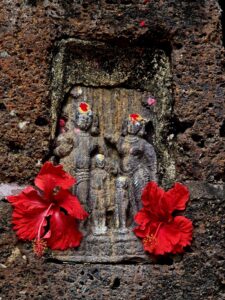
Even today, fragments of old carvings lie scattered around the compound—mute reminders that the temple once carried richer ornamentation than what survives now. When we visited, the temple priest narrated a story that locals have passed down for generations.
According to this legend, the temple’s name comes from Uttara, the daughter of King Virata of the Mahabharata. The king, deeply devoted to Shiva, is believed to have built this shrine for his daughter, naming it Uttareswar after her.
The priest also spoke of the temple’s long and difficult journey through time. For many years it stood neglected and partially ruined until 2002, when restoration efforts were undertaken by the Archaeological Survey of India, bringing the structure back from near collapse. More recently, government funds enabled the construction of a protective boundary wall around the temple precinct, giving the shrine a renewed sense of dignity and care.
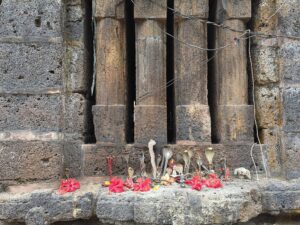
The Serpent Guardian
But the most intriguing story surrounding the temple belongs not to kings, but to a serpent. Locals believe that a king cobra guards the abode of Shiva here. According to the priest, the serpent is occasionally seen during the daily puja, appearing quietly during the ritual and disappearing once the worship concludes—as if acknowledging the sanctity of the moment before slipping back into the earth.
Whether myth, coincidence, or faith, the story adds an unmistakable aura to the temple. In places like this, belief often becomes part of the landscape. Unlike the grand temples of Odisha that draw thousands of visitors, Uttareswar remains understated and almost contemplative. A modern Nandi faces the shrine from the eastern side, while a small laterite tank sits quietly nearby, reflecting the temple walls. Standing there, one senses the passage of time—dynasties, neglect, restoration, and the quiet persistence of worship. The temple may not appear in glossy tourist brochures, but perhaps that is its greatest charm. In the stillness of its courtyard, with only the wind and temple bells for company, Uttareswar feels less like a monument and more like a memory of Odisha’s sacred past.
 Dr. Adyasha Das
Adyasha Das is a distinguished figure in the realms of academia, culture, and heritage. A poet and short-story writer in English and Odia. Dr. Das is an accomplished academic, researcher and cultural thinker currently serving as Professor at the Indian Institute of Tourism & Travel Management (IITTM), Bhubaneswar, under the Ministry of Tourism, Government of India. Her academic journey includes a postgraduate degree from the Delhi School of Economics, an MBA from Xavier Institute of Management, and doctoral research in Organizational Behaviour. Her broad body of work spans heritage tourism, cultural studies, human resource management and business communication. Her publications include The Chausathi Yoginis of Hirapur: from Tantra to Tourism (2018) and The Yogini Trail: in search of the Chausathi Yoginis (2016), among others.