

The Great Odisha Famine of 1866 stands as one of the most tragic chapters in the human history, claiming a staggering toll of human lives. The human sufferings are still part of the folklore and oral accounts passed on for the generations. It exposes profound administrative failures under British rule. Often remembered locally as the Famine of the 9th Anka, this catastrophe devastated the socio-economic structure of the region, particularly the three districts of Puri, Cuttack, and Balasore, along with parts of the tributary states. Affecting an area of approximately 12,000 square miles with a population of around 4 million people, it was described as a widespread sea of calamity that surpassed all previous famines in severity and magnitude.
There are records of eyewitness accounts painting a harrowing picture of human suffering. Towns echoed with the sorrowful whimpers of thousands reduced to mere skeletons. Crematory grounds overflowed with uncountable undisposed dead bodies, on which vultures and jackals feasted openly. Hunger drove people to abandon natural instincts: parents cast away starving children to be devoured by wild animals, and some resorted to consuming the dead bodies of their own offspring. Social evils like murder, suicide, and other desperate acts became widespread. Desperate individuals survived on wild shrubs and inedible materials. In one chilling report from Mahanga, a famine-stricken woman was said to have eaten raw human flesh. Folklores of the time still recount mothers deserting or even abandoning children due to the utter absence of food. The Famine Commission of 1866 itself likened the situation to passengers trapped on a ship without provisions, shut off by pathless jungles and an impracticable sea, with almost no importation of grain to relieve the distress. If anyone is alive today in this region, the credit must go to their lucky ancestors who survived this disaster.

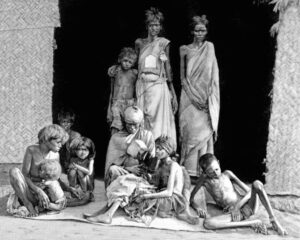
Mortality estimates varied, but officials acknowledged the scale. The Lieutenant Governor put it at one-fifth of the province’s population, while the Famine Commissioner estimated one-fourth. Historians, including the noted scholar H.K. Mahtab, have emphasized that this was a purely man-made calamity, for which the officers of the British Government bore sole responsibility. The famine exhibited glaring defects in Bengal administration and a lamentable neglect of Odisha’s development needs.
While a deficiency in rainfall played a role, the document stresses that no single natural factor alone could account for the appalling scale of death and suffering. The catastrophe resulted from a combination of factors, intensified and in critical ways enabled by administrative apathy, inaction, and policies that prioritized revenue and trade over human welfare.
The immediate trigger was the premature cessation of rains in 1865 across the lower provinces of Bengal Presidency, including Odisha. Heavy early rainfall occurred before the usual sowing time, followed by a sudden stoppage. In Cuttack, previous seasons had seen heavy rains, but the critical late rains expected in late September and October failed entirely. In Balasore, heavy July-August showers prompted cultivators to drain fields fearing crop damage, after which not an inch fell. The winter rice crop on which the population primarily depended failed disastrously due to a deficiency of about two-thirds of ordinary rainfall.
Reliable rainfall records for 1865 in the Odisha division show the details as follows: Cuttack- Total 51.4 inches (with 0.0 in October). Puri- Total 36.3 inches (particularly low late-season figures). Balasore- Total 52.60 inches (again, negligible after August). Puri emerged as the worst-affected district, evident from its lower totals and pattern. Yet rainfall totals for the year were not unusually small overall. The problem lay in timing and distribution. Crucially, the province lacked any meaningful artificial irrigation. Rivers were not harnessed; the region relied solely on natural rain, supplemented in crises only by minor natural watercourses, small tanks, and water lodgements. The success of rice crops and thus the survival of millions depended entirely on timely monsoon rains. When those failed, no protective infrastructure existed to mitigate the impact.
Even more damning was the administrative failure to prevent or address the rapid depletion of local food stocks through unchecked exports. The Famine Enquiry Committee of 1866 noted that the distress was symptomatic from the outset: scarcity of grain rather than scarcity of money. Food stocks were already inadequate when crops failed in October 1865. This stemmed from two interconnected issues: (1) Brisk export trade in preceding years had drained reserves. (2) People had not been taught (or encouraged) to retain sufficient home stocks.
Average annual rice exports in the six years before 1865 stood at around 20,000 tons. In normal years, exports reached up to 100,000 tons, sometimes 125,000 tons under controlled conditions. Detailed figures for 1860–65 reveal a rising trend: (a) 1860–61: 4,57,059 maunds (b) 1861–62: 4,44,164 maunds (c) 1862–63: 4,49,134 maunds (d) 1863–64: 5,49,516 maunds (19,625 tons) (e) 1864–65: 9,37,528 maunds (sharp increase).
By 1864-65, exports had surged, especially from Balasore (8,06,576 maunds). Agents scoured districts, purchasing rice and paddy directly from cultivators. Everyone sold eagerly because prices remained low compared to other provinces until late 1864. Demand spiked due to shortages elsewhere, notably southern India, where the traders from Madras collected grain for export by firms like the French House, Messrs Robert Chariol and Co. via False Point.
The 1863 crop was average, 1864 good in Cuttack and especially Balasore (though poor in Puri), yet exports continued unabated. By late 1865, the province was empty of its buffer stock of rice. Only in 1866 did authorities discover the alarming shortage. No measures had been taken to regulate exports, build reserves, or restrict outflows when early signs of distress appeared.
The British officials, including those in the Bengal administration, neglected Odisha’s vital development needs. No steps were taken to develop irrigation, promote local storage, or curb exports in anticipation of scarcity. When the crisis struck, the response was inadequate: almost no grain was imported into the isolated province. The people were left trapped, as if aboard a provision-less ship.
Historian H.K. Mahtab directly attributes responsibility to British officers. The famine’s scale and horrors resulted not from nature alone but from inaction, poor planning, and policies that treated Odisha as a mere revenue-producing territory rather than a region deserving investment in resilience. The Puri Raja, Divyasingha Deva, offered little help, but ultimate accountability rested with colonial authorities who controlled policy, trade, and relief.
The 1866 famine thus became a stark indictment of colonial governance. While drought initiated the crop failure, administrative apathy, failure to build irrigation, regulate exports, ensure buffer stocks, or mount timely relief turned a manageable scarcity into mass death on an unprecedented scale. Odisha’s people paid the price for a system that prioritized profit and neglect over protection of life.
Even today, the memory evokes horror in Odisha. The Great Famine of 1866 remains a grim reminder of how official indifference can transform natural adversity into one of the darkest tragedies in the region’s history.
 Bishnupada Sethi, IAS
The author serves as the Chairman of the Odisha Forest Development Corporation (OFDC) and continues as the Chief Administrator of the KBK districts.