
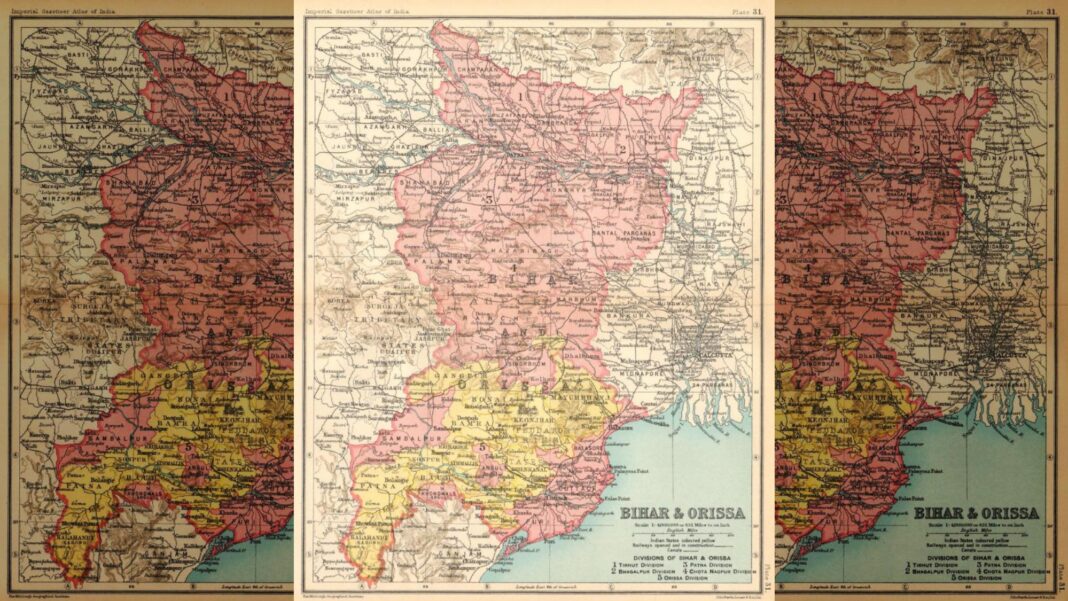
The Census of India has always been more than a mere counting of people. It is an exercise that reflects the pulse of a nation at a given moment in history. The 1931 Census of Bihar and Orissa, conducted under colonial administration, stands as a remarkable instance where statistics intersected with politics, social aspirations, and regional identity. It not only documented demographic realities but also became a subtle arena where the demand for a separate Odisha province found expression.
The census operation in 1931 was carried out through a meticulously organized administrative structure. The province was divided into charges, circles, and blocks, with each block consisting of about 30 to 50 houses. Enumerators were assigned to each block, supervised by circle officers, while charge superintendents, often police sub-inspectors oversaw larger areas.

The scale of manpower was enormous. Over 219,000 enumerators and nearly 17,000 supervisors were engaged, most of them unpaid volunteers drawn from the educated classes. Their contribution formed the backbone of the operation, demonstrating how governance relied heavily on local participation even under colonial rule.
The census unfolded in several stages, beginning with house-listing, where every dwelling was numbered and recorded. Enumerators were trained to fill detailed schedules with 18 columns, capturing a wide range of demographic and socio-economic data.
A preliminary enumeration was conducted weeks in advance, followed by the final count on the night of 26th February 1931. During this night, enumerators revisited households to update entries, removing those who had left and adding newcomers. Given the relatively stable population, nearly 90 percent of the preliminary data remained valid, highlighting the efficiency of the system.
Special arrangements were made to count travellers, labourers in fields, and people attending fairs, ensuring that no one was missed or counted twice.
One of the most impressive aspects of the 1931 Census was the speed of data compilation. Within hours of enumeration, provisional totals were calculated and transmitted through various means like telegraph, train, motor vehicles, and even runners.
Districts competed to report their figures first, and remarkably, some managed to submit their data on the very day following the census. The final provisional figures differed from the published totals by only 0.2 percent, a testament to the accuracy achieved despite logistical challenges.
In an era without computers, data processing was entirely manual. Information relating to over 42 million individuals was copied onto slips of paper, sorted by religion and sex, and tabulated across multiple centres.
Thousands of copyists and sorters worked long hours under modest pay. At peak activity, over 3,600 copyists and 1,500 sorters were engaged in this painstaking process. Their efforts transformed raw data into meaningful statistics within weeks, demonstrating remarkable administrative capacity.
The total cost of the census was approximately Rs. 4.69 lakh, translating to about Rs. 11 per thousand population. Though slightly higher than the previous census, the increase was largely due to revised accounting methods, including printing and administrative costs.
In reality, the operation was economical, aided by unpaid labour and efficient organization. The census thus balanced scale with cost-effectiveness, a hallmark of colonial administrative practices.
The 1931 Census was conducted during a period of political unrest marked by the civil disobedience movement. While there was no widespread boycott, resistance surfaced in subtle forms. Some individuals refused to serve as enumerators, citing nationalist principles, while others spread rumours or removed census markings from houses.
Despite these challenges, cooperation from the general population remained high, and refusals to answer questions were rare. However, the political climate did affect administrative efficiency, as officials were often preoccupied with maintaining law and order.
Beyond numbers, the census revealed deeper social currents. Many lower castes attempted to redefine their identities by adopting higher-status caste names, reflecting aspirations for upward mobility. The census thus became a platform where social hierarchies were contested and renegotiated.
One of the most significant undercurrents during the 1931 Census was the growing demand for a separate Odisha province. The census data became crucial in this context, particularly in regions like Singhbhum, where debates over language, caste, and regional affiliation intensified.
As noted in the census report, there was “lively concern” regarding returns of caste and language due to the prospect of creating a separate Orissa province and determining its territorial extent. This reveals how census data was not merely statistical but deeply political, used to justify claims over territory and identity.
The enumeration process, therefore, indirectly contributed to shaping the discourse on Odisha’s statehood, which would eventually materialize in 1936. The census offered empirical backing to linguistic and cultural arguments, strengthening the case for administrative reorganization.
The success of the census depended on the dedication of countless individuals, enumerators, supervisors, district officers, and volunteers. Many worked without remuneration, driven by a sense of duty.
The census report rightly acknowledges this collective effort, emphasizing that the greatest credit belongs to these unnamed workers who ensured that every individual was counted.
The 1931 Census of Bihar and Orissa was far more than a demographic survey. It was a monumental administrative exercise that captured the complexities of a society in transition. From its intricate organizational structure to its role in reflecting social change and political aspirations, the census stands as a landmark in India’s statistical and historical journey.
Importantly, it also played a subtle yet significant role in the movement for a separate Odisha state, illustrating how data can influence destiny. In counting people, the census helped shape provinces, identities, and the future of a region.
As we reflect on this historic exercise, one truth remains clear: a census is not just about numbers. It is about people, their aspirations, and the stories they collectively tell.
 Dr. Bishnupada Sethi
The author has conducted last census (2011) as Director Census Operation, Odisha. He has co-authored two books with Chittaranjan Mohanty related to census i.e., (1) Demographic Profile of Odisha (2) Scheduled Tribes in Odisha-A Demographic Analysis.