

Bhakti in Odisha is not an abstract idea but a lived experience shaped by generations. I grew up in a rural setting where the worship of Sri Chaitanya is part of everyday life. Sankirtan troupes move through villages, idols are ceremonially brought from maths during festivals, and community feasts mark sacred occasions. Almost every household has a spiritual lineage, with elders initiated into Vaishnav traditions that have continued for more than five centuries. There is a deeper historical legacy that continues to define Odisha’s cultural identity.
This enduring tradition can be traced to the early sixteenth century, when Sri Chaitanya, a wandering Bengali ascetic, arrived in Puri, then known as Purushottama Kshetra. What began as a pilgrimage soon evolved into a lifelong association that profoundly shaped the religious, social, and cultural identity of Odisha. His presence revitalised devotional practices and encouraged a more inclusive spiritual ethos.

Born in 1486 in Nadia, Bengal, as Nimai, Chaitanya displayed remarkable intellectual and spiritual abilities from a young age. By his teenage years, he had mastered Sanskrit grammar and established himself as a scholar. However, personal losses and spiritual introspection led him toward the path of bhakti. Under the guidance of his guru, he embraced devotion centred on the chanting of the divine name, moving away from rigid scholasticism and ritual orthodoxy. At the age of twenty three, he renounced worldly life and accepted sannyasa, taking the name Sri Chaitanya. Around 1510, he travelled to Puri, drawn by the spiritual magnetism of Lord Jagannath. This marked the beginning of his deep and enduring connection with Odisha.
Puri was already a major centre of pilgrimage and spiritual exchange. The Jagannath Temple had long symbolised a unique synthesis of Shaiva, Shakta, and Vaishnava traditions. Over the centuries, it had attracted great spiritual figures such as Adi Shankaracharya, Ramanujacharya, Kabir, and Guru Nanak. This inclusive religious environment resonated with Chaitanya’s philosophy of universal devotion.
During his time in Puri, the region was ruled by King Prataparudra Deva, a devout patron of the Jagannath Temple. Initially, royal protocol prevented a direct meeting between the king and the ascetic. However, the king’s humility, especially his participation in sweeping the chariot path during the Rath Yatra, deeply moved Chaitanya. Their eventual meeting symbolised the convergence of spiritual authority and temporal power, and royal support allowed Chaitanya’s devotional practices to flourish.
Chaitanya’s spirituality was marked by intense emotional devotion to Krishna, whom he identified with Lord Jagannath. His public kirtans, often accompanied by ecstatic expressions such as tears and trances, brought a renewed emotional depth to religious life in Puri. His reverence for the deity was so profound that he often chose to view the idol from a distance, emphasising humility in devotion.
The socio religious context of the time was marked by political uncertainty and rigid caste hierarchies. The decline of the Delhi Sultanate and the emergence of the Mughal Empire created instability, while social divisions excluded large sections of society from religious participation. Lower castes were denied access to temples, education, and spiritual practices.
In Odisha, reformist voices had already begun to challenge these structures through the Pancha Sakha, a group of poet saints including Balarama Das, Jagannatha Das, Achyutananda Das, Ananta Das, and Jasobanta Das. Their writings emphasised spiritual equality and accessibility, often using the Odia language to reach the masses.
Chaitanya’s teachings complemented and strengthened these reformist currents. While he did not explicitly seek to dismantle the caste system, his philosophy carried transformative implications. He emphasised that spiritual worth depended on sincere devotion rather than birth. According to him, anyone could attain divine grace through heartfelt chanting of the holy name. He demonstrated these principles through action. He performed the funeral rites of Haridas, a devotee born into a Muslim family, defying prevailing social norms. He also forgave and transformed individuals like Jagai and Madhai, who later became devoted followers. His movement welcomed people across caste, gender, and social boundaries, creating a more inclusive spiritual community.
At the heart of his teachings was the Maha Mantra, “Hare Krishna, Hare Rama,” which became a universal medium of devotion. The practice of nagar sankirtan, involving collective singing and dancing in public spaces, turned spirituality into a shared social experience. These gatherings fostered unity and helped reduce caste-based divisions. Chaitanya’s Gaudiya Vaishnavism, centred on the love of Radha and Krishna, resonated deeply with Odisha’s spiritual traditions. It built upon earlier devotional currents, including Jayadeva’s Gita Govinda, and made religious practice more accessible to ordinary people. His emphasis on humility, surrender, and collective devotion democratised spirituality.
His association with the Pancha Sakha was particularly significant. He encouraged the use of local language in religious literature, thereby expanding access to sacred knowledge. Jagannatha Das, one of the Pancha Sakha, composed the Bhagavata in Odia, which became a cornerstone of spiritual life in the region. This shift helped break the monopoly of Sanskrit scholarship and brought religious texts into the reach of common people.
The movement also had far-reaching social effects. One of its key contributions was the establishment of Bhagabat Ghara, village centres dedicated to the reading and discussion of sacred texts. These spaces served not only as religious hubs but also as centres of education and social interaction. They promoted literacy, moral values, and community cohesion.
Women, too, found greater participation in religious life through this movement. While broader societal structures remained patriarchal, the inclusive ethos of bhakti created new opportunities for engagement and expression. Devotional practices became more participatory and less restricted by social hierarchies. Culturally, Chaitanya’s influence was profound. His participation in the Rath Yatra added emotional depth and collective enthusiasm to the festival. The image of devotees pulling chariots while chanting became a defining symbol of Odisha’s spiritual identity. Art forms such as Odissi music and dance absorbed the emotional intensity of his bhakti. His life and experiences inspired paintings, sculptures, and temple iconography across the region.
Several monastic institutions and akhadas were established to preserve and propagate his teachings. In Puri, sites associated with his life, such as the Gambhira and the Garuda Stambha, remain important centres of pilgrimage and devotion.
Chaitanya’s influence extended far beyond Odisha. His teachings spread to regions like Assam and eventually reached a global audience through movements such as the International Society for Krishna Consciousness. His emphasis on devotion, equality, and universal love contributed to broader currents of spiritual awakening in India and beyond.
In Odisha, however, his impact was especially deep and enduring. His teachings helped foster resilience and unity during times of political and social uncertainty. Festivals, kirtans, and communal gatherings became expressions of collective identity and cultural continuity. Even today, his legacy continues to shape the spiritual landscape of Odisha. Annual commemorations in Puri attract thousands of devotees. Texts such as the Chaitanya Charitamrita and regional devotional literature remain widely read and revered. The tradition of Bhagavata recitation continues in villages, while sankirtan remains central to festivals and public life.
In a time marked by rapid social change and fragmentation, Chaitanya’s message remains deeply relevant. His emphasis on humility, inclusivity, and devotion offers a framework for social harmony and spiritual fulfilment. He did not transform Odisha through institutional authority or doctrinal enforcement, but through personal example and collective experience. By making Puri his spiritual home for nearly eighteen years until his passing in 1533, Sri Chaitanya forged an enduring bond with the region. His legacy lives on not only in temples and texts but also in the rhythms of everyday life. It can be heard in the chants of sankirtan, seen in the gatherings of Bhagabat Ghara, and felt in the shared belief in the equality of all before the divine.
More than five centuries later, Sri Chaitanya remains a unifying force, a bridge across regions and communities, and a timeless advocate of devotion rooted in love, humility, and human connection.
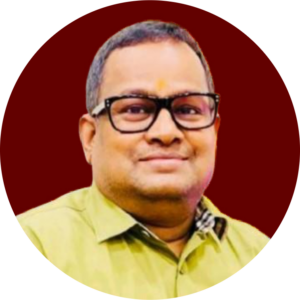 Dr. Bishnupada Sethi
Dr. Sethi serves as the Chaiman of OFDC and Chief Administrator of KBK districts of Odisha.