

The Binjharpuri cattle, often called “Deshi” locally, are a special indigenous breed from Odisha’s coastal region. They have been part of rural life for generations, especially in Jajpur, Kendrapara, and Bhadrak districts. A detailed scientific study made by our team highlighted their features, performance, and importance in their native tract.
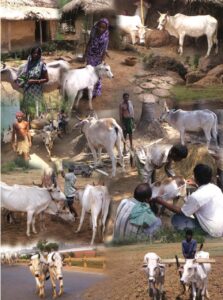
This breed stands out for several unique qualities that set it apart from many other cattle types. Binjharpuri are medium-sized, strong, and dual-purpose animals meaning they provide both milk and draught power for farm work. Bulls appear vigorous and majestic with a well-developed hump, dark black patches on the hump, neck, face, and back, even if the main coat is lighter, and a powerful build. Cows look graceful and compact, with wide-set hip bones and a prominent but medium milk vein. A standout feature is their very long tail that almost touches the ground, ending in a thick, voluminous switch of hair, something not common in many breeds. They have short ears, a thin and soft dewlap (loose skin under the neck), and medium-length horns curving upward and inward.

Coat colours are mostly white, but can include grey, light brown, or black, with calves often starting lighter and turning whiter as adults. Adult males average around 255 kg in weight and 121 cm at the shoulder, while females weigh about 207 kg and stand 107 cm tall. These measurements show they are sturdier than some other local Odisha breeds like Motu, Ghumsari, or Khariar.
What makes Binjharpuri truly special is their remarkable adaptation to nature and the local environment. Odisha’s coastal plains have hot, humid weather with temperatures swinging from 11°C in winter to over 48°C in summer, plus heavy rainfall (around 1580 mm yearly) and some saline zones. Binjharpuri cattle thrive here with minimal care. They show excellent heat tolerance, staying active and productive in hot, humid conditions where many exotic or crossbred animals struggle. They require low-input rearing i.e., grazing on local grasses, roadsides, harvested fields, or pastures without expensive concentrates. They have low incidence of diseases, good resistance to tropical parasites and tick-borne illnesses, and fewer breeding problems. This natural hardiness allows them to survive and perform on poor-quality feed, walk long distances, and need less water compared to non-native breeds. Their lower metabolic rate helps them cope with heat stress efficiently. Farmers value them because bullocks excel at ploughing and carting in muddy, humid fields, while cows give steady milk even without extra feed.
In the study, cows produced about 4 litres of milk per day (in two milkings) with good quality of around 4.4% fat and 8.5% solids-not-fat. The highest lactation yield reached over 1330 litres in the fourth lactation, lasting about 308 days. They calve first at around 41 months, produce about 9 calves lifetime, and have a calving interval of roughly 410 days. These numbers are reliable under Odisha’s low-input system.
Despite these strengths, conservation of Binjharpuri cattle is increasingly important. Though still found in relatively pure form thanks to farmers preferring natural mating over heavy crossbreeding, their numbers face threats from mechanization reducing draught needs, crossbreeding with exotic breeds, and changing farming practices. They are listed among breeds needing attention due to low or vulnerable population trends in some assessments. The National Bureau of Animal Genetic Resources (NBAGR) have recognized Binjharpuri as one of India’s registered indigenous breeds. Efforts include in-situ conservation in native tracts, farmer awareness programs, and awards for groups like the Binjharpuri Cattle Promoters and Producers Society. Government initiatives in Odisha focus on preserving such native germplasm for their unique genes related to heat tolerance, disease resistance, and adaptability; traits valuable for future climate challenges and sustainable farming.
Preserving Binjharpuri helps maintain Odisha’s agricultural heritage. These cattle support small and marginal farmers by providing milk for home use or sale, manure for fields, and reliable work power without high costs. They represent a sustainable model: productive in harsh conditions, eco-friendly, and well-suited to local ecology. With better management, selective breeding, and community support, this breed can continue thriving and contribute to rural livelihoods for years to come.
 Bishnupada Sethi
The author is an IAS Officer and presently serves as the Chairman of the Odisha Forest Development Corporation (OFDC) and continues as the Chief Administrator of the KBK districts.