
In today’s global context, a nation’s strength is no longer confined solely to its military prowess or economic prosperity; rather, its literature, culture, language, and philosophy stand as the true testaments to its identity. Against this backdrop, India’s participation as the prestigious ‘Guest of Honour’ at the Bogota International Book Fair (FILBo) – 2024, held from April 17 to May 2, was not merely an official presence—it was a triumphant cultural confluence of Indian civilization. Under the aegis of the Ministry of Education, Government of India, the manner in which India presented its ancient knowledge traditions, modern consciousness, and literary wealth on this massive Latin American literary platform has left an indelible mark on the minds of the global audience.
However, the proudest aspect of this international event was the distinct presence of Odia literature and language. The way the brilliance of Odisha’s literary icons was discussed and deliberated upon in various seminars and gatherings proves that the glory of our language has captivated the soil of far-off Colombia.
The Global Stage of FILBo
Continuously organized in Bogota, the capital of Colombia, since 1988, this international book fair has evolved into a major literary congregation for the Spanish-speaking world. Every year, a leading culturally rich nation is invited as the ‘Guest of Honour’, and this year, that distinction was bestowed upon India. At this grand gathering of lakhs of readers, publishers, eminent writers, and philosophers, the India Pavilion was not just a center for exhibiting books, but a living experience of a civilization. Rooted in the ideal of ‘Vasudhaiva Kutumbakam’ championed by Honorable Prime Minister Narendra Modi, and guided by the visionary leadership of Union Education Minister Dharmendra Pradhan, the India Pavilion became the epicenter of attraction for the world. Along with the display of over 400 Spanish translated books, the propagation of the Indian knowledge tradition was carried out based on the Prime Minister’s mantra of ‘Read & Explore India’.
Within this sphere, everything from the Vedas, Upanishads, Yoga, and Ayurveda to Mahatma Gandhi, Rabindranath Tagore, Fakir Mohan, Gangadhar, ancient Nalanda, and modern Digital India took a successful shape. But the most joyous matter was how Odia literature and the culture of Odisha became the focal point of discussion within this vast spectrum, infusing a new ray of hope for the Odia language on the world stage.
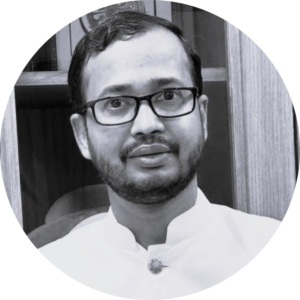
Dr. Chittaranjan Pradhan and Mishra from Odisha joined me in the Indian delegation. The exchange of ideas regarding the prowess of Odia literature, spiritual consciousness, our rich knowledge tradition, and the beauty of the language deeply moved the readers of Colombia and Latin America. This was not just the presentation of a regional language’s identity; rather, it was a literary endeavor to intimately present the great civilization of Odisha before the world.
Global Connection to Odia Icons
The most enthusiastic aspect of this world book fair was the unique interest among readers regarding the works of Fakir Mohan Senapati, the father of modern Odia literature. In the context of his short story ‘Rebati’, the message that Odia society was conscious of women’s education and social reform across time created a stir on the global stage. Particularly, the depiction of social realism, the struggles of rural life, and colonial exploitation in ‘Chha Mana Atha Guntha’ (Six Acres and a Third) resonated easily with Latin American readers, mirroring their own history. The social inequality and human struggles that they hear in the literature of Gabriel García Márquez or Mario Vargas Llosa found an echo in the writings of Fakir Mohan, Gangadhar Meher, and Gopabandhu Das. At the Bogota Book Fair, alongside the global poet Rabindranath Tagore, the literary masterpieces of these three Odia icons proved that literature is never bound by geographical boundaries.
Similarly, discussions surrounding the poetic repertoire of Kabisamrat Upendra Bhanja became a center of attraction. The vibrant metaphors of the Odia language, the cadence of words, the brilliance of rhythm, and the depth of poetic composition astonished foreign researchers. During discussions on the relevance of timeless epics like ‘Baidehisa Bilasa’, it became clear that Odia is not merely a medium of communication, but a language adorned with classical opulence. That the literary depth of the mother tongue we easily use in daily life can create such vast curiosity and respect in the minds of distant readers is truly a matter of pride.
The humanist philosophy of Santha Kabi Bhima Bhoi created a deep resonance during these literary deliberations. His profound words—
“Let my soul be condemned to hell, but let the universe be redeemed.”
— Santha Kabi Bhima Bhoi
—were accepted there not just as a spiritual utterance, but as a universal humanitarian manifesto. At a time when today’s world is reeling under the deadly grip of war, violence, and division, Bhima Bhoi’s philosophy of compassion and equality felt deeply relevant to the global citizens. Similarly, Swabhab Kabi Gangadhar Meher’s message of “Treat the universe with sweetness, and life will be sweet” instilled a positive philosophy of life in the minds of the readers.
The Missing Link: A Call for High-Quality Translation
Beyond literature, deep discussions also took place in various sessions regarding the unique architecture of Konark, the culture of Shri Jagannath, and the ideals of the Mahima religion. It was a wonderous experience for foreign listeners and researchers to realize that the core stream of Indian culture is not confined to any single language; rather, it is fulfilled through the synthesis of rich traditions from various regions like Odisha. The inclusive philosophy of Jagannath culture, the beauty of the calligraphic style, and traditions like Pala attracted many Latin American researchers towards Odisha, providing a robust identity to our civilization.
In the discussions on India’s education system and global citizen thinking, Union Education Minister Dharmendra Pradhan’s well-thought-out speech was highly touching. In his view, India’s New National Education Policy is heavily drawn from the holistic education system of Odisha. In this context, the discussions surrounding Utkalmani Gopabandhu Das and the noble humanitarian educational tradition of the Satyabadi Bana Vidyalaya deeply influenced the international audience.
The experience at Bogota has unveiled a grand truth—that within Odia literature and culture lies a universal appeal of human consciousness. A language may be regional, but supreme thoughts are never bound by geographical boundaries. The social awareness of Fakir Mohan, the poetic beauty of Upendra Bhanja, the compassion of Bhima Bhoi, and the life philosophy of Gangadhar Meher—the synthesis of all these holds the potential to transform Odia literature into a global humanitarian asset.
However, this literary experience has also reminded us of a great responsibility:
When the world is showing an interest in knowing Odia literature, our efforts to take these rich works to the major languages of the world must become more accelerated. Even today on the world stage, ‘Indian Literature’ is mostly understood as Hindi or English writings. Despite Odia literature having such a vast and majestic tradition, the primary reason it has not reached the global sphere on the same scale is the lack of high-quality translations.
In today’s world, the time has come to extensively translate the works of timeless pioneers like Fakir Mohan Senapati, Upendra Bhanja, Radhanath Ray, Bhima Bhoi, and Gangadhar Meher, alongside modern masters like Gopinath Mohanty, Manoj Das, Sitakant Mahapatra, and Pratibha Ray, into various global languages, including Spanish. It must be remembered that translation is not merely the mutation of words, but a literary bridge connecting one culture with another. Just as interest was seen towards the Spanish translations of Indian books at the book fair, if successful translations of Odia literature can be achieved, it will surely carve a special place in the hearts of Latin American readers.
This fair has also clarified a major truth—the real power of India’s ‘Soft Diplomacy’ or cultural diplomacy lies in its diversity. It is impossible to understand India within the confines of just one language or one culture. Rather, for a complete understanding of India, it is absolutely essential to comprehend Odisha’s Jagannath culture, the intimate compassion of Bhima Bhoi, the social wisdom of Fakir Mohan, and the poetic beauty of Upendra Bhanja.
This experience in Colombia has not remained just a memory of a book fair; rather, it is a auspicious sign that the Odia pen has begun its march toward global conquest. Our language and literature are timeless, and they possess the capability to influence global thought. The voice of the Odia language heard on that stage in Bogota will surely echo across the entire world in the days to come. May this success of the Odia pen established in Colombia be immortal—as an Odia, this is my sole hope.
This article was previously published in the Prameya on 13 May 2026. © The Prameya || It is republished here in the larger interest of public and the serious and meaningful nature of the subject.
Bhubaneswar, Odisha